
Regional News
NTSB Says Improperly Installed Wire is Root Cause of Key Bridge Collapse
WASHINGTON – The National Transportation Safety Board on Tuesday determined that the catastrophic Francis Scott Key Bridge collapse in Baltimore last year was caused by a single loose wire that caused a container ship to lose power and crash into the bridge.
Until the release of the voluminous NTSB findings, it was not clear what caused the ship, the 984-foot-long Dali, to suffer two power outages just before the accident.

National Transportation Safety Board Chairwoman Jennifer Homendy shows reporters the tiny wire assembly that malfunctioned on the container ship Dali, which lost power and crashed into Baltimore’s Francis Scott Key Bridge last year. (Sophia da Silva/Capital News Service)
“Locating a single wire that is loose among thousands of wires is like looking for a loose bolt in the Eiffel Tower,” NTSB Chairwoman Jennifer Homendy said.
The NTSB’s findings followed a 20-month-long investigation into the March 26, 2024, bridge collapse, which killed six highway maintenance workers on the span and closed the Port of Baltimore for three months.
“The fact is none of us should be here today,” Homendy said. “This tragedy should have never occurred. Lives should never have been lost. As with all accidents that we investigate, this was preventable.”
The NTSB found that the crew did what it was supposed to do, working quickly to deal with issues as they came up. As the ship careened toward the bridge, the crew alerted Maryland Transportation Authority officers, who closed off the bridge and prevented many more deaths.
“…But the vessel’s loss of propulsion close to the Key bridge rendered their actions ineffective,” one of the investigators, Capt. Bridget Quinn said.
The crew was not aware of the disconnected wire during the blackouts. Homendy said the defect was not even something that would be found in a routine inspection.
The NTSB found that a wire label that slid over a wire covering impeded a proper fit into a breaker. That did not allow a proper electrical connection.
“Until I saw this this morning, I did not realize we’re talking about a very small component here. And this is what caused all the problems,” Board Member Thomas Chapman said, holding up an example of the terminal block used on the Dali
One of the investigators, Barton Barnum, said the probe found that the shipping company’s oversight did not offer enough guidance to prevent this kind of accident.
The company, Synergy, does have inspection requirements but Barnum said they aren’t specific enough for crew members to know what to look for, especially when it comes to details as small as an improperly installed wire.
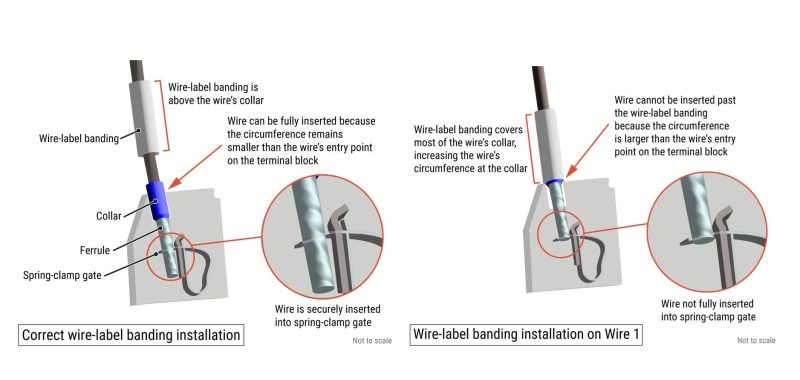
This is the National Transportation Safety Board’s rendering of the improperly connected wire aboard the container ship Dali. (National Transportation Safety Board)
The board issued several recommendations to Synergy, including the implementation of infrared thermal imaging. Already widespread on similar ships, infrared imaging allows problem areas to be spotted without handling wires by hand.
Beyond problems on the ship, NTSB determined that the collapse could’ve been prevented with proper countermeasures, noting that the Maryland Transportation Authority hadn’t conducted a vulnerability assessment to detect weaknesses in the bridge.
The Key Bridge, which opened in 1977, pre-dated regulations put in place in 1991 to prevent vessel collisions and wasn’t updated to comply with those regulations. In the years since, container ships have only gotten larger, outpacing infrastructure.
The Key Bridge isn’t the only bridge with this kind of vulnerability. During its investigation, the NTSB looked at bridges across the country and issued recommendations to 30 bridge owners.
“When acted upon, the recommendations we’ve issued today will save lives,” Homendy said.
By SOPHIA DA SILVA
Capital News Service
