
Local News
Environmental Group Finds Less Rain, Lower River Levels Have One Upside – Less Water Quality Issues – But Warn Against Lapsed Vigilance
In a report issued October 10th by the Environmental Integrity Project (EIP), a D.C. and Austin, Texas-based non-profit environmental watchdog group, reduced fecal bacteria levels that contribute to unsafe conditions for recreational river and waterway uses in the Shenandoah Valley was cited. From the report: “The health risks from farm manure runoff were somewhat reduced this summer because of the low rainfall conditions,” said Eric Schaeffer, Executive Director of the Environmental Integrity Project. “This does not mean the Shenandoah River is cleaned up or the problem of farm runoff pollution is solved. Virginia should keep up its efforts to convince farmers to fence their livestock out of streams and reduce their over-application of manure.”
The report noted that: “the percentage of sites with unhealthy bacteria levels was the lowest in the last eight years, in part because the amount of rainfall this year was also the lowest over that period.” EIP representative Tom Pelton noted that the bacteria monitoring numbers are not only from the Shenandoah River and its North and South Forks but “also the many streams and smaller rivers that feed into the Shenandoah in the Valley.”
The new report cited 2019 stats released by EIP in conjunction with the Shenandoah Riverkeeper on lagging efforts by Valley cattle ranchers in fencing their properties off so that pollution levels impacted by cattle manure will be reduced and maintained at safe levels.

File photo of Shenandoah Riverkeeper on the job surveying cattle in the Shenandoah River. Photos Shenandoah Riverkeeper/EIP

That 2019 report found “that only 19 percent of the livestock farms in the Shenandoah Valley’s biggest livestock counties – Augusta and Rockingham – had fenced their cattle out of streams … despite a pledge by the state of Virginia to EPA (Environmental Protection Agency) that 95 percent of streams through pastures would have livestock fencing by 2025 to meet the goals of the state’s cleanup plan for the Chesapeake Bay.”
The new report, also with input from the Shenandoah Riverkeeper, observed that at least in part due to that 2019 joint EIP/Riverkeeper release: “In 2022, the Virginia General Assembly approved a record $265 million for Fiscal Years 2023 and 2024 for farm pollution-control ‘best management practices’ – including stream-side livestock fencing and other steps to reduce runoff into waterways,” adding that, “As a result of the increased state funding, a growing number of farmers in Virginia have been enrolling in a state program to install livestock fencing. Statewide, 626 farmers signed up for the livestock fencing program in the (fiscal) year that ended July 1, including 33 in Augusta and Rockingham Counties, according to data from the Virginia Department of Conservation and Recreation.”

Now, if the fencing in foreground of this photo were also on the other side of the river, this lone member of the herd and its pals wouldn’t have river access either.
Those efforts need to be maintained, as suggested by Valley stats on cattle and other livestock operations: “The Shenandoah Valley has the largest concentration of livestock operations in Virginia, with almost 528,000 cows, 160 million chickens, and 16 million turkeys raised annually in Augusta, Page, Shenandoah, and Rockingham Counties. Most of their manure is spread on surrounding farmland as fertilizer, but it contains far more phosphorus than crops need for growth. The excess manure leaks pollutants into groundwater and is washed by rain into streams,” EIP reported.

That a balance between the economic benefit of those livestock businesses and the dependence upon a healthy Shenandoah River, its forks, and associated waterways by other business interests such as tourism, as well as community water use throughout the valley was also stressed in the new report by Shenandoah Riverkeeper Mark Frondorf: “Countless businesses and people in the Shenandoah Valley rely upon having a clean, healthy river system. These figures demonstrate that more needs to be done in the way of stream exclusionary fencing on farms, enhancement of buffers of trees and vegetation along streams, and a commitment of both the General Assembly and the agricultural community to put best management practices in place to make the river healthier for everyone. A healthy economy and a healthy environment must walk hand in hand,” Frondorf concluded.
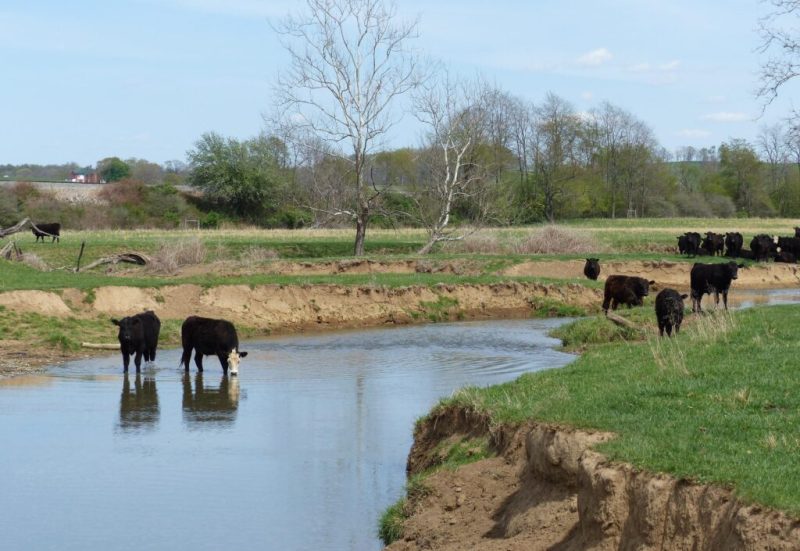
Another file photo of cattle with access to the Shenandoah – Photo acknowledgment Whitescarver
Now, if we could figure a way out to mandate increased rain and an end to the drought in conjunction with improved livestock fencing and reduced fertilizer washing into our rivers, waterways, and groundwater, we’d really be onto something.





Commentary: A Pesticide-Free Farm Can Have Worse Soil Than One Sprayed With Roundup

Warren County Sheriff’s Office Foundation Expands Community Programs, Plans Fall Events

New Proposal from Grid Operator PJM Would Require Data Centers to Gring Their Own Power

Apple Wallet Adds Driver’s Licenses and IDs for Virginia Residents

Samuels Library Sets September Lineup With SamiCon, Community Programs and Family Activities

Virginia to Receive $353 Million in Landmark Meta Child-Safety Settlement

Trump’s Second-Term Immigration Agenda Extends Beyond Border Enforcement

Reverend Michael Duesterhaus (1965 – 2026)

Groovy for a Good Cause: Vintage Fashion Show Supports Bridge of Hope

Why More Robots Can Mean More Workplace Injuries

American Legion Post 53 Builds New Pavilion for Veterans and Community

Missing Bricks Led to Discovery of Structural Concerns at E. Wilson Morrison

Spanberger Orders State Agencies to Prepare for Medicaid, SNAP Changes

Amazon Changes Course on Water Use for King George Data Center Campus

Tree Stewards Prepare for 30th Anniversary While Offering Community Tree Care Class

Challenges and Future Uncertainties

Our Young People Are a Reflection of Our Community

America 250: The Battle of Long Island

Pasta e Ceci: An Ancient Roman Comfort Dish Made Simple
How Soon Until We Have A Chinese-Style Surveillance State?

Cline Accepts Three Debate Invitations in Sixth District Race

Lloyd, Silek Spar Over WCRC Membership Payment Methods as August 27 Meeting & Officer Appointments Loom

Warren County Sheriff’s Office Joins Saturation Saturday Ahead of Labor Day Weekend

A More Permanent Closure of a Portion of Church Street Denied at Town Council Meeting
