
Local Government
Reinstatement of Two Readings Among Considerations at Town Council Work Session
“It’s a disservice to the community.”
At a January 12 work session, Vice Mayor Amber Veitenthal, speaking with force and eloquence that implied significant prior thought, described how the Town Council currently handles public hearings and expressed what she feels is an urgent need to return to an order of business that allows more time for decision-making to crystallize and does more than pay lip service to public input. The proposed reinstatement of two readings would give an item a public hearing and an initial vote at one regular meeting at the Government Center, followed a month later by a second and final vote that might be accompanied by relevant public comments, but no public hearing. Though off-putting to people who are looking for a quick bottom line, the process for which the vice mayor was arguing would allow for an interval in which council members can do their research, engage with the public, and think.
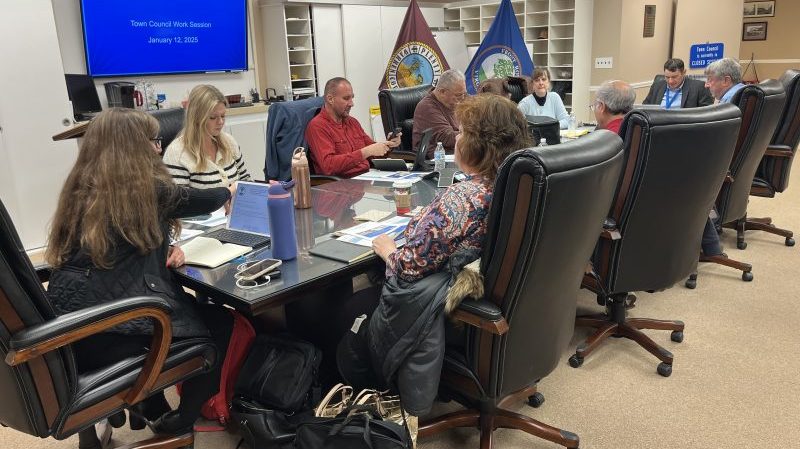
The Town Council gathers for a work session on January 12. Royal Examiner Photo Credits: Brenden McHugh
How many times, shortly prior to the meeting’s commencement, has a citizen presented the clerk with exhibits to demonstrate the point he or she plans to make in the public hearing, exhibits which the council members will only briefly consider before they immediately cast their votes? How many times have council members felt unsure about their grasp of the geography in a particular rezoning but had no time to study it? When the oncoming issue arrives at that speed and departs just as quickly, the quality of the council’s consensus is lessened, and the public may not feel truly heard. At one point during the work session, Mayor Lori Cockrell provided relevant wisdom: “Listen to hear, not to respond.” The immediacy with which council members are currently required to make a final decision compromises their ability to do that type of listening. The disservice comes as the community receives a response made in haste.


Stephen Steele of CHA provides the council with intense details about inflow and infiltration abatement in the town’s septic system.
Other council members, in response to Veitenthal, raised the valid point that not all items are equally complex and do not always require that type of extended attention. To that point, Town Attorney George Sonnett allowed for the possibility that language could be drafted to suit a scenario in which a second vote, unanimously recognized as unnecessary, is dispensed with.
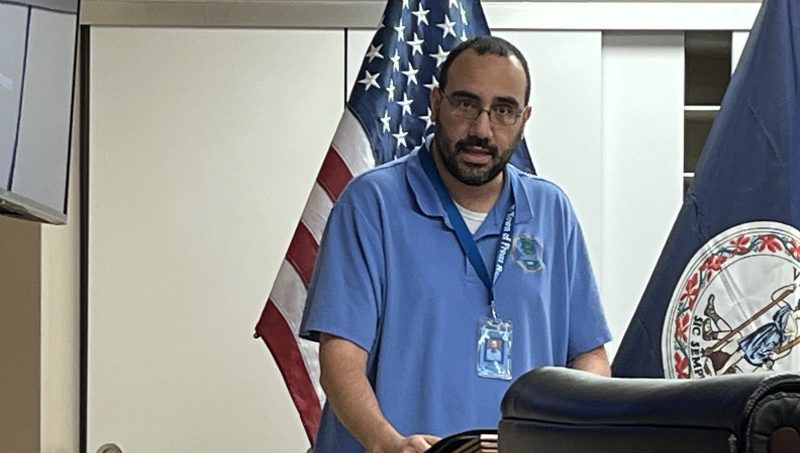
Risk and Safety Coordinator Jose Rivera presents to the council a policy as a first step in becoming fully operational for a small, unmanned aircraft system.
To be discussed further at a future work session, this question arose alongside the need to affirm a schedule for this year’s regular meetings, which the council did unanimously at the work session. Action taken at the work session also involved the repayment of a debt to VDOT, arising out of a lost opportunity connected with former EDA executive director Jennifer McDonald’s mismanagement, a lost opportunity that the mayor frankly said makes her sick. The council also heard from a CHA representative about flow metering, from Risk Management about aerial operations with yet to be acquired, small, unmanned aircraft, from Clerk of Council Tina Presley about FOIA policy, and from Town Manager Joseph Petty about launching a special events committee dedicated to making events held on town streets and public property safe and successful.

With no further business to conduct in the open meeting, the council convened a closed meeting.
Click here to watch the Front Royal Town Council Meeting of January 12, 2026.




Ruby E. Fristoe (1937 – 2026)

USDA Advances Roadless Rule Repeal; Advocates, Lawmakers Say It Puts 400,000 Acres in Virginia At Risk

Violent Crime in US Fell at Record Pace in 2025

Simple Ways to Find More Inner Peace

Number of Retiring U.S. Senators Ranks Among Top 5

DATA Centers Future Here, Changes in Zoning Text Amendment Procedures, and a Little Post-Meeting Drama for One Supervisor

Missed the VA250 Mobile Museum? Another Stop Is Coming Close By

Balancing Optimism and Caution, Spanberger Says Virginia’s Revenues Grew $2.1 Billion in Fiscal Year 2026

Lorraine Partlowe Dovel (1942 – 2026)

SCC Commissioner, Former NextEra Attorney Declines to Recuse Herself From Merger Case

Historic Preservation Group Asks Supreme Court to Halt Trump’s $400 Million White House Ballroom

How to Control Your Lights With Your Voice

This Week’s Showtimes at Royal Cinemas as of August 20th

Spanberger Signs Executive Order to Boost Virginia’s Emergency Preparedness

Middletown Secures Third Straight Virginia Trees for Clean Water Grant

Warren Coalition Plans Recovery Month Kickball Game, Picnic to Support Local Recovery

Blue Ridge Wildlife Center Patient of the Week: Common Raven

DOJ Probes William & Mary Over Alleged Race-Based Scholarship Policies

Royal Oak Computers Moving After 35 Years in Downtown Front Royal

Why You May Feel Younger Than Your Actual Age

Virginia Launches 25th Anniversary ‘Drive Sober or Get Pulled Over’ Campaign

Selah Theatre Project to Open New Winchester Arts Center With ‘Come From Away’

Alongside Kiggans, US House Speaker Says Virginia’s 2nd District ‘Will Determine the Fate of the Country’

Virginia Secures $17 Million to Upgrade Rail Service and Improve Transportation Infrastructure
