
State News
Virginia Senate Democrats Pledge Action on Affordability as 2026 Session Begins
On the eve of the 2026 General Assembly session, Senate Democrats on Tuesday rolled out an ambitious agenda centered on lowering the financial strain on Virginia families, while signalling openness to revisiting tax and revenue policy amid looming budget pressures.
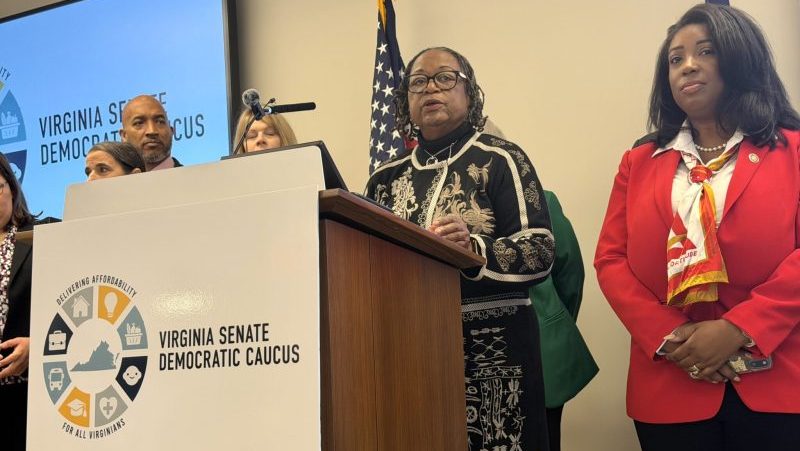
Sen. Mamie Locke, D-Hampton, chair of the Senate Democratic Caucus, speaks during a news conference Tuesday in Richmond as Senate Democrats outlined their agenda for the 2026 General Assembly session, emphasizing affordability as their top legislative priority. (Photo by Markus Schmidt/Virginia Mercury)
Democrats control both chambers of the legislature, which is set to convene on Wednesday with affordability at the forefront of lawmakers’ priorities, amid broader economic and policy debates facing the commonwealth.
At a news conference in Richmond, party leaders outlined what they called the “2026 affordability agenda,” a package aimed at easing costs for households across sectors, including healthcare, childcare, housing, energy, and food access.

The framework builds on the Affordable Virginia blueprint unveiled last month by Democratic Gov.-elect Abigail Spanberger, who has made cost-of-living issues a central theme of her early legislative push.
“Over the course of the last year, one of the things that we kept hearing about was the rising costs among families,” said Sen. Mamie Locke, D-Hampton, chair of the Senate Democratic Caucus.
“Families across Virginia are being squeezed by rising costs from housing and health care to childcare and everyday necessities, and they deserve relief. The urgency of this moment is not lost on us.”
Locke said the agenda will rest on eight pillars that also include transportation, job and food access, energy and education, aimed at restoring “hope, freedom, and opportunity for working families” in Virginia.

Senate Majority Leader Scott Surovell, D-Fairfax, tied the affordability push directly to economic pressures he attributes to federal policy shifts, including tariffs and energy costs.
In a sweeping critique of national trends, Surovell said rising prices for essentials such as food and utilities underscore the urgency of the legislature’s work.
“The truth is, President Trump’s policies are failing Virginians, and the question now is whether we’re going to let that happen, whether we’re going to do something about it,” Surovell said, previewing a slate of Democratic proposals that would raise the minimum wage to $15 an hour by 2028, create paid family medical leave and expand collective bargaining rights for public employees.
Surovell also addressed the state’s fiscal outlook, noting that new federal tax law changes — part of the so-called One Big Beautiful Bill passed by Congress last year — could cost Virginia roughly $1 billion in revenue if the commonwealth conforms its tax code to the federal structure.

The legislature must decide within the first two weeks of session whether to align state tax policy with the federal changes, he said.
“If we can form our tax policy to what Congress asks us to do, it costs us a $1 billion of revenue,” Surovell said. “We’re going to have to make a decision in the first two weeks whether or not we can conform to the federal tax law or not.”
He added that after adjustments for K-12 and Medicaid spending, Virginia is facing a $3 billion to $4 billion funding gap before new initiatives can be considered.
Among potential revenue discussions are modernizing elements of the state’s tax structure, Surovell said, including reexamining the sales tax base and whether existing income tax brackets are equitable in a changing economy.

Sen. Louise Lucas, D-Portsmouth, the Senate’s president pro tempore, echoed the centrality of affordability while placing it in the broader context of opportunity and long-term prosperity.
“We’re going to frame affordability and (it’s) inseparable from freedom and opportunity,” Lucas said, naming access to quality education, health care, and workforce development as key components of sustainable economic mobility.
The Democratic agenda dovetails with wider General Assembly expectations.
Affordability resonated with voters across Virginia in the 2025 elections, helping deliver Democratic a sharp increase in the party’s House majority and shaping policy priorities for 2026.

Spanberger’s earlier rollout of the Affordable Virginia Agenda mirrored her campaign promises and framed the session as an opportunity to tackle prescription drug costs, utility bills, and housing challenges, with a focus on measures to restrain runaway costs without overburdening the state budget.
Still, the ambitious scope of Democratic proposals has drawn scrutiny from critics who argue that some measures — such as broad regulatory changes and spending mandates — could backfire by shifting costs elsewhere in the economy or increasing burdens on businesses and ratepayers.
A recent Washington Post analysis suggested that certain affordability strategies may inadvertently raise costs through cross-subsidization or expanded mandates.
Beyond affordability, Democrats and Republicans alike are preparing for debate on other high-profile issues such as constitutional amendments, redistricting procedures, and structural reforms in areas like energy policy and worker protections.
Under Virginia’s Constitution, constitutional amendments that passed for the first time last year must be approved again in the coming weeks before moving to voters later in 2026, making this session particularly consequential.
by Markus Schmidt, Virginia Mercury
Virginia Mercury is part of States Newsroom, a nonprofit news network supported by grants and a coalition of donors as a 501c(3) public charity. Virginia Mercury maintains editorial independence. Contact Editor Samantha Willis for questions: info@virginiamercury.com.




Front Royal Cardinals Host Purcellville Cannons Sunday, July 12 at Bing Crosby Stadium

Business Growth Series: Negativity Is Driving Customers Away

Virginia Climbs to Third Spot in CNBC ‘Top States for Business’ Rankings

Virginia Cannabis Budget Language Triggers Legal Confusion, Political Fallout

Birthright Citizenship

Ask the Expert: Is a 2-1 Buydown Really a Good Deal?

Americans Have Stopped Cooking

Hike Kidz Foundation Partners with Love in Action to Deliver Fresh Food to Families

After 12 Years of Service, Seniors First Executive Director Jimmy Roberts to Retire

Warren County Residents Speak Against Data Centers at County Planning Commission Meeting

Pirate Adventure Vacation Bible School Sets Sail July 19 at First Baptist Church

The Human Access Layer

Two Juveniles Charged After 17 Vehicle Break-Ins in Bentonville Area

Prince William Supervisors Reject Dulles Cloud South Data Center Proposal

Trump Faces Looming Deadline to Sign Popular Bipartisan Housing Package

How the Declaration and the Constitution Are Inseparable

How to Say “I Don’t Know” Gracefully

Meet the Brown Marmorated Stink Bug

Fireman’s Parade Draws Crowds Despite Summer Heat as Carnival Continues Through Saturday

Warren Memorial Hospital Achieves Another National Recognition

Warren County Tourism Debate Expands Into Broader Conversation About Governance, Accountability, and the Future of Regional Marketing

Game Postponed to July 14 – Cardinals Host New Market Rebels Thursday, July 9 at Bing Crosby Stadium

Court Battles Leave Virginia’s New Assault Weapons Ban in Legal Limbo

Virginia Ranks Among Top States for Highway Safety and Mobility Benefits, but Challenges Remain