
Community Events
Successful flag raising and musket firing ceremony at Fort Loudoun Day
On May 15, 2021, the French and Indian War Foundation and the Colonel James Wood II Chapter, Virginia Society Sons of the American Revolution (SAR) participated in a flag raising ceremony and drill/musket firing ceremony at Fort Loudoun Day in Winchester. This event commemorates the beginning of work on a fort in Winchester.
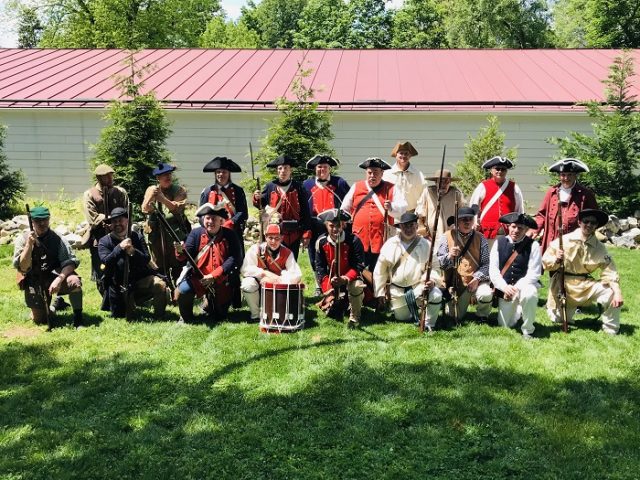
A group photo of the reenactors. Kneeling left to right: Charles Balding, Mark Buhl, Eric Robinson, Quinton Culver, Sloan Culver, Sean Carrigan, Thomas “Chip” Daniel, Dale Corey and Nathan Poe. Standing left to right: Josh Shores, Jeff Pennington, Steve Doss, Jim Moyer, Eric Moore, Marc Robinson, Will Reynolds, Fred Gill, Dennis Parmerter, Steve Resan. Photos courtesy of Scott Straub.
On May 18, 1756, George Washington sent a letter to his second in command, Lieutenant Colonel Adam Stephen, that he was beginning to construct and erect a fort at the direction of the Governor Dinwiddie. Stephen was asked to send down the men of Captain George Mercers Company, Captain David Bells men and other carpenters from other companies. The supervisor of the carpenters was Major Joseph Stevens of the Caroline County militia. The fort was built on a five acre tract of land that belonged to Isaac Parkins.
Washington had drawn the plans for the fort, laid out the site and erected a blacksmith shop nearby to supply the needed ironwork. In a surviving plan for the fort, he outlined a 204 foot square with bastions at each corner. The initial plan showed the distance between the bastions at 88 feet. The ramparts were about 16 feet in height and 13+ feet wide. The gate into the fort was located on the south side of the building. Inside the fort were five major buildings, each separated from the inner wall by a passage up to 7.3 feet wide. In a second plan, Washington extended the width of the rampart to 18 feet and reduced the length to 78 feet. He further eliminated the passageway between the buildings and the inside wall of the rampart.

A well was begun in April 1757. By 1758, the well was 102 feet deep but had not yet struck a spring. A lack of funding hampered completion of the well. Although a primary base for Virginia forces operating on the colony’s northwest frontier, after four years, the fort remained unfinished. This was due in part to lack of adequate funding, poor maintenance and the conduct of the French and Indian War. After the end of the French and Indian War, the fort remained occupied. In 1774, a partial dismantling of the hewed timber walls of the fort may have begun. A home on South Loudoun Street in Washington is said to have been built of the logs from Fort Loudoun. Today, the structure is covered with clapboard siding. The place remained a military base during the Revolutionary War, mainly for operations against the Indians, serving as a point of rendezvous.

Mercers Company preparing to fire muskets, from left to right: Quinton Culver, Marc Robinson, Jim Moyer, Sloan Culver and Steve Doss.
During 1780, Fort Loudoun was a prisoner of war camp for a short period of time. The fort had continued to decline. The hewn logs had been removed and replaced with a picket fence to enclose the prisoners. By 1786, there were no longer any walls remaining from the fort. The last of the buildings from Fort Loudoun probably survived into the early years of the 19th century, as most of the buildings had been removed as the expansion of Winchester went through the property that had been the fort. The only surviving structure from the fort is the well.
The Fort Loudoun Day Commemoration began in the morning with tours of the site and presentations by David Grosso, President of the French and Indian War Foundation and an appearance by James Wood (founder of Winchester, as rendered by Steve Resan). Reenactors from Mercers Company, Rutherford’s Rangers and the Colonel James Wood II Chapter of the SAR provided a flag raising ceremony, Mercers Company gave presentations of drill and ceremony plus a musket firing showing how these actions were taken during the French and Indian War. The SAR Chapter then showed how the same were conducted during the Revolutionary War.

Colonel James Wood II SAR Chapter preparing to fire muskets, from left to right: Fred Gill, Dennis Parmerter, Thomas “Chip” Daniel, Nathan Poe, Sean Carrigan, Will Reynolds and Dale Corey.
Participating from the French and Indian War Foundation were David Grosso, Steve Resan, Scott Straub, Marc Robinson (Mercers), Eric Robinson (Mercers), Jim Moyer (Mercers) and Dale Corey (SAR). From the Rangers: Charles Balding, Mark Buhl, Josh Shores and Jeff Pennington. From Mercers Company: Quinton Culver, Sloan Culver, Erick Moore and Steve Doss. From SAR: Sean Carrigan, Chip Daniel, Fred Gill, Dennis Parmerter, Nathan Poe and Will Reynolds.




Virginia School Board to Appeal Federal Court Order to Remove Confederate School Names

Historic Travels: Pierre’s Hole, Idaho

Business Growth Series: Give More Value, Get More Customers

Lowdown from Loudoun: Virginia Official Shares Data Center Tips with Maryland Audience

The SCC Must Judge Dominion’s Future, Not the Governor’s Office

ORDER OF PUBLICATION: In the Circuit Court for Warren County, Virginia

When the Warehouse Robot Speaks Your Language

Butterflied Roast Chicken Delivers Crispy Skin and Juicy Meat

The Hidden Cost of Empty Storefronts

DOJ Targets 3 More States in Effort to Axe In-State Tuition for Immigrants

Program Connects Deployed Service Members with Foster Homes for Pets

Warren County Celebrates First Customer Connection Through All Points Broadband Expansion

Dominion Asks SCC to Recover an Additional $922 Million for Fuel Costs Over Multiple Years

Aging in Place: County Planning Commission Considers an Option for the Elderly

Virginia’s Vaccine Recommendations, Requirements Won’t Change After Trump Order, Officials Say

Trump Administration Urges Supreme Court to Rule Soon on Limiting Vote-by-Mail in Midterms

Virginia Resident Seeks Answers from State Education Superintendent Over Genocide Definition

Foster Families Needed Across Northern Shenandoah Valley to Keep Children Close to Home

Data Center Debate Draws Crowd as Residents Demand Transparency, Local Control

Blue Ridge Arts Council Wraps Up 37th Gazebo Gatherings Season with Ryan Jewel Concert

$1.65-Million Auction Dent Put in $10-Million Debt to First Bank & Trust on ITFederal Developmental Loan to FR-WC EDA

Where Motive and Opportunity Align on Zoning Code

What Candidates Have Planned for Virginia’s Coast Could Decide a Key Congressional Race

This Week’s Showtimes at Royal Cinemas as of August 14th
