
EDA in Focus
Did Town Council’s December 1 ‘Special Closed Meeting’ violate multiple FOIA laws?
Royal Examiner editorial department staff have occasionally pondered the often overly vague language of motions used to adjourn to Executive/Closed Sessions, particularly on the Town side of local municipal government. Those motions and the information in them are guided by Virginia Freedom of Information Act (FOIA) standards on a variety of levels. Royal Examiner recently contacted Virginia FOIA Advisory Council Executive Director Alan Gernhardt about those standards, particularly as they applied to a December 1 “Special Closed Meeting” of the Front Royal Town Council called by Mayor Chris Holloway.
Gernhardt’s response referenced a history of Virginia FOIA Advisory Council opinions on the state standards for balancing the public’s right to know how they are being governed by their elected officials and those officials’ occasional need for some degree of secrecy, generally in competitive bidding, property transactional, legal, and personnel matters. How the wording of motions to adjourn to Closed/Executive Session must balance these sometimes-conflicting standards in a democratically based but also economically competitive and sometimes legally contentious society, revolve around three elements. Those are (1) the subject of the closed meeting; (2) the purpose of the closed meeting; and (3) reference to the applicable FOIA law section exempting the meeting from the public view.
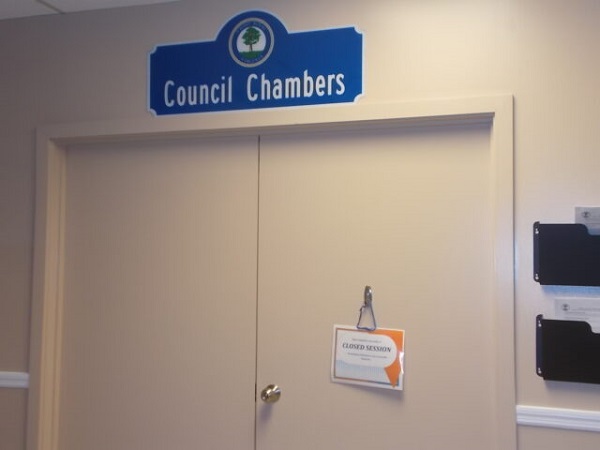
File photos during a previous Front Royal Town Council Closed Session in Town Hall. On December 1, 2021, council could not use the second floor meeting room due to a previously scheduled planning commission meeting, so moved to the first-floor Finance Dpt. section of the building, which was totally locked to public access for at least a portion of that meeting. Royal Examiner File Photos by Roger Bianchini

“The law clearly states, and this office has previously opined, that a motion that lacks any of these three elements would be insufficient under the law,” one example of an earlier state FOIA Advisory Council opinion Gernhardt provided to Royal Examiner states. However, it adds that: “… when identifying the subject of a closed meeting, the subject need not be so specific as to defeat the reason for going into the closed session but should at least provide the public with general information as to why the closed meeting will be held.”

This information takes us to the motion used to convene the December 1 Special Meeting closed session announced the previous day. That motion circulated with the “Town Council Special Closed Meeting” agenda prior to the meeting, reads in its entirety: “I move that Town Council go into Closed Meeting pursuant to Section 2.2-3711.A.7 of the Code of Virginia for consultation with legal counsel and briefings by staff members or consultants pertaining to actual or probable litigation involving a former employee of the Town, where such consultation or briefing in Open Meeting would adversely affect the negotiating or litigating posture of the public body.”
For starters, the passage “pertaining to actual or probable litigation involving a former employee” seems far too vague to comply with state FOIA statutes since the discussion seemingly involves only one former employee, hence one litigation – So, which is it, actual or probable litigation?
The question is an important one because whether the litigation has been filed and has appeared on a court docket impacts the degree of specificity or vagueness with which the “subject” or “purpose” of the meeting may be described. For unfiled litigation, Gernhardt told us such descriptions as “litigation with a former employee” are sufficient to meet FOIA requirements because “it says more than just ‘litigation matters’ while not disclosing the actual nature or details” of a case yet to be filed on a court docket.
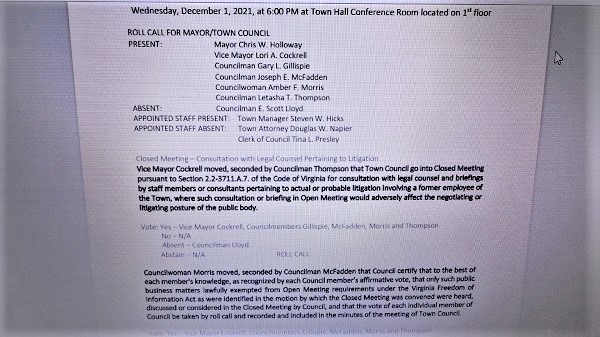
Photo of minutes of Dec. 1 Town Council ‘Special Closed Meeting’ approved by council on Dec. 13. The only open portions of the meeting were the motions to go into closed session, and coming out certifying that only topics cited in first motion were discussed behind closed doors. But what active litigation, as Royal Examiner has been told it was, involving what ‘former employee’ was discussed? The Town will not specify, despite FOIA law precedents pointing toward more than vague litigation references for filed court cases. Note, the meeting time was announced the previous day as 6:30 p.m.

Regarding legal cases that have been filed with detail of an alleged cause made by a specific party made public through the court system, Gernhardt said somewhat more specificity is required. “For litigation matters, I generally would recommend using the style of the case if it has already been filed and appears on a public docket,” he said. “Style” in this case appearing to reference at base minimum, whom the litigation is with. That is the policy that Warren County and its post-financial scandal, re-tooled Economic Development Authority (EDA) have taken with all motions on existing litigation.
Just two days after town council’s vaguely adjourned to Special Closed Meeting of December 1, the County EDA adjourned to a 12-item Closed Meeting that included six real estate, four legal, one bank re-financing/legal, and one personnel matter. ALL 12 matters were identified as to “subject” by name with some degree of purpose though not to a degree to defeat the purpose of having the discussion behind closed doors by FOIA requirements. Ironically, three of the four legal matters related to litigation between the County EDA and the Town of Front Royal municipal government. We will include that litigation portion of the EDA motion to illustrate what we believe is a FOIA-compliant motion into closed on existing legal matters, now being used by both the County and its EDA:
“4. CLOSED MEETING Dec. 3, 2021, motion into: … · 4 matters – Consultation with legal counsel and briefings by staff members pertaining to actual or probable litigation, where such consultation or briefing in open meeting would adversely affect the negotiating or litigating posture of the public body, EDA v. Jennifer McDonald, et al., EDA v. Town of Front Royal, Town of Front Royal v. EDA, and legal advice related thereto and regarding other matters relating to claims of the Town of Front Royal pursuant to Va. Code §§ 2.2-3711.A.7 and 8.”
To contrast, let’s revisit the Town motion in question as presented and approved in that meeting’s minutes as having been read into the record by Vice-Mayor Lorie Cockrell, seconded by Letasha Thompson: “I move that Town Council go into Closed Meeting pursuant to Section 2.2-3711.A.7 of the Code of Virginia for consultation with legal counsel and briefings by staff members or consultants pertaining to actual or probable litigation involving a former employee of the Town, where such consultation or briefing in Open Meeting would adversely affect the negotiating or litigating posture of the public body.”

On the Town side it appears one of the three elements required by FOIA law – “subject” is missing in that whether it is an unfiled “probable” litigation or an “actual” litigation that has been filed, say for example former Council Clerk Jennifer Berry’s federal sexual harassment suit, at the time scheduled for trial in February 2022, is not specified.
And were it to be filed litigation that was discussed behind closed doors December 1, is it possible a second key element, “purpose”, is missing? For the only purpose cited in the motion is “consultation with legal counsel and briefings by staff members or consultants”. Could that be enough “purpose” to satisfy FOIA law regarding “actual” litigation in what was called as an “emergency meeting” as will be discussed in more detail here later; or would additional detail such as “discussion of approaching filing deadlines” be required?
Royal Examiner spoke to Jennifer Berry’s attorney, Tim Cupp, in her suit against the Town on December 1st looking for clues the closed session might have been called regarding his client’s case. While declining to speculate why the mayor had called that special closed meeting, Cupp did note that December 1 was the final day for Discovery motions filings in the Berry case on the Harrisonburg federal Western District of Virginia docket slated for trial in February. Could it be a coincidence that within days of the Front Royal Town Council’s “Special Closed Meeting” of December 1, the Berry vs. Town of Front Royal federal sexual harassment trial in which Mayor Holloway has been named as a figure in alleged attempts to have Berry withdraw a related internal complaint involving former vice mayor and councilman William Sealock, was rescheduled to May 2022?
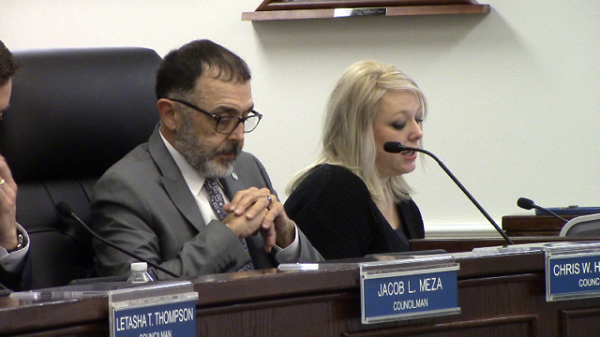
File photos from a council meeting and work session before Council Clerk Jennifer Berry, above right’s, position was eliminated by downsizing of town staff during interim town managership of Matt Tederick, and prior to her filing a federal lawsuit citing alleged sexual harassment by former councilman and vice-mayor Bill Sealock. Berry also alleged then Councilman Chris Holloway, above left, among others, attempted to get her to withdraw an internal complaint about the alleged behavior. According to her suit’s timeline it appeared the full council was aware of Berry’s allegations against the vice mayor by the time of these January 2020 meetings.

Ultimately, as Gernhardt pointed out to Royal Examiner, a determination on meeting FOIA law compliance would be determined by a judge were a complaint to be filed that it had not been in a particular case. Gernhardt also provided Royal Examiner with a Virginia Supreme Court ruling, BEVERLY COLE, INDIVIDUALLY, ET AL. v. SMYTH COUNTY BOARD OF SUPERVISORS, ET AL. (No. 17120 May 28, 2020), which overturned a lower court decision, and mandates the above-referenced “subject” and “purpose” standards.
In that case, the Virginia Supreme Court ruled unanimously that the Smyth County Board of Supervisors used an improper motion to go into closed session and talked about matters beyond the scope of the claimed exemption.
While exploring FOIA law regarding the above issues of adequate “subject” and “purpose” standards being met in convening the December 1 “Special Closed Meeting” two other factors attracted Royal Examiner editorial staff’s attention. Those were, first, the short turnaround on notice of the meeting being circulated, approximately 27 hours, as opposed to the three-day minimum public notice for non-emergency special meetings; and second, the fact that both access doors to the section of the Front Royal Town Hall where the special meeting was taking place were locked while the meeting was still in progress.
Locked Out or Not Locked Out?

Notice of the council special meeting emailed to the media at 3:22 p.m., Tuesday, November 30, by Town Administrative Assistant and Council Clerk Tina Presley read: “The mayor has called a special closed meeting for Wednesday, December 1, 2021, at 6:30 p.m. in Town Hall.”
With a Town Planning Commission work session on a new short-term tourist rental ordinance under development scheduled for 6 p.m. in the second-floor meeting room town council normally uses for meetings at Town Hall, it was unclear exactly where that council special meeting would be held. In response to inquiries, it was eventually determined to be somewhere in the Finance Department section of Town Hall. That section is on the Crescent Street/Afton Inn side of the first floor of Town Hall to the left as you enter the primary, East Main Street entrance.
We note this because when the December 1st planning commission meeting ended around 7 p.m., the two media present, this reporter and Alex Bridges of the Northern Virginia Daily, attempted to enter the Finance Department section of town hall to ascertain if the council special meeting was still in progress and await its adjournment for any announcement or action. Finding the access door locked, we sought the assistance of Planning Director Lauren Kopishke, mingling with planning commission members on their way out of town hall. Surprisingly, Kopishke found that her access code credential was somehow disabled, preventing her assisting media access to the area of the council special meeting.
Press also established that the rear parking lot outside access door, the only other entrance to that section of the building, was also locked between 7:15 and 7:30 p.m. Town Manager Steven Hicks later informed the press that once out of closed, the open meeting was adjourned at 7:46 p.m. without any announcement or action.
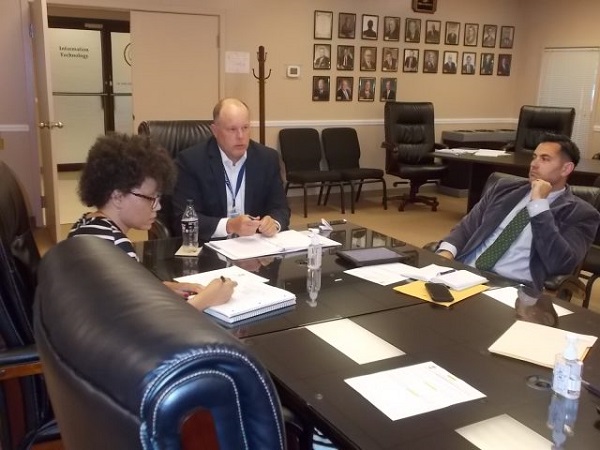
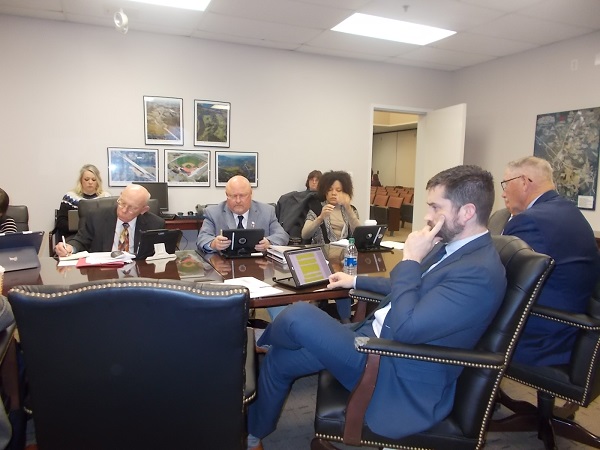
Town Manager Steven Hicks, center, holds council’s attention at an earlier 2021 work session in town hall’s second-floor meeting room where ‘To lock or not to lock the outside access doors’ was not the Shakespearean question at hand.
So, in addition to questions about FOIA public disclosure standards being met, the additional question of public/press access to the open portions of the special meeting were raised. Questioned about this, Hicks told Royal Examiner that the doors in question had been unlocked at the meeting’s convening and adjournment, so that any public or press present could have accessed the open portions of the meeting. Unfortunately, no member of the press or public, to our knowledge, was present at those specific times of 6:30 and 7:46 p.m. to test that timely locking and unlocking scenario.
Special or Emergency Meeting?
Council Clerk and Administrative Assistant Tina Presley sent media an e-mailed notice of the meeting at 3:22 p.m. Tuesday, November 30, some 27 hours prior to the meeting’s announced 6:30 p.m. open session starting time the following evening. In a Dec. 2nd telephone conversation regarding the special meeting’s announcement, Ms. Presley relayed to Royal Examiner’s Norma Jean Shaw, “I just did what the mayor asked me to do.” When asked why she didn’t post the meeting notice on social media or the Town’s website Presley stated, “I guess I could have, but I only sent it to the three local reporters who normally cover the council meetings.”
The fact the meeting was bypassing the normal three-day minimum public notice of municipal government meetings indicated that it was not only a “special meeting,” but an “emergency” one requiring immediate attention for one reason or another.
Was there sufficient reason, as the town manager contends there was, to designate an “emergency” meeting that allowed less than three-days’ public notice? Because of the ongoing refusal of the town administrative or contracted legal staff to elaborate on the subject or purpose of what is now admitted to have been closed session discussion of existing litigation, your guess is as good as ours. But is the fact we are still guessing at answers to numerous questions about that behind-closed-doors meeting an indication that the Front Royal Town government is in ongoing violation of Virginia Freedom of Information Act standards?
Perhaps a judge will tell us.

Could answers to questions about the subject and purpose of town council’s Dec. 1 ‘Special Closed Meeting’ be mandated by a local judge? Perhaps, though it appears the Va. Supreme Court has already weighed in on the issue regarding filed litigation requiring more “subject” and “purpose” specificity than unfiled to convene into closed session.




County Supervisors Fill Vacant Planning Commission Seat, Look to Future on Processes and Capital Improvements

America 250: ‘I Only Regret That I Have but One Life to Lose for My Country’

Building Gas Plants More Important Than Dominion Sale, Data Center Politics

Home Inspectors Help Buyers and Sellers Understand a Property’s Condition

Bowling Together: Why Work Is More Than a Paycheck

This Week’s Showtimes at Royal Cinemas as of September 24th

POLICE: 7 Day FRPD Arrest Report 9/21/2026

Blue Ridge Wildlife Center Patient of the Week: Eastern Cottontail

UVA Health Review Examines Real-World Results of Incisionless Liver Tumor Treatment

Maximilian James Donora (1995 – 2026)

Dollars for Dolly Campaign Aims to Turn Small Gifts Into Big Community Impact

Clean Virginia: NextEra’s Utility Takeover Attempts, Alleged Political Moves Relevant to Merger Case

Commentary: If You Enjoy Virginia’s Wildlife, Thank a Hunter or Angler

Spanberger Presses Congress for AI Guardrails as States Forge Ahead

‘Drive Them Into Hell’: Trump Ponders Destruction of Iran at United Nations

National Chicken Month Celebrates a Versatile Source of Protein

Face Paint That Can Read Your Heartbeat

Leisa Wood (1961 – 2026)

GO VOTE: Because Complaining Alone Isn’t a Good Strategy
The Third Most Important Gift Is Laughter

Skates, Treats and Safety: Warren County Sheriff’s Office Foundation Pack October with Community Events

Celebrate Kids Day Returns Sept. 27 With Family Fun, Activities and a New Train Ride

Survey Finds That More Than Half of Virginia Families With Children Face Food Insecurity

Could Virginia’s New Law Allowing 1% Sales Tax for School Construction Need a Fix?
