
Community Events
Colonel James Wood II Chapter, Cowpens Commemoration
On 15 January 2022, the Colonel James Wood II Chapter of the Virginia Society Sons of the American Revolution sponsored a commemoration of the Battle of Cowpens at Mt Hebron Cemetery, Winchester. The battle was fought on 17 Jan 1781 near the town of Cowpens, South Carolina in Cherokee County. BG Daniel Morgan led an army of tough Continentals and backwoods militia to victory over LTC Banastre Tarleton’s battle-hardened force of British regulars.
In the lead-up to the battle, the British under Lord Cornwallis were in the process of a successful southern campaign in an attempt to defeat colonial forces during the American Revolutionary War. The British had captured Savannah, Charleston, and Camden, South Carolina in their efforts to regain control of governments in the southern colonies. Nathanael Greene was given command of the American Forces in the south with the idea of rebuilding the tattered army and slowing the British war effort.
Two weeks after taking command, he split his army, sending General Daniel Morgan to cut supply lines and hamper British operations in the remote, undeveloped areas of the south. Banastre Tarleton was sent to stop Morgan.
On 12 January, Morgan’s Army was found on the Pacolet River in South Carolina. Tarleton began an aggressive pursuit and despite the rain and flooded rivers, gained ground. Morgan retreated to burr’s Mill on Thicketty Creek. He decided to make his stand with the flood-swollen Broad River to his back on a field used for cattle grazing that was some 500 yards long and just as wide. At dawn on 17 January, it was clear and bitterly cold. Tarleton had roused his troops to move on Morgan at 2 a.m. in the morning, looking to catch the colonists in the early hours of the day.

When Morgan’s scouts brought news of Tarleton’s approach, he moved among his men shouting, “Boys, get up! Benny’s coming!” Tarleton formed his Army on the Green River Road for an attack. He was confident of victory as Morgan was hemmed in by the Broad River and the park-like terrain was an ideal battlefield for his dragoons. He had Morgan right where he wanted him. He attacked head-on, with a line extending across the meadow, artillery in the middle, and fifty Dragoons on each side.
To counter this, Morgan organized his troops into three lines. In front, hiding behind trees were selected sharpshooters. At the onset of the battle, they picked off attackers, sending the Dragoons into a retreat. With this, they moved back 150 yards to join a second line made up of militia commanded by Andrew Pickens. As they moved back, the British reformed and charged again. Morgan’s men fired two volleys and retreated to a third line.
At this point, Tarleton’s Army believed the colonists were in full retreat and they charged in time for William Washington’s patriot cavalry to come into the battle from the flank. This put the crown’s troops in disarray.
Again the British officers rallied their troops with the reserve force sent in to turn the tide of battle to the royal forces. During the noise and confusion of battle, a colonial command to the continental forces was misunderstood for retreat. The British sensing victory charged hard after the Americans. Morgan rallied his troops and had them face about and fire in unison into the charging ranks. Added to this was a fierce Patriot bayonet charge, which turned the tide of battle.

Reformed colonial militia and cavalry entered the battle, leading to a double envelopment of the enemy. The British began surrendering en masse. The battle was over in less than an hour in a complete victory for the American forces. Tarleton and some of his men escaped and returned to Lord Cornwallis’ army with news of the shocking defeat. British losses were 110 dead, over 200 wounded and 500 captured. Morgan lost 12 killed and 60 wounded. This battle was the turning point of the war in the south which led up to the patriot victory at Yorktown and ultimately an end to the war.
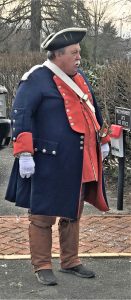
Color Guard Commander Marc Robinson (photo courtesy of Anita Bonner)
The ceremony was emcee’d by chapter Vice President Thomas “Chip” Daniel. Attending to present greetings were Virginia Society 2nd Vice President Ernie Coggins and Virginia Society Children of the American Revolution President Sara Cox.
Chaplain duties were led by Rt Rev Larry Johnson and Rev Jim Simmons. Marc Robinson commanded a color guard consisting of Ken Bonner, Sean Carrigan, Forrest Crain, Kelly Ford, Doug Hall, David Huxsoll, Dennis Parmerter, Nathan Poe, Eric Robinson, and Bill Schwetke.

Wreaths were presented by 2nd Vice President Coggins; President Cox; Marc Robinson, Colonel James Wood II Chapter; Bill Schwetke, Culpeper Minutemen; David Husxoll, Fairfax Resolves; Paul Cox, Colonel Fielding Lewis; Anita Bonner, Lanes Mill, Daughters of the American Revolution and Anna Cox, Colonel Alexander Spotswood Society, Children of the American Revolution.
Dale Corey gave a presentation on the battle and a musket salute was fired to commemorate the patriots who fought at Cowpens. After the ceremony, prayers were conducted at Daniel Morgan’s gravesite by Rt Rev Johnson and Rev Simmons to honor the participants of the battle.
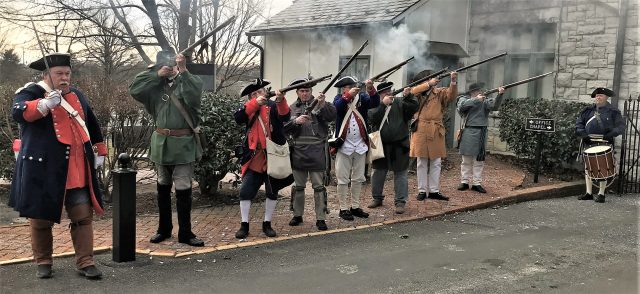
Musket Squad firing salute l. to r. Marc Robinson, Bill Schwetke, Clay Robinson, Forrest Crain, Dennis Parmerter, Kelly Ford, Ken Bonner, Sean Carrigan, and Doug Hall (photo courtesy of Scott Straub)
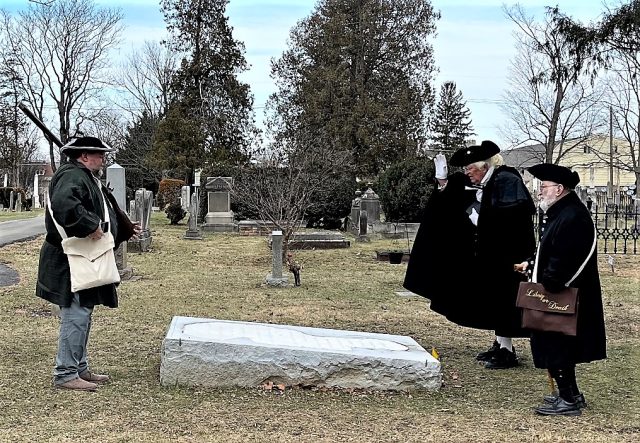
Daniel Morgan’s gravesite l. to r. Kelly Ford, Rt Rev Larry Johnson and Rev Jim Simmons (photo courtesy of Scott Straub)





Warren County Sheriff’s Foundation Working to Strengthen Community Connections

Dr. Arthur Gaillard Gower III (1933 – 2026)

The $4 Frame That Held a Treasure

Mary A. Shaw (1958 – 2026)

Come On Down to the Great American State Fair — There’s Plenty of Room

Man Accused of Threatening Former Delegate Kim Taylor Enters Plea Agreement

Mark Allen Kisner (1957 – 2026)

Peggy Ann Franklin Thompson (1940 – 2026)

Spanberger, Assembly Ignore Dominion Sale, Focus on Scapegoating Data Centers

The Declaration of Independence First Received in the Churches

What Frederick Douglass Asked of America

Here Are 10 Notable New Virginia Laws That Will Take Effect July 1

Virginia to Fund Cancer Screening Program for Firefighters

How a Texas Metal Shop Became Igloo

Warren County Officials Urge Safe, Legal Fireworks Use During July Fourth Holiday

Virginia Colleges Face Global Competition as More Students Consider Studying Abroad

Virginia Has a New Two-Year Budget. Here’s What Lawmakers Now Require of Data Centers

Todd Gilbert Set to Start State 26th District Judicial Appointment Wednesday, July 1

Make-A-Wish Greater VA Makes a Dream Come True in Strasburg

Cardinals Return Home Wednesday, July 1 to Face Charlottesville Tom Sox

Blue Ridge Wildlife Center Patient of the Week: Great Horned Owl

July Celebrity Birthdays: Do You Share a Birthday?

Supreme Court Upholds Birthright Citizenship in Major Immigration Ruling

Charlee & Joe to Perform July 2 at Gazebo Gatherings
