
EDA in Focus
Connolly again berates Egger for continuing workforce housing discussion
The divide about exactly what constitutes appropriate Front Royal Town Council meeting business ramped up another notch on Monday, May 22.
Addressing the size of the EDA response to her submitted questions about the workforce housing project – 383 pages by Royal Examiner count – Bébhinn Egger observed, “It sort of reminded me of the person who goes in to pay their fine with all pennies … it was every piece of paper they could find with the words workforce housing on them. And I had asked very specific questions and I expected very specific answers to those questions. After looking through the packet, very few of those questions are answered. So, I think it’s very important for council in the future to think about whether this is an acceptable way for our questions to be answered.”
Egger noted that she has seen a great deal of constituent interest in how the workforce housing project has evolved, and asserted that the questions she has asked are the questions many town citizens would also like answered.

As former EDA Board member William Sealock listens to her right, Bébhinn Egger makes her and constituent case for more clear answers from the EDA on withheld information on workforce housing project. Photos/Roger Bianchini

“And I know I’m not the only one with questions – since the last meeting (May 8) I have been stopped on the street, in the grocery stores, and by people who have taken the time to call me up; and a lot of our constituents have these same questions.
“So, it’s really important that we are treated with respect in getting our questions answered. And on the end of their cover letter they did mention if there were any additional questions they should be submitted to Jennifer McDonald and she’d be happy to answer them.”
Egger explained that at Mayor Hollis Tharpe’s suggestion of May 8, she personally e-mailed her questions to EDA Executive Director McDonald – “And I’ll be doing that again for the majority of questions that have not been answered.”

Following the conclusion of her remarks, which will be explored in more detail below, Egger’s colleague John Connolly picked up where he left off on May 8. He again berated Egger for not having her discussion about dynamics of the workforce housing project privately, out of the public eye.

John Connolly describes the ‘Connolly Rules of Order’ to Councilwoman Egger, which do not include her being allowed to raise constituent issues he does not want to hear about. Fortunately Mayor Tharpe, to his right, has continued to follow Roberts Rules of Order in allowing the councilwoman the same procedural rights as her male col-leagues.
He asserted that project financing or costs were beyond the scope of council interest, that the special permitting exceptions requested by the EDA and granted by the Town were purely a land use decision. He also chided Egger for not asking appropriate land-use questions when the special exceptions permitting request was before council last November.
That assertion appears to ignore the fact that prior to council’s November 14 final approval of the Special Use Permit exceptions, Egger was the only council member to raise hard land-use questions, particularly as they applied to road exceptions and public safety concerns brought to council by area residents. Connolly joined the 5-1 council majority (Egger dissenting) in voting down Egger’s land use concerns. (William Sealock and Chris Morrison have since replaced Bret Hrbek and now-Mayor Tharpe on council).

Connolly again accused Egger of grandstanding and using the “council concerns and inquires” portion of the meeting as a “soapbox” to promote “personal vendettas”. However, it has been Connolly himself who has appeared to take a policy disagreement to a more personal, even “showboating” level. Connolly has taken on an almost parent-to-child tone to lecture Egger on everything from “respect” to what are appropriate topics of conversation at the dinner table – oops, I mean the “Requests and inquiries of Council Members” portion of town council meetings – and “daddy” has made it clear he does NOT hold “all his children” to the same conversational standard, as illustrated in his “special exception” for Jacob Meza referenced below.
“I think one of the most legitimate critiques of town council in the past few years has been the level of professionalism with which we conduct ourselves in this office,” Connolly began at a very measured pace (Wonder where he heard that? Have you heard that? I haven’t heard that!). “And it’s one thing to talk about respect and wanting respect to be given,” he said glancing “stage right” toward Egger’s dais position. “I was always raised that respect is earned and we should be giving respect in order to get respect.
“Mr. Mayor, my point of view is thus: we all have access to Jennifer McDonald, we can call her and talk to her. We have ridden this train before where members of council have made accusations about public figures; about staff members; about people in the limelight; about businesses without going and getting their information first (does he mean like from the EDA about the un-gifting secret deadline? – I’m confused).
“The question about the workforce housing project was a land use question; it was a planning and development question. I fail to see how (shoulder twitch for punctuation) Miss Egger’s issues with how this was or was not funded were pertinent to the question at hand, that was before council at that time, is WHY she didn’t ask any questions about that, really, at that time (REALLY?).

“IF there are still questions to be had, I want to know why council members haven’t picked up the phone or gone to the EDA office, which we know we’re welcome to do because Jennifer has told us multiple times we are welcome to do that INSTEAD of making a big stink here in public, while the TV cameras are on, about someone’s performance? (one must wonder if Connolly read even the 8-page press release accompanying the EDA workforce housing packet, which made it clear the EDA Board was NOT going to authorize release to Town officials of any detail of its confidential agreement with the property owners, including the loss-of-gift deadline)

I feel your pain (if, in fact, you are feeling pain) – to far left Vice-Mayor Tewalt occupies as Councilman Connolly continues his dissertation about respect and his ‘he’s OK, she’s NOT’ procedural world-view …

“On the whole I don’t know whether there are more questions that need to come out here or not. What I DO know is that has nothing (dramatic finger punching) to do with the agenda that’s before us for this meeting here this evening. My understanding of the ‘Requests and Inquires of Council members’ portion of our agenda, IS that it is not so we can use this time to soapbox; to go through our own personal vendettas; and our own personal motivations and drive our own personal agendas (WOW, talk about the pot calling the kettle black) but so that we can raise inquires, like Councilman Meza did in raising the issue of the railroad tracks and things that have been brought to us as an outlet for new business that needs to be brought up.”

So let me get this straight – Christendom College graduate John Connolly thinks that trains stopped here blocking railroad tracks for extended periods of time IS new business; but thinks the April 28 revelation council and its planning staff were not informed of a pending project start deadline adding $445,000 to the EDA cost for the workforce housing project IS NOT?!!?
R-E-S-P-E-C-T
Egger later responded to Connolly’s thoughts on the origins and acquisition of respect.
“I think with the discussion of respect, when the EDA disclosed at their last meeting (April 28) that there was a confidential agreement that included a deadline that was not given to us when we voted in November, that’s the first breach of respect – that they are withholding information from us … I don’t think my questions were given in an attacking sort of way, but I was very firm because I was extremely upset, and still am, that they’re withholding information and don’t seem to think there’s a problem with that.
“So that, I think, is the first breach of respect.”
Egger repeated that she hoped her inquiry was not interpreted as disrespectful, adding that she would re-submit it in the hope of getting “answers for our constituents.”
What’s the Town got to do with it?
During her remarks of May 22, Egger re-addressed the contention, expressed on May 8 by Mayor Tharpe and John Connolly that the workforce housing project was no longer a town concern because no town tax money was going directly to support it.*
“I think that stance lacks the bigger picture because we did vote on a Special Exception for this project; and come to find out we voted on that without being given extremely, extremely important information. We were told that the land was being donated; and if you remember I ended up voting ‘no’ on that special exception – but I really took that into consideration that they were receiving a donation for the land because that’s HUGE, that’s a big asset. And I’m sure others on council took that into consideration because that is a big asset … a huge plus, the land being donated.
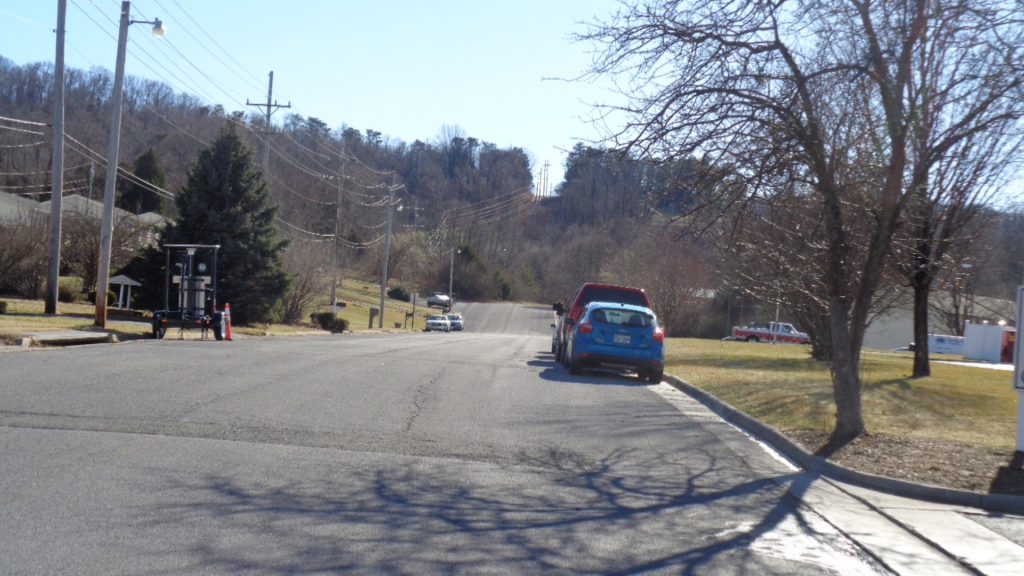
Three shots of the gifted-ungifted workforce housing parcel – the first is up dead-end Royal Lane toward the parcel; then parcel boundary markers at the edge of the day care center parking lot at the end of Royal Lane and about 10 feet past those boundary markers. It appears no site work has yet been done – UNLESS that is a very expensive brush-clearing project in the bottom photo.


“But we were not given the information that there was a HUGE contingency on that donation and there was a huge chance that property was going to be reverted back to the property owners. And the EDA board has stated in writing that they were under no obligation to tell the town council that.
“And I for one do NOT accept that – that we are going to be asked to vote on something and not given pertinent information that would help us make a well-informed decision.”
Egger said that assuring council has ALL the relevant information impacting decisions on projects inside the town limits that impact town citizens was the reason she would continue to pursue the matter until she believes her questions, the questions of her constituents were answered. She pointed out to her colleagues that to the best of her recollection, all citizen comment council heard prior to its vote had been AGAINST approval of the special use exceptions the EDA had requested, particularly related to traffic and public safety concerns.
Egger then offered to include any of her colleagues interested in answers to specific workforce housing questions, in her next e-mail query to the EDA. The responding silence was deafening, other than Councilman Meza’s acknowledgement there might be relevant issues of exploration by council related to all it had approved in the special use permitting exception granted to the EDA in November.
Appendix
On May 8, Egger requested answers from the EDA to the following questions by May 19:
- Who put the $445,000 price on the now-voided gifted deed of transfer?
- A timeline on all permitting for the project, particularly now that fingers have apparently been pointed the town’s way for the failure to meet the March 1, 2017 deadline;
- Why there was a confidential agreement between the EDA and the Campbells on the land transfer?
- An itemization of how the EDA has already spent $500,000 on the project, leading to the decision to proceed with a purchase of the property;
- Public disclosure of all familial relationships between anyone involved in the transaction;
- And finally, appraisal prices on the Afton Inn and old Stokes Mart/B&G Goods building the EDA is also involved in managing or marketing.
* Footnote
EDA’s are quasi-governmental institutions created by municipalities to oversee economic development in their communities. In Front Royal and Warren County’s case, both municipalities were involved in the creation of what eventually became known as the Front Royal-Warren County Economic Development Authority (originally Industrial Development Authority). Both funded that entity with annual operational budgets and a share of debt service payments. While both the town and county still support EDA debt service payments in their annual budgets, the County took over the Town’s operational funding several years ago as part of the ongoing 522 Corridor Agreement negotiations compensating the Town for its extension of central water-sewer into the county’s northside industrial-commercial corridor. Much of that budget assumption compensation by the County involved taking on funding responsibility for things town citizens were being double taxed for as both citizens of the county and town. The 66%-34% “Fair Funding” formula of shared County-Town expense on EDA or related matters was also developed, at least in part, to address the fact town citizens are also county citizens.




Mayor Lori Athey Cockrell Looks to Water, Economic Development and Rail Trail in Another Term

WCHS vs. Brentsville HS – Girls Volleyball – October 6, 2026

BMI Is Only One Piece of the Health Picture

The Eye Surgery Factory That Could Not Expand

Ancient Ownership of Israel

VDOT: Warren County Traffic Alert for October 5 – 9, 2026

Reaching Out Now Expands Programs and Opportunities for Warren County Youth

Dance and Arts VA Finds New Home, New Opportunities on Water Street

Ann L. Shuman (1933 – 2026)

Wendy Lee Whitacre-Stout (1966 – 2026)

Spanberger’s Energy Plan Keys in on Clean Energy to Meet Growing Demand and VCEA Goals

Jean Elizabeth Grubbs Fogle (1939 – 2026)

Feds Provide Guidance on New Federal K-12 Scholarship Tax Credit Program

Why Wait Till November? Mid-Term Election Early Voting Processes in Place Now

US Senate Leaves Nation’s Capital in Advance of Midterms With Much Still Undone

Business Growth Series: If You Don’t Control Your Day, It Controls Your Business

The End of a 20-Year Monopoly on the Credit Score
Voltron and Immigration

States OK Solar Panels for Balconies. Safety Guidelines Haven’t Caught Up

Trump TV Ads Paid for with $20M in Homeland Security Funds, Dems Find

Blue Ridge Wildlife Center Patient of the Week: Gray Treefrog

Birthday Twins: See Which Famous Face Shares Your Big Day

Meet-and-Greet Set Sunday for Republican-Endorsed Front Royal Candidates

Barbara Ann Mathews Smelser (1943 – 2026)
