
EDA in Focus
BAR delays vote on Afton Inn demolition to September 12
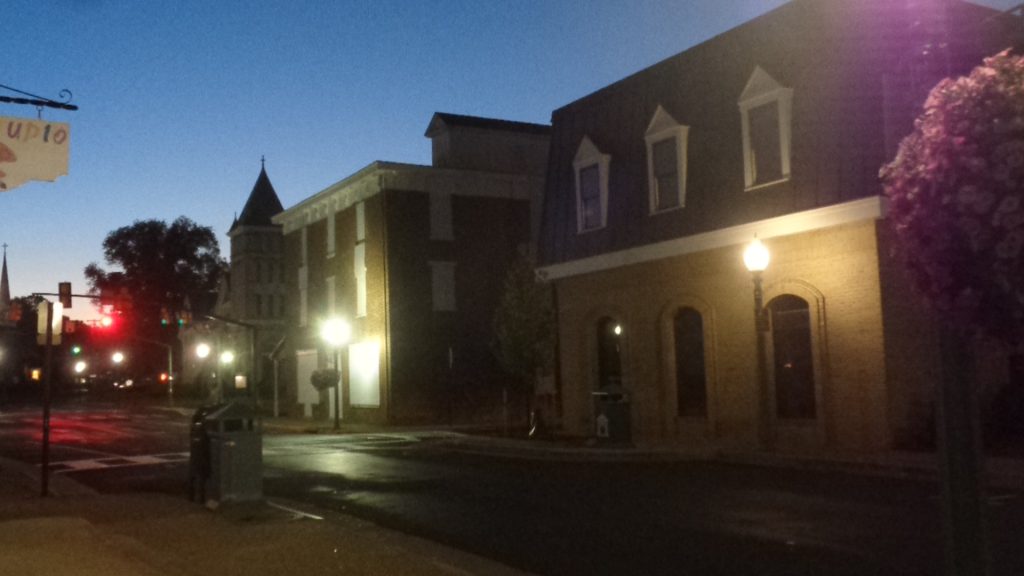
It may not be the midnight oil burning, but a decision with long-term ramifications for Front Royal’s downtown business district is burning toward resolution under the glow of street lights in front of the Afton Inn and Front Royal’s Town Hall. Pho-tos/Roger Bianchini
Following a public hearing Tuesday, August 22, at which 14 people spoke in front of a packed Town Hall second floor conference room, the Front Royal Board of Architectural Review (BAR) delayed a vote on approval or rejection of a plan to demolish the Afton Inn. BAR Chair Angela Toler’s motion to delay action to the board’s next meeting on September 12, seconded by Nancy LeHew Krogsund, passed unanimously.
The motion to delay a vote came after Toler initiated a brief discussion of adjourning to closed session to consider the architectural review board’s course of action. Several current and former public officials present challenged the legality of such a move. It was a challenge that press row would have joined had the BAR attempted to go into what would have clearly been an illegal closed session were discussion of the Afton Inn demolition and the public hearing input been the topic.
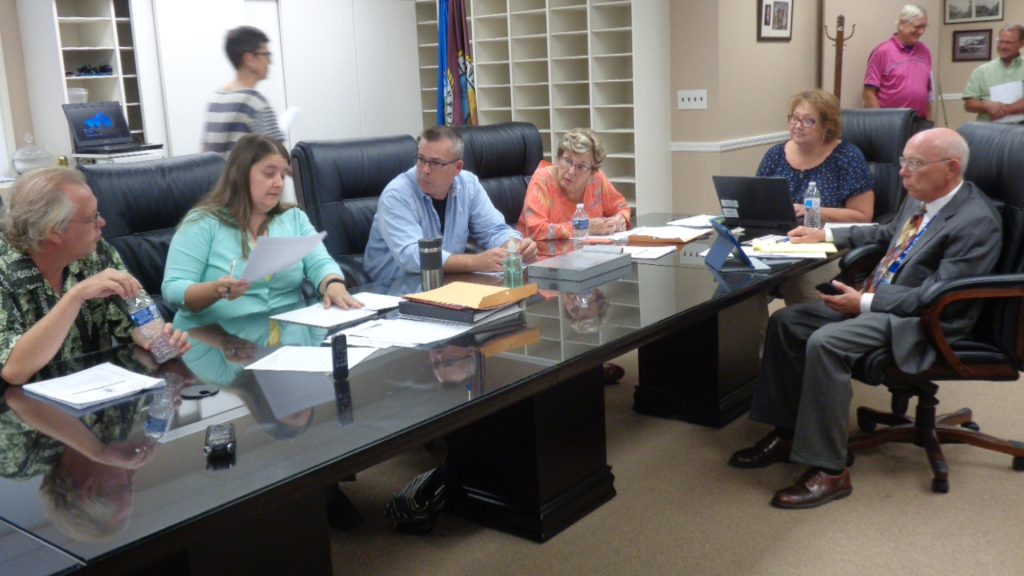
Maybe that wasn’t such a good idea, BAR Chair Angela Toler may be thinking of post public hearing closed session suggestion.
The request to demolish the 149-year-old building opened in 1868 as the Montview Hotel was submitted by the Front Royal-Warren County Economic Development Authority on behalf of the Northern Virginia-based MODE Development Partnership. Demolition is phase one of a two-phased demolition and rebuild plan. Architectural drawings submitted by the MODE group present an exterior design based on the appearance of the Afton Inn after its elaborate porch system was lost in the early 1900s.
That design plan led to the testiest exchange of the public hearing. Former EDA Board member and chairman Rick Novak, whose Royal Cinemas practically lies in the shadow of the long derelict Afton Inn, challenged BAR member Joan E. Harding on previous work session comments concerning saving the derelict structure and the submitted drawing of a replacement building.
“You’re laughing,” Novak challenged Harding directly on assertions about ways to achieve renovation of the crumbling Afton shell. Novak also read from the BAR’s charter of its role “to improve the downtown … to stabilize and improve property values – You’re a little late to the party on this one,” he told the board.
Harding shot back to Novak’s challenge of her renovation claims, asserting she could back them up.
Noting Harding’s reference to the MODE exterior drawing of its replacement building as “a modern box” she found distasteful, Novak pointed out that drawing was based directly on the old box crumbling directly across Crescent Street from Town Hall. “What is so warm and fuzzy about that building?” Novak asked, adding that since its porch structure disappeared “It is not so attractive a building – what is the treasure of the Afton Inn?”

Nostalgia versus reality – Rick Novak displays history and present of the Afton Inn. Photo/Royal Examiner
And that was the crux of the dueling perspectives expressed for and against demolition on August 22 – nostalgia versus the reality of the present.
Earlier in his remarks Novak wondered at earlier proponents of renovation’s claims of affordable ways it could be achieved – “Where have you been?” he asked of those claiming there are untapped ways to make renovation affordable, as one said “I think for less money than demolition.”
Former Mayor Tim Darr and former Councilman Bret Hrbek both spoke in favor of the MODE plan to demolish and rebuild. Both were in office three years ago when council decided to swap the just-abandoned old Town Hall for the Afton Inn. They noted the hopes for renovation aggressively pursued by the EDA on behalf of the town government over the past three years, to no avail.
Hrbek called the building an eyesore that has been an embarrassment to the town for decades. He asked the BAR to look at new economic development in Blacksburg achieved through redevelopment rather than renovation of aging structures.
“It time to let go of the old and to move forward with the new,” Hrbek said. He warned the BAR that if this redevelopment opportunity was driven away with unrealizable dreams of renovation efforts and money suddenly appearing like a genie out of a bottle after three years of unsuccessful searching for that genie, “That building is an eyesore that will sit there in perpetuity.”

The winter of someone’s discontent – whatever happens to the Afton Inn, it will be hard to miss from Town Hall across Crescent Street.
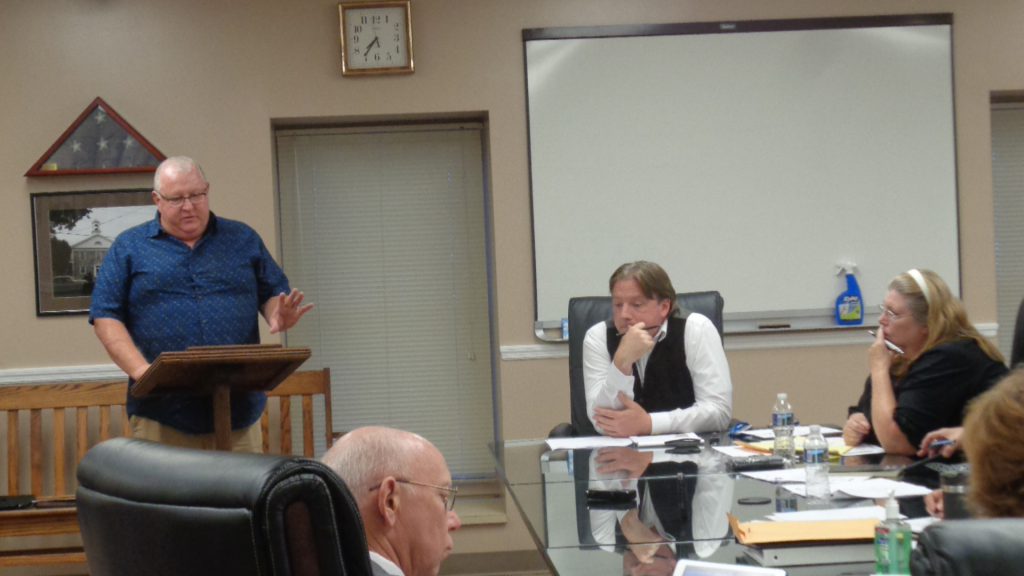
Retired Mayor Tim Darr presented two possible scenarios for the Afton Inn’s future.
Darr said there were two realistic options for the Afton Inn, to allow it to be “torn down” to facilitate the kind of sympathetic design redevelopment as is now on the table; or have the EDA hand the building back over to the Town to supervise its renovation as a municipal and community project – “and that will cost town taxpayers money,” and lots of it the retired mayor warned.
“I agree with Rick (Novak),” Darr said, “We have gone through every avenue” to try and achieve the finances to redevelop through renovation. He even said that he had hoped to ask the late artist Patricia Windrow before her death to paint the boarded up windows “to try and make it look a little better.”
Following Darr to the podium, Dean Corwin was brief and to the point. Corwin said he was born here in 1944 and remembered the Afton Inn becoming an eyesore at the town’s primary downtown intersection as early as the 1960s. He wondered at the percentage of the building’s life as a local historic treasure versus a dilapidated eyesore, stating, “It needs to come down, it’s past time.”
Following Corwin’s comments, the tally was six in favor of demolition; four against and one with a mixed perspective. However, two developers, Curtis Siever and Mike Revell, who noted they were not currently local residents or businessmen, but apparently now Winchester-based, went back to back against demolition, indicating a preference the building be saved. They claimed renovation of old structures was an important part of Winchester’s downtown revitalization.
That took the tally to 6-6, with one “tweener” who said they could go either way, when another former mayor AND councilman, Stan Brooks, arrived late but in time to become the final speaker. But rather than break the tie, Brooks added a second “tweener” vote “as long as something gets done.”
Brooks opened by saying he understood the impulse to save what now may be the Town’s oldest downtown building. However, he added that as a developer he had looked into trying to purchase and redevelop the Afton Inn but had not been able to find a way to make it achievable financially.
“There are a lot of challenges with this building, he observed.
Brooks suggested that the town government and EDA look into acquiring the entire block on which the Afton Inn stands, along with the old Comcast/Xfinity building and the still-Duncan family owned brick apartment and first-floor barber shop building facing the first block of North Royal Avenue. That he reasoned, would give leverage for a truly major redevelopment project at the head of the Town’s Historic Downtown Business District.
Present but not speaking were Mayor Hollis Tharpe and Councilman William Sealock, EDA Executive Director Jennifer McDonald, MODE architect Jim Burton, Warren Heritage Society Director Patrick Farris, among others.
Other speakers included past failed renovation proposal partner Shelley Cook (against demo); East Main Street’s C&C Frozen Treats owner William Tuck (for demo); Joe Andrews (against); downtown businessman Craig Laird (for); June Reinhardt (against, unless every renovation avenue is documented to have been exhausted, so almost a third “tweener”); and Rockland resident Mary Ryan (against).
Many speakers suggested that, as had been discussed by the BAR in recent weeks, if demolition is approved assurances such as a performance bond or contracts be in place to assure that first, the demolition is completed; and then that the redevelopment project follows as planned.

Above, the Afton Inn circa early 1940s; below MODE drawing of a stucco-based rebuild.

So the clock ticks toward a decision some three weeks away with HUGE ramifications for the Town of Front Royal’s goal of major downtown revitalization. And the question “will demolition provide a catalyst for that economic renewal or doom it to failure?” looms heavy on the minds of five people appointed to be overseers of both the town’s past and its future.
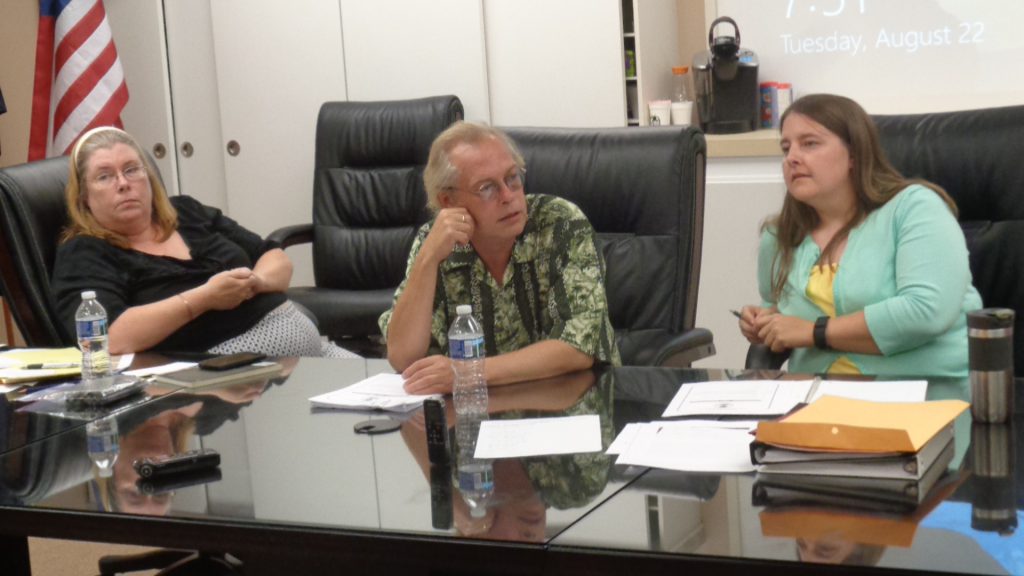
Along with his colleagues to left Joan Harding and right Angela Toler, BAR member Duane Vaughan ponders what he has heard.
Perhaps as board member Duane Vaughan said on August 8 as the BAR reviewed Town Planning Director Jeremy Camp’s “Demolition Review Guidelines” – “Question number one is all that really matters.”
That question under the heading “Contribution to the Historic District” – “Is the building not identified as a contributing structure?”
If the answer is “NO” the building “IS a candidate for demolition” without further scrutiny.

Blue Ridge Wildlife Center Acknowledges a Quarter of a Century of Work in Wildlife Preservation & Human Education

What Does A ‘Fair Share’ Really Mean?

South Warren Ruritan Club Hosts 20th Annual Spaghetti Dinner Fuels Scholarships for Local Teens

Trees Take Root as Virginia’s Frontline Defense Against Urban Heat

Virginia Set to Rejoin RGGI as Utilities Prepare to Pass the Cost Back to Ratepayers

Virginia Joins Multi-State Lawsuit Challenging Trump’s Election Order

Trump Budget Seeks 43% Boost in Defense Spending, Cuts in Many Domestic Programs

Virginia Sees 33,000 ACA Enrollment Drop Since Subsidies Expired, More Likely on the Way

Annual Dental Checkups and Cleanings: Essential Appointments

4 Stimulating Activities for a Healthy Brain After 50
The First Amendment: America’s Unique Foundation of Freedom

How to Tackle Credit Card Debt

Summer Enrichment Camp Gives Teens Hands-On Learning Opportunities

VDOT: Warren County Traffic Alert for April 6 – 10, 2026

David Silek to Remain in Chairman’s Seat of WC Republican Committee Pending 6th District Appeal Decision

Sales Set to Bloom Like Daffodils This Spring

America 250: The Bookseller Who Helped Save the Revolution

Business Growth Series: Why Good Businesses Still Struggle to Grow

Brownies with Mini Chocolate Easter Eggs

Shenandoah Downs Opens 11th Season April 11 with Tribute to Roger Hammer

We Don’t Know Everything About DNA

How PAAS Came to Dominate the Easter Egg Dye Tradition

Spanberger Signs Bipartisan School-Safety, Student Support Bills Into Law

Melanie J. Pomeroy (1958 – 2026)
