
Local News
Blue Ridge Heritage Project cuts ribbon on chimney memorial
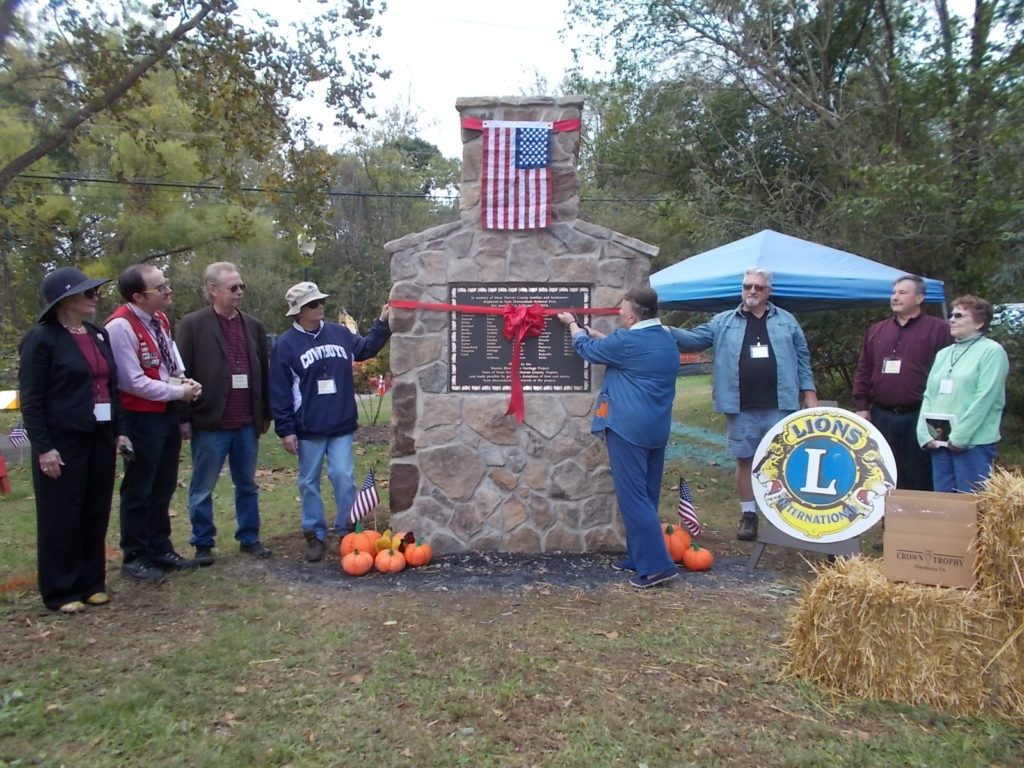
As fellow county project committee members look on, descendant Margie Hockman (Griffith) does the ribbon-cutting honors – from left, Suzanne Silek (Silman-Pomeroy-Beaty), Daryl Funk (Corbin), Duane Vaughan (Silman-Pomeroy-Beaty), Cheryl Fox-Wyrick (Fox), Hockman, Jim Guy (Griffith), Thomas Lockhart (Lockhart, Overall) and Patricia Brinklow (Fox). Photos/Roger Bianchini
Over 100 people gathered Saturday afternoon, October 13, 2018, for the ceremonial ribbon cutting of the Blue Ridge Heritage Project memorial stone chimney. With completion of phase one of a three-phased memorial project Front Royal and Warren County became the seventh of the eight communities to erect the characteristic stone chimney monument – only Augusta County remains to establish its chimney monument.

The memorial plaque at the center of the chimney monument
The Blue Ridge Heritage Project was established to commemorate the sacrifice of an estimated 500 mountain families displaced in the 1930’s to facilitate creation of Shenandoah National Park.
Many of those present were descendants of one or more of the 68 family names emblazoned on a plaque in the center of the stone chimney monument central to the Blue Ridge Heritage Project theme of remembrance of the upheaval and sometimes involuntary sacrifice of those mountain families of the 1930’s.
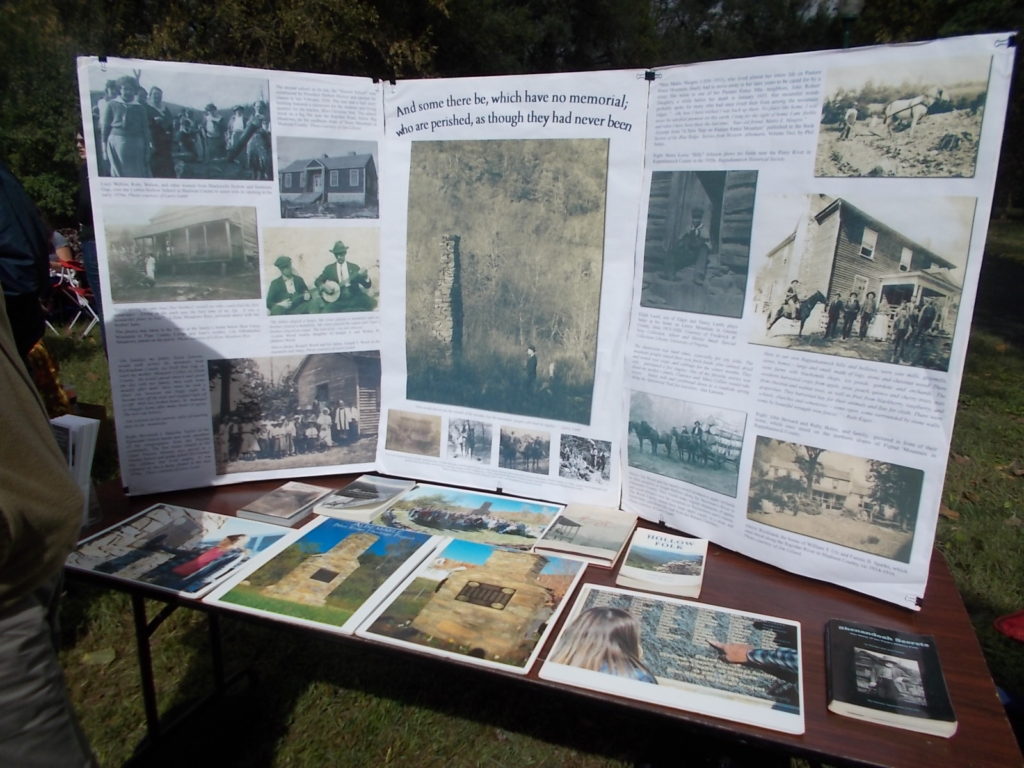
A Blue Ridge Heritage Project display table featuring the words “And some there be, which have no memorial; who are perished as though they had never been” – words no longer true for those displaced by the creation of an eastern national park.

Some Silman-Pomeroy-Beaty and Marlow descendants await the ribbon cutting.
While the ribbon cutting ceremony went from 1 p.m. to 2 p.m., informational displays, including a Shenandoah National Park table and refreshments were available from 10 a.m. to 3 p.m. Saturday. The event provided a cross-town juxtaposition to Front Royal’s annual Festival of Leaves celebration of the onset of the fall tourist season held in Front Royal’s Historic Downtown Business District.
The memorial site is along the town walking trail at Happy Creek near Criser Road and the nearing-completion Criser Road Bridge project, just east of Burrell Brooks Park on the town’s south side. The Town of Front Royal donated the land for the memorial and Mayor Hollis Tharpe was present to help celebrate the ribbon cutting.

Storm clouds were prevalent as Front Royal Mayor Hollis Tharpe spoke, though the sun prevailed and rains abated for the ceremony – and for the nearby Festival of Leaves.
As noted by local project committee Chairman Darryl Merchant, phase two of the project will add a 16 x 22-foot concrete patio and phase three, two benches, a flagpole and informational kiosk.
Pointing to the outline of the planned patio area marked out toward the crowd from the chimney memorial, Merchant noted that many of the old family homesteads began with cabins no larger than the planned patio and sitting area. Also a descendant, Merchant acknowledged a hurtful and negative pseudo-science stereotyping utilized to justify removal of mountain families from their homesteads.
As Merchant has pointed out periodically over the three-year run up to the day’s events, those with legal title to their land were the lucky ones, receiving either valley land or financial compensation for their property. Those who rented or were unable to provide legal title to the land they had settled received no such compensation and were largely left to fend for themselves, some after seeing their homes burned to assure their departure.
The bottom line assessment of the process, a process that stretched from 1924 to 1938, was: “The FORCED RESETTLEMENT represents a classic case of bureaucratic ineptitude.” See a history of the process involving local, state and federal officials, as well as members of the private sector, toward the end of this linked story. See Related Story
Project organizers have pointed to the park service’s embracement of the goal of shedding light on a previously ignored, yet fundamentally important part of the Shenandoah National Park story. In fact, the park service had a display table at Saturday’s event.

‘What kind of varmint this be?’ one child at the Shenandoah National Park table might have been wondering in old-school speak, more or less…
It is to acknowledge the lifestyle, culture, rugged individualism and self-reliance of those mountain people that the Blue Ridge Heritage Project was established. Merchant introduced project founder Bill Henry of Greene County.
The Blue Ridge Heritage Project is a non-profit, 501-c 3 founded by Henry. The project’s organizational literature states its purpose: “To establish a memorial site in each of the eight counties where land was acquired for Shenandoah National Park (Albermarle, Augusta, Greene, Madison, Page, Rappahannock, Rockingham and Warren) to acknowledge the sacrifice of involved families in those communities.
“In order to recognize their contributions and their losses, each site will contain a memorial to the people from that county whose land was acquired for the park. Through educational displays, cultural displays and demonstrations the project hopes to accurately depict the people’s lives and to help preserve their lifestyle, crafts, music, and traditions,” project literature states.
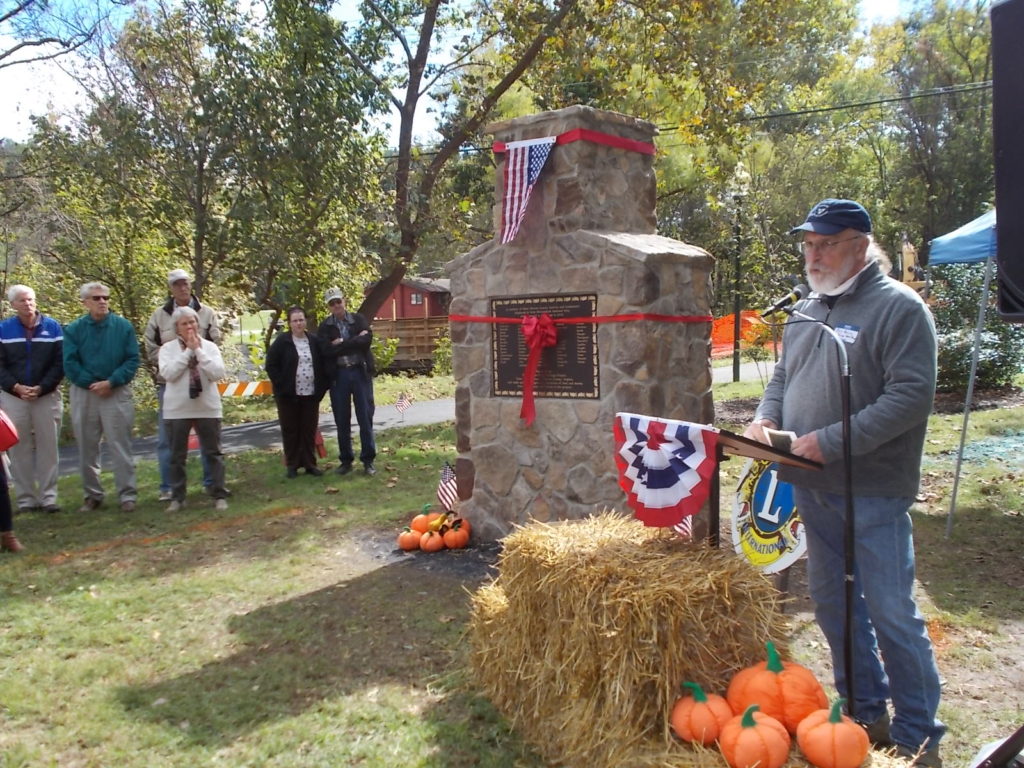
Bill Henry of Greene County founded and propelled the Blue Ridge Heritage Project forward through all eight counties impacted by the creation of Shenandoah National Park.
“The ultimate goal, as of the broad study of history itself, is to give visitors to this particular series of memorials a greater appreciation for the impact the park had on individual lives in general and for that particular community. – Altogether, the eight sites will create an understanding of life in the Blue Ridge Mountains.”
Merchant, Henry, Lion’s Club member Darryl Funk and Front Royal Mayor Tharpe addressed the crowd Saturday in celebration of those 68 county families whose names will join the estimated total of 500 families in those eight counties whose land was taken for what was seen as a greater national good. That good was creation of a national park designed to preserve a slice of the natural beauty of the eastern United States for generations to come, as had been previously done in the western portion of the country.

More faces of the displaced
Eighty years later Shenandoah National Park continues to stand as an important tourism and economic-engine for the region. And now those uprooted to create what has become a worldwide tourist attraction will be remembered for their sacrifice in facilitating that creation.
Total cost of all three phases is estimated at $25,000, with phase one priced at $12,000, including $9,000 for the stone chimney and $3,000 for the bronze plaque bearing the displaced family names. Merchant acknowledged stonemason Richard Morris, present in the crowd, for his work in constructing the chimney memorial.
As reported last week, almost $13,000 has been raised to fund the project. And Saturday there was some playful one-upsmanship between local civic groups in keeping that fundraising going. Addressing the crowd, descendant and Lion’s Club member Daryl Funk noted that the Lion’s Club had donated the first $500 to the project and not to be outdone by the Front Royal Rotary Club, presented a check for another $2,000 prior to the ribbon cutting.
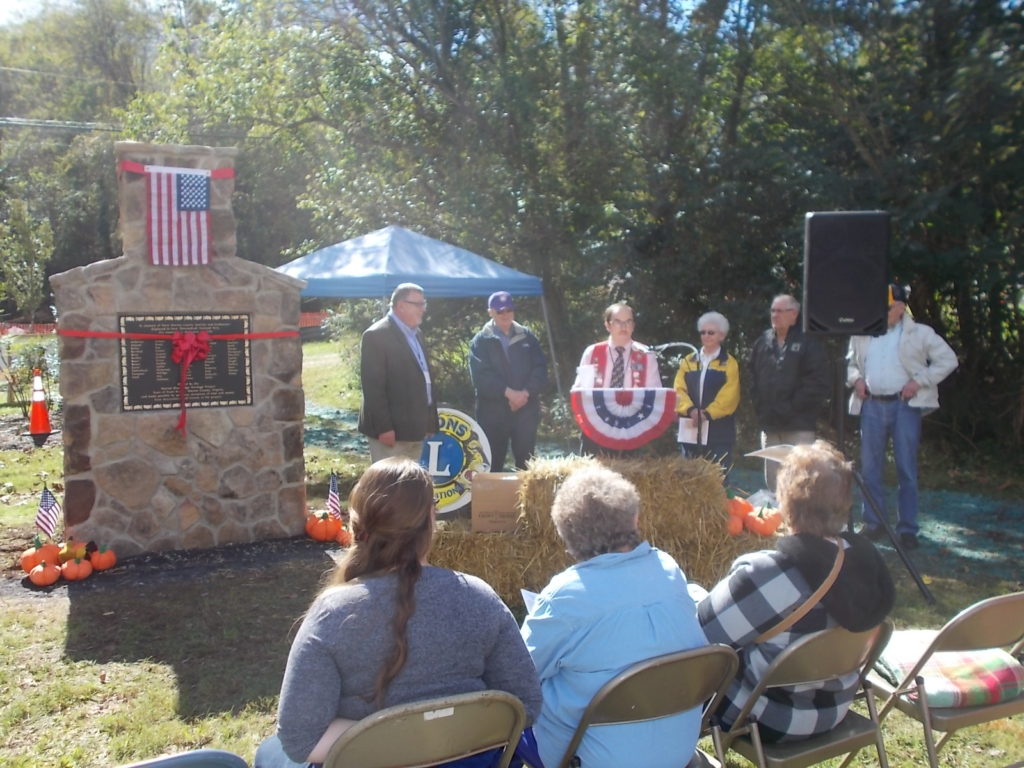
With Daryl Funk at the microphone, the Lions Club meets the challenge with a $2,000 donation to help keep phases two and three of the Blue Ridge Heritage Memorial project going.
Donations can be mailed to the: Warren Blue Ridge Heritage Project, PO Box 1508, Front Royal, Va. 22630. Online, one can access additional information, including on fundraising and project assistance, at either the Blue Ridge Heritage Project Facebook page or website – www.blueridgeheritageproject.com – click the “Warren County” tab – and a new local Facebook page, the “Front Royal Warren County Blue Ridge Heritage Project”. County project Chairman Merchant may also be reached at (540) 683-6878.

Committee Chair Darryl Merchant traces the 94-year history leading to this moment of remembrance of Warren County families displaced for the creation of Shenandoah National Park.

A young park fan examines a plastic national park display designed to help develop the ability to identify what animals might be in the area while you are hiking the park.
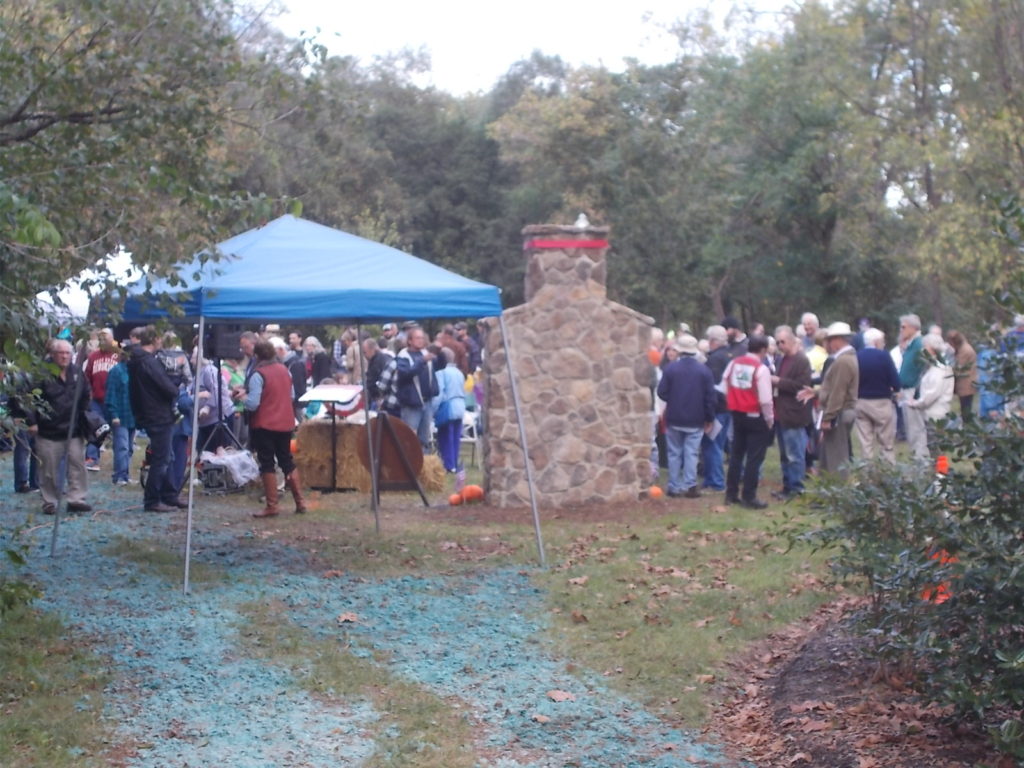
The crowd of descendants and observers mingle following the monument ribbon cutting

Business Growth Series: Why Good Businesses Still Struggle to Grow

Brownies with Mini Chocolate Easter Eggs

Shenandoah Downs Opens 11th Season April 11 with Tribute to Roger Hammer

We Don’t Know Everything About DNA

How PAAS Came to Dominate the Easter Egg Dye Tradition

Spanberger Signs Bipartisan School-Safety, Student Support Bills Into Law

Melanie J. Pomeroy (1958 – 2026)

David Benjamin Heller (1990 – 2026)

1776 Wasn’t Just About Independence

Three-Tiered System for Urban Agriculture Based on Lot Size Takes Shape at Town Planning Commission Work Session

Child Abuse Awareness Month Brings Focus to Reporting, Prevention in Warren County

National Dental Hygienists Week: Is Your Oral Care Routine Optimal?

The Coin That Traveled Through Time and Space

One “What If?” Question Is Changing the Future of Farming

AA Speaker to Explain Recovery Program at United Methodist Men’s Dinner
Jeannette M. Hyland (1944 – 2026)

Allen William Derflinger II (1959 – 2026)

Warehouse Clerk: A High-Demand Job—Even With Robots

FDA Cracking Down on Compounded GLP-1 Drugs

“Christmas in April” or Overspending? Budget Draws Criticism

Court Ruling Voids Prince William Data Center Rezoning, Raising Stakes for Local Debate

Spanberger Signs First Bills Targeting Healthcare, Housing and Energy Costs

Blue Ridge Singers Spring Concerts to Showcase Powerful Blend of Voices and Brass
What Counts as “Good Policy” Depends on Who’s in Power
