
Local News
Blue Ridge Wildlife Center Patient of the Week: Bald Eagle
How can you help Bald Eagles? Switch your ammunition!
This immature bald eagle was brought to us after it was found down on the side of the road unable to stand or fly. Thanks to the Good Samaritans who spotted it, it was brought to our Center for evaluation and treatment.
On exam, there were no physical injuries found, but the bird was unable to stand and appeared disoriented. Due to lack of any other indications of trauma, we suspected lead poisoning. Our suspicions were confirmed by laboratory diagnostics which showed extremely toxic lead levels.
Unfortunately, over 80% of our eagle patients come in with elevated lead levels.
How do they get lead poisoning? You may be surprised to learn that Bald Eagles not only hunt for their food, but they also scavenge and eat carrion (dead animals). In Virginia, the most commonly used ammunition by deer hunters is lead bullets. After a successful kill, many hunters will field dress the deer (remove the internal organs) in the woods and leave gut piles behind. Lead fragments can travel up to 18” from the bullet wound and into the gut pile. Scavengers, like eagles, eat these gut piles and a piece of lead as small as a grain of rice can kill an adult Bald Eagle.
If the lead poisoning alone doesn’t kill the eagle, the effects (incoordination, altered mental status) make it more likely that they will be victims of vehicle or wall collisions and other trauma.
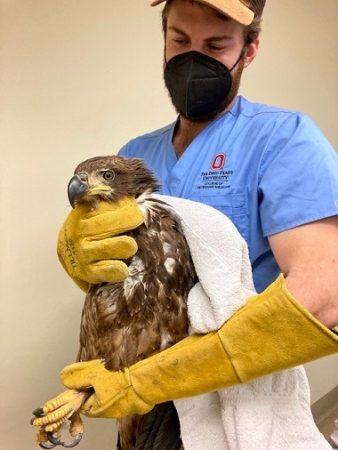
One of our current veterinary students, Charlie, of The Ohio State University College of Veterinary Medicine, is holding this eagle so that we can administer its lead-chelating medication and subcutaneous fluids.
What every hunting family should know:
Lead fragments also end up in the meat that is used for human consumption, and the fragments are so small that they can’t be seen.
We receive donations of venison from hunters each year to offset some of our food costs. We have the ability to radiograph all donated meat prior to feeding out and sadly, a large portion of this meat is contaminated and has to be thrown out.
Our patients are not the only recipients of venison donations. Lead contamination in meat donated to food banks (which is critically important, especially in COVID times) has caused issues for recipients. Many of these recipients are children or pregnant women, two of the most at-risk groups.
This pamphlet by the Michigan Department of Health & Human Services has great information about lead ammunition health risks and safer alternatives.
No level of lead is safe for humans or animals. Now is the time to make the switch to non-toxic ammunition!

The Hidden Risks of House Hunting Solely Online

Choosing the Right Cleaner for Every Surface in Your Home

New Church Among Consent Items at County Planning Commission Meeting

Warren County GOP Mass Meeting Results Challenged After Allegations of Voting Irregularities

‘This Is About Equity’: In Richmond, Virginia Workers, Lawmakers Push for Inclusive Labor Rights for All

After Five Years of Attempts, Virginia On Track to Set Up a Prescription Drug Affordability Board

New Drug Take-Back Box at Warren County Sheriff’s Office Offers Safe Way to Dispose of Medications

‘Feeding Our Neighbors’ Continues Local Effort to Provide Free Meals in Front Royal

Blair David Eller (1963 – 2026)

Writing Workshop at Samuels Public Library Aims to Help Community Communicate More Clearly

Simple Steps to Reduce Wildfire Risk Around Your Home

Lyme Disease Cases Continue to Rise as Tick Season Returns

County Receives 5 More FY-27 Budget Overviews Prior to Closed Meeting on Administrator Search & Business Expansion

Belle Grove Opens March 21 With First Public Viewing of Memorial Quilts Honoring Enslaved Individuals

Iran At a Crossroads: Democracy, Monarchy, and the Lessons of the 1950s

Federal Judge Upholds Ruling That Certain Ex-Felons Should Not Automatically Lose Voting Rights

Virginia Lawmakers Explore Autonomous Technology for Transportation

Misconceptions About Multiple Sclerosis

Five Reasons to Consider a Career in the Community Sector

Frederick County Cattle Carrier Crash – Animals Still Reported At Large

‘Grow Up’: Former Republican Delegate Defends Civil-Rights-Themed Mailers in Redistricting Fight

Virginia One Step Closer to Probation Reform With Bills Headed for Spanberger’s Desk

Merit Versus Reality: Town Council Weighs Priorities Against Finance

Blue Ridge Wildlife Center Patient of the Week: American Beaver
