
Local News
Blue Ridge Wildlife Center Patient of the Week: Wood Frog

BRWC Patient 24-128 recovering from surgery. @BRWC 2024
Despite it still being winter, warm days tend to bring brumating (similar to hibernation) amphibians and reptiles to the surface. In this Wood Frog’s case, they were roused by the warm weather and then, sadly, attacked by a domestic cat.
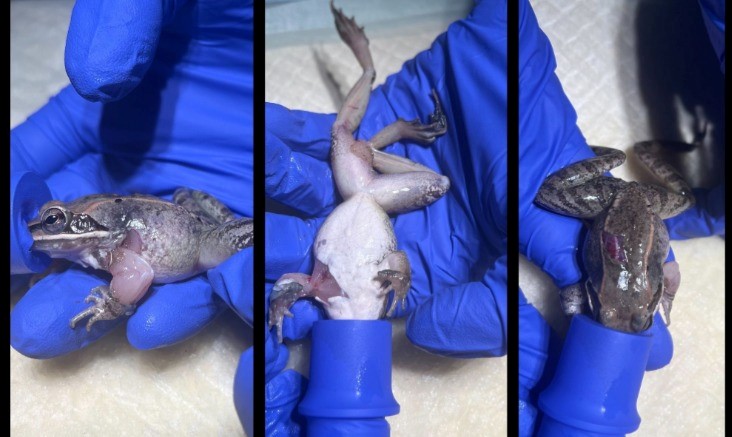
BRWC Patient 24-128 pre-surgery. @BRWC 2024
Upon admission, the patient was cold and lethargic with several lacerations. The frog also had several degloving (skin partially or completely ripped from muscle and connecting tissue) wounds and muscle tears on the left hind limb.
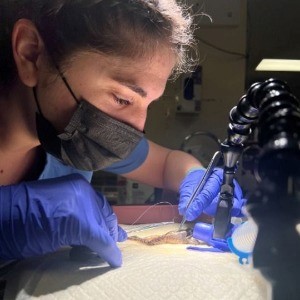
BRWC Patient 24-128 surgery. @BRWC 2024
As the frog was in stable condition, staff quickly anesthetized to flush and close the lacerations.
Amphibian skin is an important player in oxygen exchange, so during surgery, in addition to working on a tiny patient, our hospital team had to also make sure to keep the the patient moist.
We expect this patient’s forearm skin to heal well in the next few weeks. However, the hind limb has a large muscle tear that will take much longer to heal.
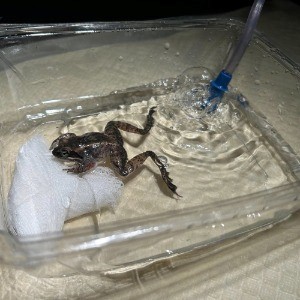
BRWC Patient 24-128 recovering from surgery. @BRWC 2024
After surgery, the patient recovered in shallow, filtered water aerated by our oxygen concentrator and received long lasting pain medications and antibiotics.
Although prognosis is guarded due to the severity of the wounds, the patient is currently active in their enclosure.
We hope this frog is ready to go on May 1st, the first day of the year that we can begin releasing overwintering reptile and amphibian patients!
Wood frogs are some of the earliest frogs we hear calling in Virginia, beginning in January. They have an incredible ability to survive winter temperatures by literally freezing! They stop vital functions (like breathing and circulation) while up to 70% of their body water becomes ice. During this time, blood glucose protects the cells from fully freezing despite sub-zero temperatures.
Domestic cats are huge threats to native wildlife, killing between 86 and 320 million amphibians each year in the United States (in addition to billions of birds and mammals and millions of reptiles). Please keep pet cats indoors or safe in “catios.” Monitor other domestic animals including dogs, horses, poultry, and other livestock. It is our job as responsible pet owners to monitor our pets and protect native wildlife!
Looking for an easy way to help native wildlife? Become a monthly BRWC donor! For as little as $5/month, you can provide year-round, sustainable support that helps us fulfill our mission.

The Hidden Risks of House Hunting Solely Online

Choosing the Right Cleaner for Every Surface in Your Home

New Church Among Consent Items at County Planning Commission Meeting

Warren County GOP Mass Meeting Results Challenged After Allegations of Voting Irregularities

‘This Is About Equity’: In Richmond, Virginia Workers, Lawmakers Push for Inclusive Labor Rights for All

After Five Years of Attempts, Virginia On Track to Set Up a Prescription Drug Affordability Board

New Drug Take-Back Box at Warren County Sheriff’s Office Offers Safe Way to Dispose of Medications

‘Feeding Our Neighbors’ Continues Local Effort to Provide Free Meals in Front Royal

Blair David Eller (1963 – 2026)

Writing Workshop at Samuels Public Library Aims to Help Community Communicate More Clearly

Simple Steps to Reduce Wildfire Risk Around Your Home

Lyme Disease Cases Continue to Rise as Tick Season Returns

County Receives 5 More FY-27 Budget Overviews Prior to Closed Meeting on Administrator Search & Business Expansion

Belle Grove Opens March 21 With First Public Viewing of Memorial Quilts Honoring Enslaved Individuals

Iran At a Crossroads: Democracy, Monarchy, and the Lessons of the 1950s

Federal Judge Upholds Ruling That Certain Ex-Felons Should Not Automatically Lose Voting Rights

Virginia Lawmakers Explore Autonomous Technology for Transportation

Misconceptions About Multiple Sclerosis

Five Reasons to Consider a Career in the Community Sector

Frederick County Cattle Carrier Crash – Animals Still Reported At Large

‘Grow Up’: Former Republican Delegate Defends Civil-Rights-Themed Mailers in Redistricting Fight

Virginia One Step Closer to Probation Reform With Bills Headed for Spanberger’s Desk

Merit Versus Reality: Town Council Weighs Priorities Against Finance

Blue Ridge Wildlife Center Patient of the Week: American Beaver
