
Local News
Colonel James H. Drake: The Man Who Almost Became Stephens City’s Confederate Hero
Green Hill Cemetery in Stephens City holds a piece of history that never quite came to be. Established in the 1880s, this five-acre, nondenominational cemetery was once part of the town commons, used for militia drills, and later as pasture for livestock. According to former Mayor Ray Ewing, who served from 1994 to 2010 and now acts as a Green Hill trustee, the cemetery’s original design centered around a proposed memorial for Colonel James Henry Drake, a Confederate hero from the Civil War.
Drake, a native of Stephens City (then Newtown), was intended to be reinterred at Green Hill, but plans fell through when his widow, Sarah Rosenberger, objected. Instead, Drake remains buried in the old Trinity Lutheran Church cemetery on Mulberry Street. His absence at Green Hill is marked by an empty space where a memorial and tall trees once stood. A black cast iron well water hand pump was placed there but was removed around 2000 due to concerns about soil contamination, leaving the spot vacant.
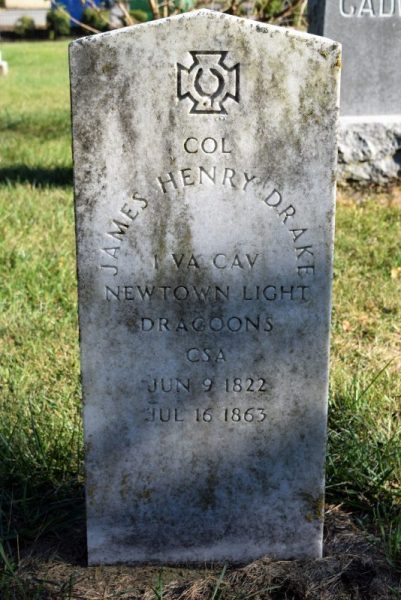
Colonel James Henry Drake’s grave marker in the old Trinity Lutheran Church Cemetery on Mulberry Street in Stephens City, Virginia. Courtesy Rick Wilde.
But who was Colonel James H. Drake, and why was he almost honored with such a prominent gravesite? Born on June 9, 1822, Drake was a plasterer, mechanic, and militia officer before the war. When the Civil War began, he joined the Confederate States of America, serving in the First Virginia Cavalry. His leadership and bravery were quickly recognized. He rose from Commissary of Company A, Newtown Light Dragoons, to Colonel by May 1863.
Drake’s military career was marked by significant battles. He fought in the Seven Days Battles, Stuart’s ride around McClellan, Gainesville, Second Bull Run, Antietam, Fredericksburg, Kelly’s Ford, Chancellorsville, and Brandy Station. He commanded the First Virginia Cavalry at the Battle of Gettysburg, which was critical in protecting General Robert E. Lee’s retreat.
Tragically, Drake was mortally wounded on July 16, 1863, during a skirmish near Kearneysville, West Virginia. He was shot in the thigh, right breast, and right shoulder. Despite his severe injuries, his men managed to retrieve him from the battlefield. He died later that night and was buried with full military honors on July 18, 1863, at Trinity Lutheran Church.
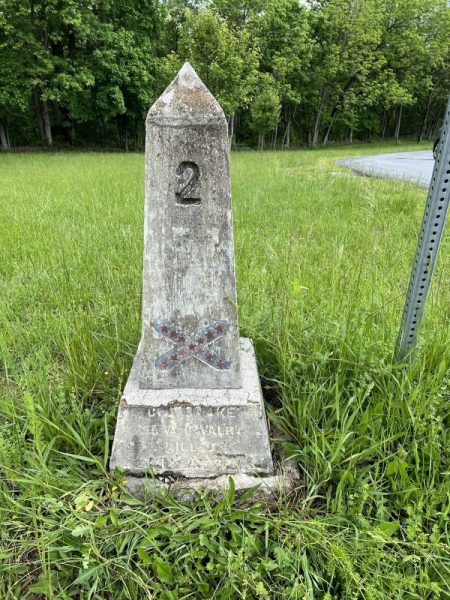
Jefferson County Camp, United Confederate Veterans Marker #2 sits a few feet off West Virginia Route 480. It commemorates Colonel James H. Drake of the 1st Virginia Cavalry, who fell mortally wounded during an engagement at Kearneysville, West Virginia. Courtesy Mark Gunderman.
Drake’s legacy lived on through his comrades’ and community’s dedication and respect. Major General J.E.B. Stuart mourned Drake’s death, noting that it deprived his regiment of a “brave and zealous leader” and the Confederacy of a “patriotic defender.” General Fitzhugh Lee praised Drake’s gallantry and devotion, emphasizing his readiness and bravery in facing danger.
The 1913 Gettysburg reunion, marking the 50th anniversary of the Battle of Gettysburg, included Colonel Drake on the roster of Virginia troops. His story was passed down through the generations, highlighting moments like when he reportedly saved young Milton Boyd Steele during the Gettysburg Campaign by keeping him away from the front lines. Steele, a wagon driver, survived the war and later enlisted with the First Virginia Cavalry.
In 1993, the Turner Ashby chapter of the United Daughters of the Confederacy (UDC) held a grave marking ceremony for Drake at the Trinity Lutheran Church Cemetery. About 100 people attended, including Drake’s great-granddaughters and local officials. The UDC provided a headstone for the grave that had been unmarked for 130 years.
Colonel Drake’s life and service left a lasting impression on Stephens City. Historian Linden “Butch” Fravel remarked that Drake is “the closest thing the town has to a Civil War hero.” Though his memorial at Green Hill Cemetery never materialized, his story remains a poignant chapter in the town’s history.
Reference: 1st Virginia Cavalry, by Robert Driver, Jr., dated 1991, published by H. E. Howard, Inc. Lynchburg, Virginia, was essential in writing this article.

Virginia Joins Multi-State Lawsuit Challenging Trump’s Election Order

Trump Budget Seeks 43% Boost in Defense Spending, Cuts in Many Domestic Programs

Virginia Sees 33,000 ACA Enrollment Drop Since Subsidies Expired, More Likely on the Way

Annual Dental Checkups and Cleanings: Essential Appointments

4 Stimulating Activities for a Healthy Brain After 50

The First Amendment: America’s Unique Foundation of Freedom

How to Tackle Credit Card Debt

Summer Enrichment Camp Gives Teens Hands-On Learning Opportunities

VDOT: Warren County Traffic Alert for April 6 – 10, 2026

David Silek to Remain in Chairman’s Seat of WC Republican Committee Pending 6th District Appeal Decision

Sales Set to Bloom Like Daffodils This Spring

America 250: The Bookseller Who Helped Save the Revolution

Business Growth Series: Why Good Businesses Still Struggle to Grow

Brownies with Mini Chocolate Easter Eggs

Shenandoah Downs Opens 11th Season April 11 with Tribute to Roger Hammer

We Don’t Know Everything About DNA

How PAAS Came to Dominate the Easter Egg Dye Tradition

Spanberger Signs Bipartisan School-Safety, Student Support Bills Into Law

Melanie J. Pomeroy (1958 – 2026)

David Benjamin Heller (1990 – 2026)
1776 Wasn’t Just About Independence

Three-Tiered System for Urban Agriculture Based on Lot Size Takes Shape at Town Planning Commission Work Session

Child Abuse Awareness Month Brings Focus to Reporting, Prevention in Warren County

National Dental Hygienists Week: Is Your Oral Care Routine Optimal?
