
Opinion
Colonial family cemeteries retain early immigrant history
Colonial Virginia churchyards were not always the first preferences for burials. The custom was to bury the dead at home. While uncommon today, family (or private) cemeteries were a matter of practicality during the colonial settlement of America. The farm itself served as the burial ground. These family graves may be found in many places in various types of communities throughout the state. If a municipal or religious cemetery had not been established, settlers would seek out a small plot of land, often in wooded areas bordering their fields, to begin a family plot. Often, two families from adjoining properties would arrange to bury their dead together. Later on, during the 18th century, pastors complained about this practice because it meant they had to travel to plantations and farms to oversee funerals. The ideal situation during the Colonial period in English colonies was to bury the dead in churchyards located in close proximity to church buildings. Churchyard burials remained standard practice into the 20th century for European Americans and other cultures in the Judeo-Christian tradition.
The Ewing clan headed by William Ewing settled in the lower Shenandoah Valley more than 280 years ago. The Ewing’s are one of Stephens City’s oldest families dating back to 1737 before Frederick County and Stephens City (formally Stephensburg) were founded. The Ewing Family Cemetery was established prior to the first local church graveyards. Living on the frontier, the very earliest Ewing settlers had no professional stone workers to hire when their loved ones died. They would either craft simple wooden markers or wooden crosses to mark recent burials. Gravestones tended to be of a lesser size and most often fashioned from softer types of stone such as limestone and slate, which were easier to quarry, cut and carve. Often times field stones and roughly carved rocks were employed with names and dates scratched onto the stone.
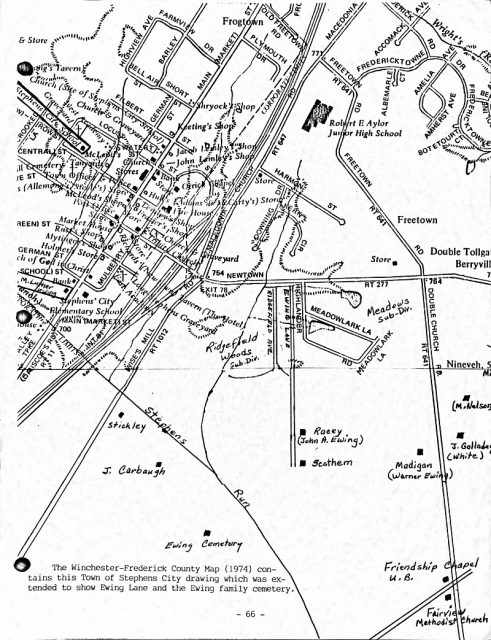
Map of Stephens City circ 1974, courtesy Ray Ewing
The cemetery property was part of the original acreage of William Ewing who acquired more than 625 acres from Josh Hite. Hite had received a grant of 100,000 acres from the Virginia governor and council in the late 1720’s with the stipulation that 100 families be settled within two years. Ewing and his descendants came and farmed their land for 175 years.
The cemetery is located within the Southern Hills housing development in Stephens City at the end of the Brandenbury Court cul-de-sac. The property was once included in the Julian Carbaugh farm. The burial plots reside high on a hill overlooking the Shenandoah Valley with beautiful views of the Blue Ridge Mountains looking east and the Alleghany Mountains to the west.
Ray Ewing was born in a house that resided on Fairfax Pike (Route 277) near the old homestead. His family later moved in the 1940s to a house on Germain Street behind the Methodist Church. “I couldn’t be prouder that my ancestors are some of the first families to migrate here,” Ray Ewing said. “Knowing that one’s ancestors have lived in a community for more than 280 years really helps you to appreciate your roots,” he said. “It’s reassuring to look along Main Street at sights in the historic old town and know that your great, great grandfather observed these very same sights.”
The Ewing Cemetery was enclosed in 1994. A 50 foot by 60 foot wire fence was erected to protect the existing headstones from cattle grazing on the then Julian Carbaugh property. A great deal of brush and several trees were removed so that the grave markers could be more readily identified. During this time a number of headstones were unearthed increasing the number of Ewing family burial stones from 9 to 16. Four stones or parts of stones are illegible and the Ewing’s have not yet been able to identify who they may have been. Town Elders cited that at one time there were 20 headstones located here.
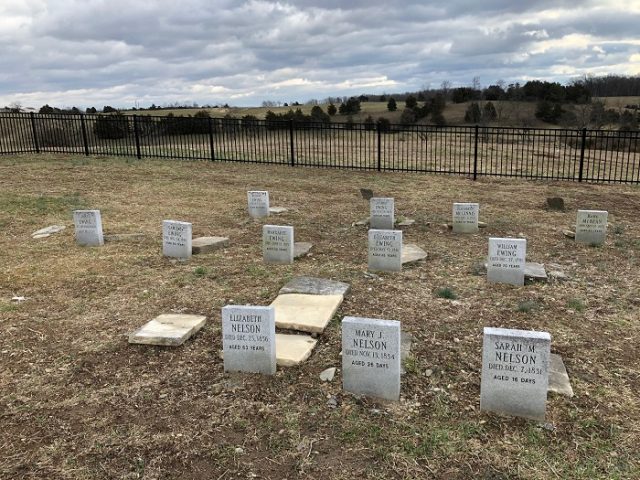
Ewing Family Cemetery, courtesy Mark Gunderman
Twelve of the old headstones which could be accurately identified were replaced with newer ones courtesy of the Ewing Family Association in advance of a September 2008 dedication ceremony. The cemetery is currently surrounded by a new metal fence and appears to benefit from regular lawn maintenance.
John Ewing born in 1648 and died 23 Sep 1745 (aged 96–97). John emigrated from Londonderry, Ireland to Pennsylvania (Chester County) with his sons William and Samuel and their families in 1729. After remaining in Chester County for some years after William and family moved south, it is fair to believe in his last years John moved down to Virginia to be closer to his sons. John is buried in the Ewing Cemetery.
William Ewing born 1711 and died 27 Dec 1781 (aged 69–70). William Ewing was born 1711 in Carnshanagh, Ireland, to John and Janet McElvaney Ewing. With his family, William came to Pennsylvania in 1729, and in April 1737, William moved down from Pennsylvania just six years after the first European American settlements began. William is the ancestor of the Stephens City Ewing’s. William is buried in the Ewing cemetery.
Samuel B. Ewing born 1719 and died 24 Aug 1798 (aged 78–79) Samuel B. Ewing married Margaret McMichael or McMeekin. They moved from Chester County, Pennsylvania to Frederick County, Virginia, and then, on to Kentucky. Samuel returned to Virginia and is buried in the Ewing Cemetery.
Margaret E. Ewing Carr born 1750 and died 18 Jun 1815 (aged 64–65). Samuel’s daughter, Margaret married her cousin Robert Ewing in 1790. Old headstone for Margaret read “Margaret Ewing died June 18, 1815, Age 62 years.” Margaret is buried in the Ewing Cemetery.
Elizabeth Tharp Ewing born 1732 and died 17 May 1816 (aged 83–84). John’s wife Elizabeth married in 1750 and was buried in the Ewing Cemetery.
Elizabeth Ewing McGinnis born March 2, 1763 and died 7 Dec 1820. Elizabeth Ewing (aged 57) was the fourth child of William and Elizabeth. Elizabeth married John McGinnis and lived near Stephens City. Old headstone read, “McGinnis died Dec 7, 1820 aged 57 years.” Elizabeth is buried in the Ewing cemetery.
Joshua Ewing born unknown and died 24 Jul 1824 (aged 26 years). Very little is known about Joshua’s life. Joshua is buried in the Ewing cemetery.
Mary Ewing McBean born March 31, 1765 and died 17 Sep 1825 (aged 60). Mary Ewing, the second daughter of William and Elizabeth Ewing, was born. Mary, called Pollie, married Mr. McBean. Old headstone read, “Mary McBean died Sept 17, 1825 Aged 60 years.” Mary McBean is buried in the Ewing cemetery.
Robert Ewing born 28 Feb 1761 and died 7 Oct 1826 (aged 65). Robert is the son of William Ewing and is buried in the Ewing cemetery.
Sarah M. Nelson born 21 Nov 1831 and died 7 Dec 1831 (aged 16 days). Old headstone for infant daughter read “Sarah M. daughter of Moses and Elizabeth Nelson died Dec. 7, 1831 aged 16 days.” Sarah is buried in the Ewing cemetery.
Mary J. Nelson born 18 Oct 1834 and died 13 Nov 1834 (aged 26 days). Old headstone for infant daughter read “Mary J. daughter of Moses and Elizabeth Nelson died Nov. 13, 1834 aged 26 days.” Mary J. is buried in the Ewing cemetery.
Elizabeth Ewing Nelson born 28 Oct 1793 and died 25 Dec 1856 (aged 63). Margaret and Robert’s daughter, she married Moses Nelson. Old headstone read, “Elizabeth wife of Moses Nelson died Dec. 25, 1856 aged 63 years.” Margaret is buried in the Ewing cemetery.
Janette McElvaney Ewing born 1663 and died unknown. Married to John Ewing in 1683 and buried in the Ewing family cemetery. No headstone has yet been located.
Margaret McMichael Ewing born 1723 and died unknown. Married to Samuel B. Ewing in 1744. No headstone has yet been located.
There once was a county road beginning at Rt. 277 (Fairfax Pike) and working its way for about one mile to the old Ewing property. When modern housing development began, all of the last remnants of the original Ewing homestead and outbuildings were demolished along with Ewing Lane. A later home was built outside of the development and used the old Ewing road. The developers were required to construct a private entrance to that property and chose Ewing Lane for the new street, thus memorializing the family homestead.
Mark P. Gunderman
Stephens City, Virginia