
State News
Commentary: Legislators Cue Up Last Year’s Vetoed Energy Bills for a New Session, But Leave Us Wanting More
Last spring, Gov. Glenn Youngkin vetoed more energy bills than he signed, killing legislation designed to increase rooftop solar and energy storage, strengthen utility planning requirements, and make efficiency improvements more available to low-income residents.
Now, with Abigail Spanberger set to replace Youngkin in the Governor’s Mansion and Democrats in a position of legislative strength, those bills are back.
Democrats revive clean-energy bills as Spanberger prepares to take office
Members of the Commission on Electric Utility Regulation (CEUR) met several times this fall to examine last year’s failed energy bills to determine which should get the commission’s endorsement this year. CEUR is comprised primarily of legislative leaders from the Senate and House committees that hear energy bills, so endorsements signal a strong likelihood of passage.
But while the bills CEUR endorsed show promise, I can’t help thinking they had better be just a starting point.
Energy affordability and making data centers pay their fair share are supposed to be the top objectives for legislators this year. That makes it interesting, and concerning, that even as CEUR went beyond the vetoed bills to endorse some small new initiatives, it didn’t propose any legislation that would either supercharge generation in Virginia or put the onus on the tech companies to solve their supply problem themselves.
We know bills like that are coming. Ann Bennett, the lead author of the Sierra Club’s comprehensive report on the state of the industry in Virginia, was, I hope, being hyperbolic when she told me she expects “a hundred” data center bills this session. Regardless, there will be a lot of them.
Many will be land use bills that don’t go to the energy committees, but others will tackle the central contradiction at the heart of Virginia’s data center buildout: our leaders want the industry to grow, but haven’t faced squarely the problem of where the energy will come from.
Getting more power on the grid (or freeing up capacity)
Some of the vetoed bills returning this year will put more energy on the grid. They won’t be enough to power the data center industry, but every bit helps. This includes one of the environmental communities’ top priorities, a bill that expands the role of rooftop solar in Virginia’s renewable portfolio standard (RPS).
A new bill permitting balcony solar also got CEUR’s endorsement. Balcony solar – two or three panels that plug into a wall outlet, reducing a resident’s need to buy power – is the buzziest new idea of the year. The systems are too small to make much of a difference in megawatt terms, but by democratizing access to solar they counter the reputation of solar as a technology for rich people and will make it possible for solar skeptics to see for themselves that solar does actually work and save money.
Another CEUR initiative is a bill similar to one Youngkin vetoed that creates a carveout in the state’s renewable portfolio standard specifically for geothermal heat pumps. Like balcony solar, geothermal heat pumps don’t put electricity onto the grid, but by freeing up power for other customers it has the same effect.
CEUR also endorsed a bill to simplify billing in the shared solar program in Appalachian Power Company’s territory, but a far more significant proposal to greatly expand shared solar in Dominion territory was deemed not ready for consideration after one of its patrons, Del. Rip Sullivan, D-Fairfax, said it was still in negotiation.
The SCC recently directed a change in the calculation of Dominion Energy’s minimum bill that industry advocates say should make the program workable for customers beyond the low-income residents who were the only ones formerly able to access it. As currently drafted, the bill would allow shared solar to increase up to a maximum of 6% of Dominion’s peak load. That gives this bill the potential to make a meaningful dent in Virginia’s energy shortfall – if Dominion doesn’t block it.
That assumes developers can get the community solar projects permitted at the local level.
Virginia localities are notorious for denying permits to solar projects of all sizes, a recalcitrance that has contributed to Virginia having to import fully half of the electricity consumed in the state. CEUR has now scrapped last year’s big idea of allowing solar developers to appeal local government permit denials to the SCC, after failing to persuade enough legislators to vote for it last year. All that is left of that bill is a piece that establishes a university consortium to provide research and technical assistance.
Luckily, last year’s other major solar siting bill lives on; it codifies best practices for solar projects without removing localities’ ability to deny permits even for projects that meet the high standards. New this year, however, is a requirement that localities provide a record of their decisions to the SCC, including the reason for any adverse decision.
It’s not the solution the industry and landowners need to bring predictability to the local permitting process, but it does ratchet up pressure on county boards that have a habit of denying projects without articulating a legitimate reason. And sure enough, imposing that modest amount of accountability was enough to get Joe Lerch from the Virginia Association of Counties to speak against the proposal at the CEUR meeting.
VACO seems likely to lose the fight this time around, and it should. Blocking solar development leads directly to higher electricity prices for consumers across the state. Moreover, it denies even a minimum of due process to landowners who want to install solar on their property – including farmers who need the income just to hold onto their land. For VACO to insist on counties having carte blanche to reject projects, with no responsibility to justify their decision, is arrogant and an abuse of the local prerogative.
Making the most of what’s already there
Anyone who keeps up with energy news has learned more in the past year about how the grid works than most of us ever wanted to know. There is widespread agreement that grid operator PJM has mismanaged its job, keeping new low-cost generation from interconnecting and driving up utility bills for customers across the region. Unfortunately, there is little that Virginia can do by itself to fix PJM.
But one key bit of information we can use is that utilities and the grid operator build infrastructure to meet the highest levels of demand on the hottest afternoons and coldest nights of the year, leaving much of that infrastructure sitting idle at other times. A recent study showed the grid could absorb far more data center demand than it can now if it weren’t for the 5% of the time when demand is at its highest.
The issue is framed in terms of data centers being willing to curtail operations at times of peak demand, a solution for the companies that can do it. But there is also a broader point: we don’t need as much new generation if we use what we have better.
That’s the principle behind several bills that CEUR endorsed. The most significant of these is a bill vetoed by Youngkin last year that almost doubles the targets for short-term energy storage laid out in the Virginia Clean Economy Act and adds targets for long-duration energy storage. As currently drafted, the 2026 version also adds new fire safety standards.
But CEUR did not discuss another obvious approach to increasing storage capacity on the grid: requiring data centers to have storage on-site, replacing highly-polluting diesel generators for at least the first couple of hours of a power outage and using spare battery capacity to assist the grid at other times. If Virginia is going to keep adding data centers at the current rate, this simply has to be part of the plan. We need far more storage than the CEUR bill calls for, and tech companies, not ratepayers, should bear the cost.
CEUR’s utility reform proposals would also help Virginia’s grid get the most out of what we already have. A bill to improve the integrated resource planning process (again, vetoed by Youngkin) requires utilities to consider surplus interconnection service projects to maximize existing transmission capacity.
Helping low-income residents save money
CEUR endorsed several proposals that could help residents save money on energy bills. Some, like shared solar, balcony solar, geothermal heat pumps and the distributed solar expansion bill, would benefit anyone willing to make the investment.
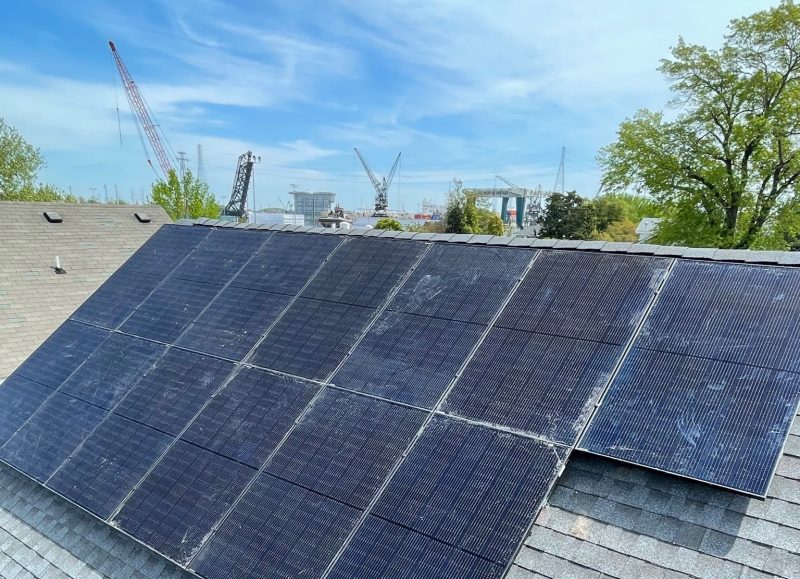
Solar panels being installed on a low-income house in Norfolk. (Photo courtesy Norfolk Solar Qualified Opportunity Zone Fund)
For low-income residents, weatherization and efficiency upgrades remain the focus. Last year, the governor vetoed legislation from Del. Mark Sickles, D-Fairfax, and Sen. Lamont Bagby, D-Henrico, which would have required Dominion and APCo to expand their low-income weatherization assistance to reach 30% of qualifying customers. Sickles has already reintroduced his bill as HB2. CEUR endorsed a different recommendation from staff that the two utilities be required to extend their spending on energy assistance and weatherization programs.
CEUR did not examine a related bill that has been reintroduced this year following a Youngkin veto last winter, establishing an income-qualified energy efficiency and weatherization task force to produce policy recommendations to ensure repairs and retrofits reach all eligible households.
However, CEUR endorsed a bill that will require all utilities to disclose to the SCC information about electric utility disconnections, which presumably will inform the work of the task force.
We’re going to need more
Even taken together, CEUR’s initiatives don’t fully address the biggest energy crunch Virginia has ever faced, and the rising utility bills that result. Possibly that is intentional; Democrats will continue to control the governor’s seat as well as the legislature for at least two years, giving them time to ramp up programs and see what works.
But data center development is so far outstripping supply-side solutions that if legislators aren’t more aggressive this year, next year they will find themselves further behind than ever.
As more bills are filed over the coming weeks, we are likely to see plenty of bold proposals. Hopefully, legislators now understand the urgency and will be ready to act.
by Ivy Main, Virginia Mercury
Virginia Mercury is part of States Newsroom, a nonprofit news network supported by grants and a coalition of donors as a 501 (c) (3) public charity. Virginia Mercury maintains editorial independence. Contact Editor Samantha Willis for questions: info@virginiamercury.com.

‘Feeding Our Neighbors’ Continues Local Effort to Provide Free Meals in Front Royal

Blair David Eller (1963 – 2026)

Writing Workshop at Samuels Public Library Aims to Help Community Communicate More Clearly

Simple Steps to Reduce Wildfire Risk Around Your Home

Lyme Disease Cases Continue to Rise as Tick Season Returns

County Receives 5 More FY-27 Budget Overviews Prior to Closed Meeting on Administrator Search & Business Expansion

Belle Grove Opens March 21 With First Public Viewing of Memorial Quilts Honoring Enslaved Individuals

Iran At a Crossroads: Democracy, Monarchy, and the Lessons of the 1950s

Federal Judge Upholds Ruling That Certain Ex-Felons Should Not Automatically Lose Voting Rights

Virginia Lawmakers Explore Autonomous Technology for Transportation

Misconceptions About Multiple Sclerosis

Five Reasons to Consider a Career in the Community Sector

Frederick County Cattle Carrier Crash – Animals Still Reported At Large

‘Grow Up’: Former Republican Delegate Defends Civil-Rights-Themed Mailers in Redistricting Fight

Virginia One Step Closer to Probation Reform With Bills Headed for Spanberger’s Desk

Merit Versus Reality: Town Council Weighs Priorities Against Finance

Blue Ridge Wildlife Center Patient of the Week: American Beaver

POLICE: 7 Day FRPD Arrest Report 3/9/2026

Discover Rotary with the Rotary Club of Warren County

Maureen Cora (Cooper) Valdez (1942 – 2026)

President Trump Secures Trillions in New U.S. Investments as Companies Expand American Manufacturing

Judge Blocks Some of Trump DOJ’s Sweeping Changes to Immigration Appeals

Front Royal Women’s Resource Center to Host ‘Dare to Dream’ Luncheon March 28

Virginia’s Congressional Republicans Urge Trump Admin to Review Legislation to Tighten Oversight of VMI
