
Local Government
Council approves ongoing project budget amendments, bids for services without dissent
Unlike some past, and possibly future meetings, it was a full but uncontroversial agenda facing the Front Royal Town Council the evening of Monday, October 25. In fact, the most controversial part of the meeting may have been when during her motion for approval, Vice-Mayor Lori Athey Cockrell noted that proposed Town Board of Architectural Review (BAR) member/re-appointee “Gary Vaughn”, whose last name was misspelled in the agenda packet minus a second “a”, was also known locally as “Dewey”.
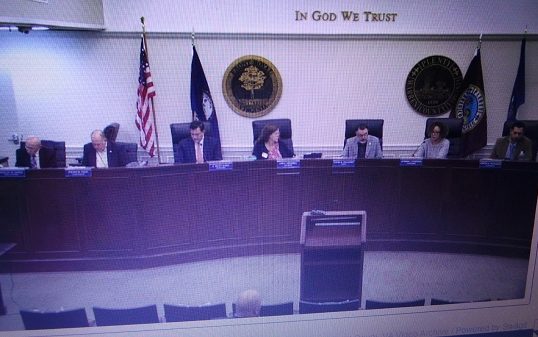
The four council members present, flanking the mayor third from right, found themselves on the same page on eight action items at Monday evening’s meeting. Royal Examiner Photos by Roger Bianchini
However, even that nickname revelation created no dissent among the four-member quorum present. Cockrell’s motion to reappoint Vaughan, as well as appoint Katherine Snyder, to corresponding four-year BAR terms running from November 13, 2021, to November 13, 2025, passed by a unanimous 4-0 roll-call vote, Gary Gillespie absent and resigned Jacob Meza’s seat still vacant pending the November 2nd Special Council Election.
The BAR appointment/reappointment vote was just one of eight 4-0 votes for approval on the evening, largely revolving around budget amendments to continue projects into the coming fiscal year and contractual bid awards for services, as well as one for pump equipment replacement at the Town’s water treatment plant.
Of those two budget amendments made after public hearings at which there were no speakers, $2,052,07.98 was committed to continue “urgent sanitary sewer point repairs” that were state-mandated for upgrades; and $11,351,303.86 to Outstanding Purchase Orders “to carry forward unpaid balances on purchase orders not completed as of June 30, 2021”. That $11.35-plus-million dollars will be split between seven departmental fund balances, including the Town General Fund ($1.37 million), Special Projects ($1.12 million), Electric Fund ($602,321), Sewer Fund ($3.53 million), Water Fund ($2.46 million), Solid Waste Fund ($253,029), and Street Fund ($2 million).
Connected to the $2.05 million budget amendment on Sanitary Sewer System repairs was the awarding of a contract to Snyder Environmental Services, Inc. to accomplish those repairs. Awarding of the contract to Snyder Environmental was recommended by CHA Consulting, the Town’s hired Infiltration & Inflow Abatement project consultant, as well as by Town staff. And speaking of CHA Consulting, following the BAR appointments they led off the Contract and Bid Awards portion of “Business Items” not requiring public hearings to precede council action.
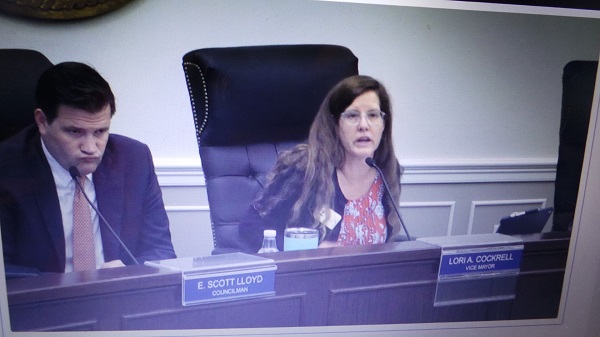
On a more serious note, Vice-Mayor Cockrell pointed to Town staff shortages as the reason snow removal for the coming winter will be bid out, as opposed to done in house as usual.
However, prior to a vote on the awarding of the Snow Removal contract to Timber Works LLC, Vice-Mayor Cockrell did comment that from information received earlier a staffing shortage currently existing within the town department that normally takes care of snow removal was the reason the contract was being offered to an outside company this year. Town Manager Steven Hicks verified Cockrell’s information. The snow removal contract was set at a rate of “$125 per hour for each 7.5 snowplow and $125 per hour for each skid steer loader”.
A bid award of $23,950 was awarded to CHA Consulting for “the successful completion of an Operations Plan and Drought Management Plan as requested from the Water Treatment Plant”.
A “sole source purchase” was also approved to replace three “raw water pumps at the Luray Avenue Pump Station from Flomex, Inc., in the amount of $316,860”. It was noted in the staff summary that $190,000 going to the purchase was available in “the Water Treatment Plant’s existing budget (line item) 9601-47001” and that “the remaining funds were encumbered under the Water Treatment Plant’s capital improvements line item” in purchase orders for $75,000 (30053), two at $29,609 each (30147 and 30282), and $55,782 (30351).
The business items portion of the agenda was wrapped up with a bid award for De-Icing Road Salt to Morton Salt, Inc at $79.61 per ton.
Council also approved a two-item Consent Agenda, adopting Resolutions of support of the Empower Retirement Plan Document and application for a VDOT Revenue Sharing Program for the 8th Street Bridge replacement project.
All approvals were by a 4-0 council consensus.
Rail Trail tourism revenue potential
Also, near the outset of Tuesday’s meeting council heard a summary of the Rail Trail Project the Town has been invited to join with several other municipalities in a three-county portion of the Shenandoah Valley. Northern Shenandoah Valley Regional Commission Executive Director Brandon Davis cited estimates of potential tourism revenue that could be generated by converting abandoned railroad tracks into hiking paths joining the involved communities. He cited the idea of taking now abandoned railroad tracks that were an “engine for economic development” in the 1800s and resurrecting that economic development revenue potential in 2021 through a different use targeting the Valley’s natural tourism potential and destination for hikers.
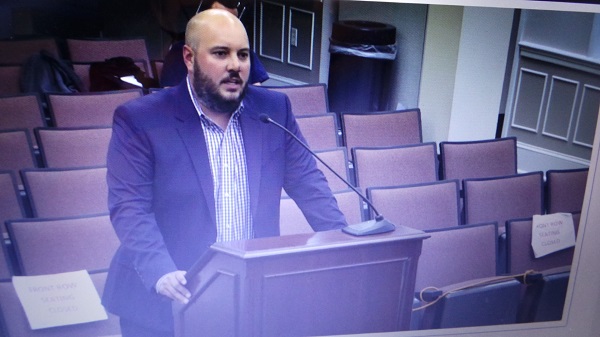
Northern Shenandoah Valley Regional Commission Executive Director Brandon Davis pitched the tourism revenue potential of participation in the Rail Trail program his commission oversees. The plan to convert abandoned railroad lines into a hiking trail network connecting participating communities in three valley counties was cited at a projected tourism revenue of over $32 million total divided among the participants upon completion in 2030.
The projected revenue estimates he gave should have gotten council’s attention. They included $32.3 million in new tourism revenue for the three-county area per year, beginning in 2030 when the project is expected to be completed for system-wide Rail Trail use. It was also estimated to generate 319 new jobs in tourism related businesses like restaurants, motels, hotels, retail and others as of 2030. Increased annual tax revenues were estimated at $1.7 million for counties, $200,000 for towns, as well as an additional $600,000 per year for the state. In addition, $18.7 million in spending was estimated in spending to complete the conversion of the abandoned rail lines into walkable hiking trails.
“This would be a transformational project that would only continue to give back to our communities over time. And it would be a destination facility, not just something that’s used by locals … And we believe people will visit our area because of this trail, not just as an added benefit to all the great reasons to come here,” Davis told town officials. He also noted the input of a qualified expert in the area of tourism and finances to the Rail Trail revenue estimates, a Dr. Cline, whom Davis said he wanted to thank publicly for his input.
No action was required as the Town and County are both still receiving developmental information on the project, though a commitment decision is likely expected in the not too distant future on yet another project the two municipalities could jointly and cooperatively participate in.

James Christopher “Chris” Sain (1948 – 2026)
Alice “Maybelle” Henson (1938 – 2026)

How Sleep and Stress Affect Cancer Risk

Spanberger Signs Sweeping Public Safety and Gun Violence Bills

Horses, Fans Return as Shenandoah Downs Season Begins

Skill Games Halted Again as Spanberger Issues Veto

VDOT: Warren County Traffic Alert for April 13 – 17, 2026

The Cat Who Outlasted Six Prime Ministers

Front Royal, Virginia. Vacation Destination?

Virginia State Police Report Major Drug Seizures in Weekly Crime Suppression Effort

Virginia Secures Birth Control Access as Other Southern States Eye Abortion Pill Manufacturers

SCC Approves Loudoun Transmission Line, Nixes Undergrounding; Final Route to be Determined

Slate of New Virginia Laws Address Health Care and Housing Affordability
James J. Coverston Sr. (1942 – 2026)

Business Growth Series: Your Biggest Problem Isn’t Competition — It’s Being Overlooked

Why Many Experts Say a Concussion Should Be Called a Brain Injury

Missouri Man Arrested in Undercover Operation Targeting Online Crimes Against Children

Trump Tax Plan Credited With Higher Refunds, Lower Taxes

Spanberger Vetoes Fairfax Casino Bill, Citing Local Opposition

Blue Ridge Point-to-Point Races Return Saturday at Woodley Farm

Legislative Effort to Buy Monroe’s Loudoun Estate on Pause, Budget Effort Underway

US House Democrats Call for Congress to Come Back Into Session for Iran War Debate

Virginia to Raise Minimum Wage to $15 by 2028 Under New Law

Spanberger Signs Bills to Aid Low-Income Utility Customers, Manage Power Demand
