
Local Government
Council forwards rezoning over neighbor objections, okays flat tax rate, prepares to open Commons pavilion and celebrates trees
Eight to 10 people appearing to be there in support of three who spoke with concerns about potential impacts of a rezoning proposal by Rockledge Development Company LLC on their neighborhood left Monday’s Front Royal Town Council meeting with a bad taste in their mouths. That taste was of a done-deal on council approval of the rezoning application to facilitate a duplex development project that was immune to their collective concerns and desire for more detailed information on the project from the developer.
The fact no one from the Rockledge Development Company showed up for the public hearing on their rezoning request only compounded those citizens’ anger at the 4-2 vote of approval, on a motion by Jacob Meza. Vice-Mayor Lori Cockrell and Gary Gillespie cast the dissenting votes. Cockrell had suggested delaying action until the developer could come in to address concerns about a potential change in the character of the neighborhood along Hillcrest Drive and Jefferson Avenue near the 15th Street Health and Human Services Complex at the old middle school site.

Council was split on whether a delay was necessary in approving a rezoning until the developer was present to respond to neighborhood questions. Gary Gillespie and Lori Cockrell, at left, found themselves in a 4-2 minority on waiting. Royal Examiner Photos by Roger Bianchini
However, Mayor Chris Holloway cut Cockrell short, seeking a motion before further council discussion. Meza obliged with a motion to approve and took the lead in explaining the approval side’s belief that the developer’s proposal that had moved through the planning commission stage on a recommendation of approval, contained all the necessary information for council to move forward without further input on the proposal for the 2.1-acre parcel.
The rezoning request from Residential-1 (R-1) allowing only detached single-family houses to Residental-3 (R-3), would permit the duplex units the developer wishes to build on the vacant parcel.
The staff summary noted the developer had included a voluntary proffer limiting their project to duplexes, and not R-3 enabled higher-volume apartment units. The rezoning application summary also noted an adjacent R-3 zoned parcel.
However, during council discussion, it came to light that the only adjacent R-3 zoning was for the County Health & Human Services Complex parcel, as opposed to other existing residential development. However, a trip through the area by this reporter the following day found some fairly nice duplex units not far from the neighborhood in question already in place.

Debbie Earl led off the trio of neighborhood speakers opposing the rezoning – and offered a petition signed by 36 people in support of that opposition.
Debbie Earl, Peggy Thompson, and Donna Tebow all spoke against the proposal until more detail easing the neighborhood concerns were publicly addressed to those neighbors’ satisfaction. Tracing the history of the neighborhood bordering currently undeveloped land, the trio of speakers pointed to one of the few in-town neighborhoods retaining a rural feel for what was described as a “working, middle-class” citizenry that had come back from a past experience of “some rough days” when drug use, dealing and other less desirable influences had surfaced.
“This feels like going backward instead of forward,” Tebow told council of a proposal for more affordable housing units than the existing single-family, detached homes on the adjacent streets in question.
“Please do not rezone our neighborhood,” lead-off speaker Earl implored council.
However, the majority of Meza, Joseph McFadden, Letasha Thompson, and Scott Lloyd, the latter by phone connection, held sway that the property owner’s proposal had addressed such concerns at the planning department level and did not need further explanation or justification.
Stable tax rates
The other public hearing was on the establishment of tax rates for the Fiscal Year-2022 Town Budget under development. And since council chose to advertise tax rates at their existing level, which allowed only that they are adjusted down, not up, without re-advertising for a public hearing, it was little surprise Cockrell’s motion to approve flat Real Estate and Personal Property Tax rates at 13 cents and 64 cents per $100 of assessed value, respectively, passed unanimously with little discussion.
Also approved were Personal Property Tax Relief rates of 53% on the first $20,000 of the assessed value of qualifying vehicles; and a relief rate of 100% for qualifying vehicles with an assessed value under $1,000.
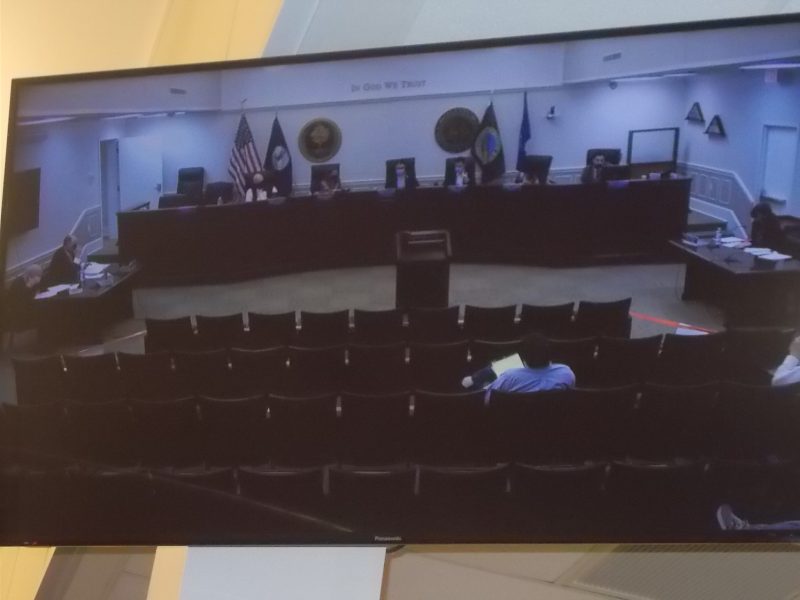
If divided on the rezoning proposal, council was united in approving a flat tax rate for FY-2022
Pavilions and Tree Cities
During Town Manager Steven Hicks report to council, he noted an April 9 morning ribbon-cutting for the Village Commons/Gazebo area Pavilion under construction off the Laura Virginia Hale Place side of the central Historic Downtown park area. A time is still under consideration.
The non-walled, roofed-over Pavilion with an attached enclosed bathroom facility was included as part of the Community Development Block Grant (CDBG) proposal for improvements to the town’s Historic Downtown Business District.
According to Town Purchasing Agent Alisa Scott, the total approved cost of the Pavilion was $295,000. Other aspects were business façade improvements, wall murals and the updated Wayfinding sign project currently underway in conjunction with Warren County.

The new Village Commons Pavilion is nearing completion and a ribbon-cutting is scheduled for April 9.
Perhaps somewhat ironically for some, Hicks also read from an Arbor Day Foundation acknowledgment of the Town of Front Royal again achieving Tree City USA status for 22 consecutive years.
Ironically, because council was at the center of a public firestorm over its defoliation, floodwater plan along Happy Creek and its Shenandoah Greenway Trail area between the Prospect Street Bridge and South Street.
Meza lauded the project rocks replacement of previously existing foliage, including a massive number of trees along the Happy Creek’s riparian buffer. He cited public comment to him commending how much better the area looks now, compared to prior to the flood control plan’s implementation.
In fact, as previously reported the beginning of the implementation of that plan led to the mass resignation of the Town’s Urban Forestry Advisory Committee (UFAC) created as part of its Tree City USA designation. None of the Town’s related organizations, from UFAC to the Tree Stewards were consulted on the defoliation and de-treeing plan designed to speed high and floodwater, including some concrete commercial areas, down the creek and eventually to the Shenandoah River, and away from the Town’s sewer and stormwater system.

Rock Creek or Happy Creek? – Jacob Meza lauded the Town’s work around this mid-town section of Happy Creek and the adjacent Shenandoah Greenway Trail as a beautiful improvement over what was there before – unless perhaps you’re a tree lover or a neighborhood kid wanting to get Creekside to wade, hunt crawdads or fish.
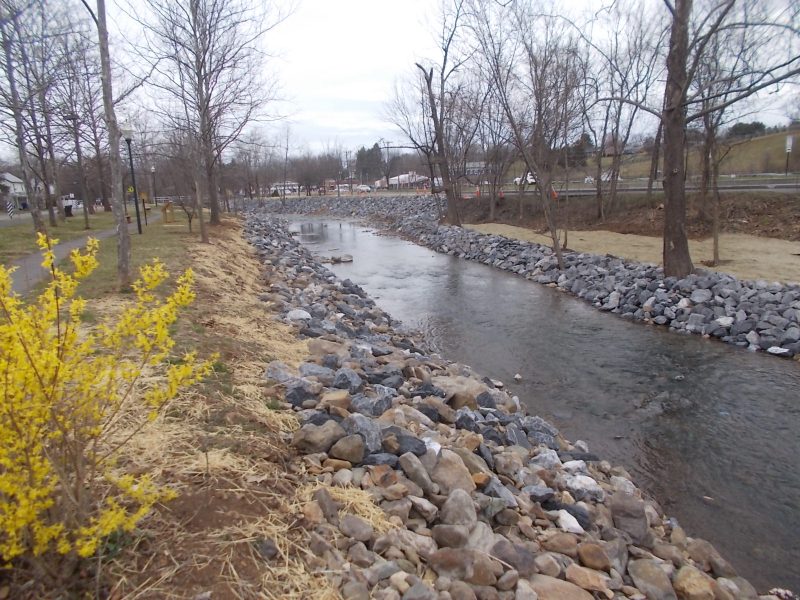
On the bright side for critics of the project, it does seem no additional trees were taken down after the public outcry about the initial creek riparian buffer tree overkill by the Town’s own stated project standards. That overkill of trees larger than 4 inches in diameter was blamed on a contractor. Though some public feedback, as well as references from the contractor to only following Town directives, have disputed that assertion of fault for the larger trees removed during the project’s early stages.
Hicks cited an April 30 tree planting event. We will have more detail on that event as it becomes available.
We’d tell you to see the video for those conversations and other council business, but there was no video as the County-run SWAGIT video broadcast/taping service was not operational Monday, ostensibly due to the County software “intrusion” that has also shut down recent use of County staff emails as a precautionary measure.

Virginia Joins States Challenging Trump Admin Regulations That Limit Free Birth Control Access

Update: Charlotte Swanson Smith (1951 – 2025)

Why We are Challenging the Republican Mass Meeting

Bruce Norman Showman (1954 – 2026)

EDA Relaunches Small Business Loan Program to Help Warren County Entrepreneurs Access Capital

Targeted Exercises to Improve Your Putting

The Hidden Risks of House Hunting Solely Online

Choosing the Right Cleaner for Every Surface in Your Home

New Church Among Consent Items at County Planning Commission Meeting

Warren County GOP Mass Meeting Results Challenged After Allegations of Voting Irregularities

‘This Is About Equity’: In Richmond, Virginia Workers, Lawmakers Push for Inclusive Labor Rights for All

After Five Years of Attempts, Virginia On Track to Set Up a Prescription Drug Affordability Board

New Drug Take-Back Box at Warren County Sheriff’s Office Offers Safe Way to Dispose of Medications

‘Feeding Our Neighbors’ Continues Local Effort to Provide Free Meals in Front Royal

Blair David Eller (1963 – 2026)

Writing Workshop at Samuels Public Library Aims to Help Community Communicate More Clearly

Simple Steps to Reduce Wildfire Risk Around Your Home

Lyme Disease Cases Continue to Rise as Tick Season Returns

County Receives 5 More FY-27 Budget Overviews Prior to Closed Meeting on Administrator Search & Business Expansion

Belle Grove Opens March 21 With First Public Viewing of Memorial Quilts Honoring Enslaved Individuals

Iran At a Crossroads: Democracy, Monarchy, and the Lessons of the 1950s

Federal Judge Upholds Ruling That Certain Ex-Felons Should Not Automatically Lose Voting Rights

Virginia Lawmakers Explore Autonomous Technology for Transportation

Misconceptions About Multiple Sclerosis
