
Local Government
County Emergency Services and Sheriff talk equipment and personnel costs
Money, law enforcement, and emergency services were at the forefront of an eight-item work session agenda of the Warren County Board of Supervisors, Tuesday night, August 11.
First up was good news from County Fire & Rescue. That news was the receipt of a federal FEMA grant in the amount of $725,454.55 to achieve a total of $854,427 for state-of-the-art breathing apparatuses for department personnel responding to fire and other emergency situations where not only smoke, but contaminated air may be an issue.
And while a local match of $128,972.47 will be required for the full purchase of 114 SCBA units and a total of what appeared to be 428 associated pieces of associated equipment, as noted in earlier discussion of the grant application process, the department was facing the necessity of acquiring the equipment in order to maintain certified safety standards to replace now obsolete and dysfunctional equipment with an approximate million-dollar price tag on it.
So Emergency Services Chief Richard Mabie and Fire Marshal Gerry Maiatico, along with the supervisors, gave a BIG shout out to County Grant Facilitator Brandi Rosser for her work in acquiring the grant funding for the County.
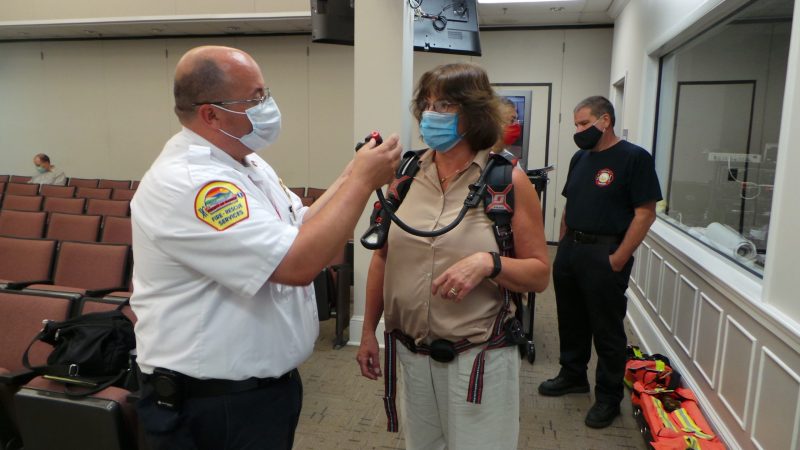
Above, with the assistance of Fire Marshal Maiatico, Board Vice-Chair Cullers tries on one of the apparatus backpack assemblies prior to Tuesday’s meeting. Below, a sampling of the new equipment awaiting presentation to the board Tuesday night. Royal Examiner photos by Roger Bianchini, video by Mark Williams.

The variety of equipment, some of which was on display before and during the work session, and financial variables were dizzying as outlined in a power-point handout. However, the bottom line was simple as Board Vice-Chair and expenditure “conscience” Cheryl Cullers pointed out in citing the difference between $128,000 and a million dollars to become industry-standard compliant in equipping the County’s emergency service personnel adequately to perform their crucial function to this community.
“I just want to say thank you again to Ms. Rosser and you guys … for all the work. This is a big relief,” Cullers said.
To accommodate an August 30 deadline for official acceptance of the grant, the matter was placed on the August 18th meeting agenda for board approval.
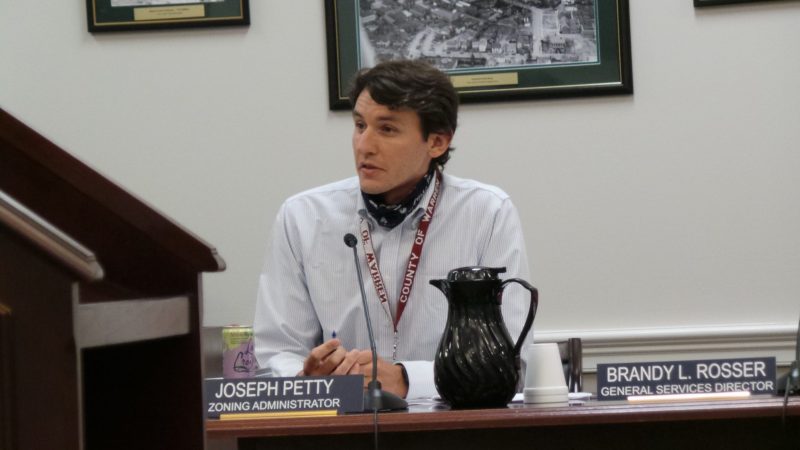
Zoning Administrator Joe Petty explains the requested ordinance amendments.
Following two reports by Zoning Administrator Joe Petty on suggested adjustments to county codes on first, storage of inoperable recreational vehicles and other equipment and then on regulations of signage, including political, to accommodate a 2015 U.S. Supreme Court decision concerning signage content, it was Sheriff Mark Butler’s turn to address operational costs, but this time without the assistance of federal money.
Sheriff Butler implored the supervisors to provide the necessary funding, cited at a total of $130,000, to allow his communications staff to be expanded by two positions and that his existing staff be given a two-step pay increase.
It would be an increase that would allow communications or dispatch, staff to be paid at least as well as Butler noted recent local classified ads indicated, a “Sheetz clerk with no experience” at clerking, much less at the crucial law enforcement job of fielding citizen calls in often stressful situations and directing field officers into potentially volatile or life-saving situations.
The sheriff also pointed to impacts on his communications department, which he noted handles all 911 calls for the county, from the COVID-19 Coronavirus pandemic.
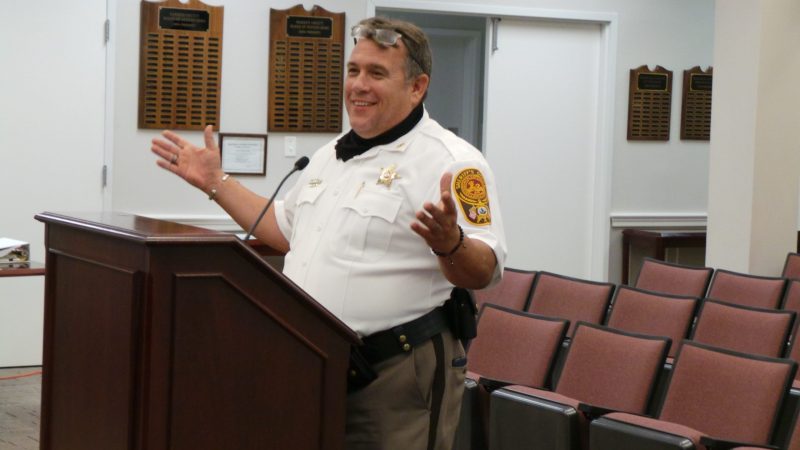
Sheriff Butler makes his case that communications/dispatch officers should be paid more than convenience store clerks.
“COVID has definitely changed the way we do things. The problem with communications is you have an area where so many people are sitting right on top of each other. So, if one person comes in ah, symptomatic, they’re gone for three days because we don’t do tests. So that really shook us so bad that we can’t man our staff, that we took deputies off the street to man communications,” the sheriff noted of a personnel juggling act that ensued.
As for existing communications staff salaries, Sheriff Butler said, “These individuals are trained to actually handle these calls. So, we want the best communications officers we can find. Well, if I go through the pay scale it would shock you to hear that someone with six years in our agency and considered one of our best communications officers, makes about $33,000 a year.”
The agenda summary accompanying Butler’s request stated that “the average dispatcher makes $15 an hour which is the same as minimum wage in most states”. Butler asked the board to raise the pay step for dispatch officers from 5 to 7 at a maximum annual budget hike of $30,000 per year. Butler said that increase would make his department competitive with surrounding jurisdictions, most prominently Front Royal and Fauquier County.
The two additional, full-time positions were requested at a maximum annual budget increase of $100,000.
“I’d love to have four, but I need two,” Butler told the supervisors of the request for additional staffing. “I’m not asking you to break the bank – I’m saying pay them more than the starting salary at Sheetz,” the sheriff reasoned.
With an already packed, 10-public hearing August 18 meeting agenda, the board agrees to forward the request to its September 1st agenda.
See these discussions, as well as Zoning Administrator Petty’s two ordinance amendment summaries and end of meeting board discussions of a list of 40 “goals” and creation of a committee to deal with countywide broadband communications issues in this Royal Examiner video:


Cars Changing Lives Plans May 8 Golf Tournament to Support Transportation for Families in Need

William Gladwell Mason “Bill” Wilson (1936 – 2026)

Early Voting Begins Friday for Virginia Redistricting Referendum

Immigration Arrests Spark Bills to Guarantee K-12 Education Rights for All Virginia Students

Last-Minute Tweak to Bill Could Double Virginia’s Medical Malpractice Payment Caps for Plaintiffs

Discover the Power of Protein During National Nutrition Month

Why You Don’t See Your Own Nose

Cross County Emergency Service Funding, Roosters in R-1, and Sheriff’s Office Asset Upgrades Lead Budget Discussion

Freedom 250 Mobile Museum Truck to Visit Middletown During America’s 250th Anniversary Celebrations

Laurel Ridge SBDC Launches Workshop Series to Help Small Businesses Pursue State Contracts

Bedford County Supervisor Files Suit Challenging Reproductive Rights Constitutional Amendment

Bill to Require Factual Teaching About U.S. Capitol Attack Clears Virginia General Assembly

Bills Aimed at Lowering Utility Bills Also Renew Pricey Power Line Burial Program

At Nearly 100, Lillian Sloan Still Shows Up to Serve at Warren Memorial Hospital

Samuels Public Library Adult Programming Events for March

Jeannette Rankin: A Pioneer Who Opened the Doors of Congress to Women

Short-Term Rental, Rezoning, Retaining Wall, ADUs, and Special Events at Town Council Work Session

Celebrate the People Who Keep Your Business Running

Front Royal to Host Tourism Summit April 7

Thomas Ray “Tom” Lomax (1953 – 2026)

Barry Richard Hadley (1959 – 2026)

Public Notice

Rockland Non-Agenarian (90 to 99 years old) Celebrates 94th Birthday with Humane Society Supply Call, Especially for Cats!

Iran War Drives Gas Price Uncertainty Ahead of Busy Summer Season
