
Local Government
County Ponders State Help Fighting ‘Spongy Moth’ Defoliation Threat Countywide, and Northside Farmer’s Market Proposal
A somewhat lengthy work session of the Warren County Board of Supervisors starting at 6 p.m., Tuesday evening July 8, was highlighted by several items with current zoning and permitting issues waiting for decisions from the county’s elected officials. Those included the proposed establishment of a permanant Farmer’s Market for county-based farmers on a portion of the McKay Springs property on the county’s north side, and permitting rules and waivers of those rules for Short-term Tourist Rentals and Road Name changing applications.
However, the meeting was kicked off by a presentation by State Forestry Department representative Cain Harbison on the defoliation threat presented by Spongy Moths, formerly known as Gypsy Moths when they first began reaking havoc nationally, circa 1989 to 1991. Harbison focused on the availability of State Grant funding to municipalities dealing with the 2020’s version of the moth and its larvae. See the chairman’s introduction of Harbison’s presentation beginning at the 3:03 mark of the linked County video.
As Tuesday’s work session began, Board Chairman “Jay” Butler began by asking for a change in the order of presentation of agenda topics. That change moved the “Homsteaders” Farmers Market presentation up from next to last to second following the Spongy Moth presentation, and moving a Zoning staff presentation on a Zoning Text Amendment concerning the establishment of Accessory Dwelling Units, currently available only by Conditional Use Permitting (CUP) in the Agricultural Zoning District.
The agenda switch, appearing to accommodate Homesteader representatives Sarah Kerns and Amber Martin’s not having to sit thru nearly the entire agenda schedule before being called to present and then being free to leave the 6 p.m.-convened work session, which ended up running to 9:35 p.m., was approved without dissent. The zoning text amendment presentation moved down was to be presented by County staff, who would be required at the entire meeting on the majority of topics anyway.
So, we’ll start in the adjusted order of the Agenda Packet, first wth the Spongy Moth threat and the availability of State revenue to combat it, and the Homesteader group’s Farmer’s Market proposal.
The Moth threat and counter options
- Presentation – State Forestry Department about the Spongy Moth problem and solutions

The Board of Supervisors listen as Va. Dept. of Forestry representative Cain Harbison, below, explains the State grant application process regarding creating a more cost efficient way to help municipalities in fighting the latest ‘Spongy Moth’ invasion and the potential for widespread defoliation. Royal Examiner Photos Roger Bianchini

The gist of the Department of Forestry report was the looming threat of massive defoliation from the newest generation of the Spongy Moths, and as noted above the availability of State grant funds to aid municipalities in battling that environmental threat.
As the board discussion began, South River District Supervisor Cheryl Cullers, whose district has seen past consequences of the moth infestations observed, “They’re defoliating trees when they’re at the caterpillar stage and then they turn into moths.”
Forestry Department rep Harbison then stepped to the podium to describe various impacts of the recent infestations on local trees citing the loss in certain types of trees from the moths in question’s life cycles: “Bentonville really got hit hard last year. What was completely defoliated are the Blue Polygons on the map. That was last year’s defolitation. That is total canopy removal, every leaf eaten between May and June.
“Now trees can recover from that from one year to the next. This year where we’re seeing total defoliation is the Yellow Polygons on your map,” Harbison warned of the coming cycle.

It was a sparce crowd for the July 8 supervisors work session as Va. Dept. of Forestry representative Cain Harbison’s presentation opened the 6 p.m. convened session.
As to the application for State assistance in battling this defoliation, Harbison said, “Really, and this is kind of why I was asked here, our program can give the County money in order that you can give landowners money in order to get a spray contract in large. Because it’s extremely difficult for landowners to be able to coordinate a spray contract because we spray using aerial spray, helicopters.”
Harbison noted that those aerial helicopter contracts generally sought a minimum of 500 acres at what he called “an extremely high rate” per acre. He held Shenandoah County up as an example of what could be achieved through a County contract with the Virginia Department of Forestry for spraying of all its involved acreages, while issuing individual sub-contracts with the county’s landowners. Shenandoah’s contract this year was set for a total of 5,000 acres at a much lower per-acre rate of $40 dollars per acre, with the County able to pass on a cost of $20 dollars per acre to the landowners, Harbison told Warren County officials.
He held up several county governments’ experiences with the process, noting that Page County had a total of 8 landowners sub-contracted by the County on a total of 2,000 acres at “a very similar cost rate” to his earlier example. “BTK” was later cited as the involved anti-moth spray. That led Shenandoah District Supervisor John Stanmeyer to note he has had excellent success using BTK to protect several trees, including apple trees, on his property.
In order to apply for the State contracts a County must have a “designated Spongy Moth coordinator” Harbison told the supervisors, pointing to the amount of work involved in setting up a countywide spray contract.
The deadline on the grant applications for a coming year of infestations is generally March 5, but with the infestation in process Harbison cited sooner better than later in working toward and applying for the single countywide grant.
When Fork District Supervisor Vicky Cook asked if there was interest in pursuing this countywide contractual arrangement, County Administrator Ed Daley indicated from a staff perspective that, yes, it appeared there was.
County Administrator search
After referencing County Administrator Daley’s input here we will briefly jump to the final agenda item of the evening’s work session. That item was an update by Daley on the County’s search for a new county administrator to replace him upon his pending retirement.
Daley noted a total of 40 resumes submitted to the contracted recruiting firm of Colin Baenziger & Associates, with 7 narrowed down by by the recruiter to more detailed profiles being aquired. Two more names were added to the additional scrutiny list by individual supervisors raising the total of under-consideration candidates to 9.
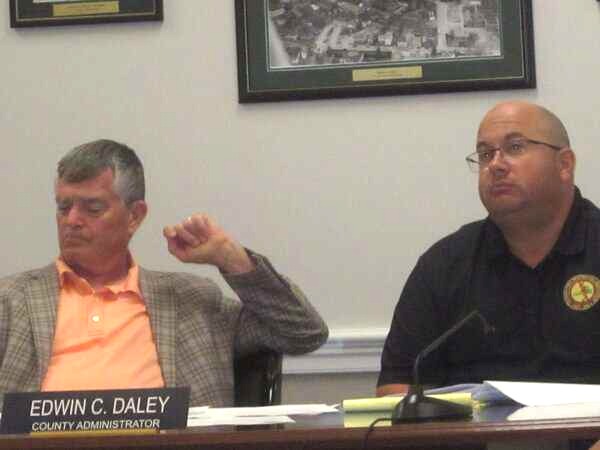
County Administrator Ed Daley, left, at staff table with Deputy Fire & Rescue Chief Gerry Maiatico. The latter weighed in on 911 emergency call logistics in road name change senarios, particularly in more remote areas of the county.
The goal is to further narrow that final consideration number down to about 4 to 6 final candidates to be interviewed by the board in the coming week. Those final candidate interviews are typically done in Closed Session.
Homesteaders Farmer’s Market
We will go here to the staff summary of the Homesteaders organization’s initiative to have a portion of the McKay Springs property on the county’s north side selected as the site of a permantely established Farmer’s Market targeted exclusively to county farmers and their products year round.
Homesteader organizers Sarah Kerns and Amber Martin told the supervisors that 300 member applications had been acquired in three months. The project seems generally supported by the County. One matter of concern is with Virginia Department of Transportation (VDOT) issues with an entrance/exit way to and from the property under consideration for expansion dependent on the number of visitors on a daily average being determined.
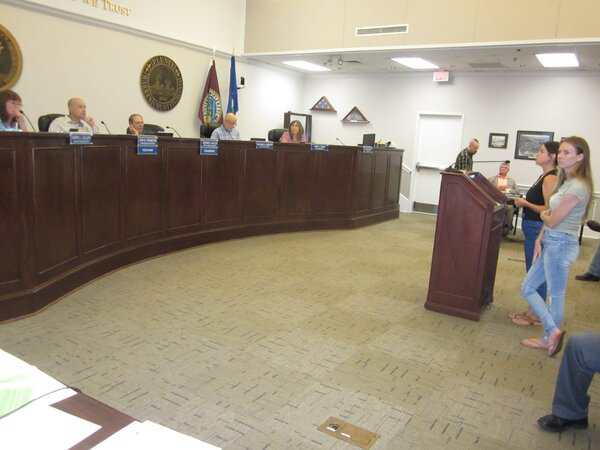
Homesteader reps Amber Martin, closest to camera, and Sarah Kerns, explained progress on creation of year-round Farmer’s Market proposal on a portion of the County-owned McKay Springs property in the county’s commercial north-side area.
Below is a portion of the staff report included in the Agenda Packet on the evolving process and the County’s existing codes establishing a precident for the use as a “commercial” enterprise:
- Discussion – Homesteaders on Reliance Road
“The Warren County Board of Supervisors have been approached by the local Homesteaders organization to develop a Farmstand (Market) Hub at the County owned property off Reliance Road in the area known as McKay Springs. These lots were formerly used as a trailer park owned by Garland and Lillian Eastep and are currently vacant. The Homesteaders are willing to maintain the site and provide any necessary improvements for access to it. The Hub will allow local homesteaders, farmers, and gardeners to place individual farm-stands on the property to sell locally grown and raised agricultural products from Warren County farms and gardens. At a recent meeting the Board voted to support the use of the property by the Homesteaders but they expressed that the public health, safety and welfare issues must be addressed prior to the use being established. Comments from VDOT have been received regarding the required entrance to the property and the design criteria. The properties are identified on Tax Map 12A-113 as parcels 1 through 14 and are zoned Commercial. Supervisor Jamieson has submitted a technical memo he drafted as a supplement to the item discussion which is included in the packet.
“Executive Summary:
“The Board of Supervisors has approved a farmstand hub on parcels 12A-113-1 through 12A 113-14. This memorandum provides the legal and technical framework for implementing this directive through administrative interpretation of existing Commercial District provisions. No text amendment or variance is required – current ordinances provide sufficient authority through reasonable interpretation of “general retailing” provisions …
“… Current Warren County ordinances provide overwhelming legal authority to implement the approved farmstand hub. The county’s own precedent establishes wayside stands as commercial retail operations, which clearly belong in commercial districts under general retailing provisions of § 180-27(14).”
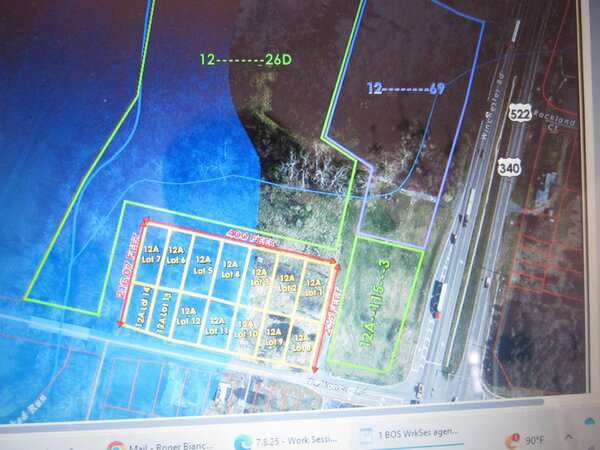
Graphic illustrating the location of the portion of the McKay Springs property targeted for development of a year-round Farmer’s Market. If we are reading the map correctly, the market area is focused in the red-outlined area containing the series of 12-A parcels
Other Business
Below are excerpts from the Agenda Packet staff summaries of the other business discussed at the July 8th work session:
- Discussion – Short-Term Tourist Rentals – Setback Waivers – Chase Lenz
EXPLANATION & SUMMARY:
Planning staff will present a brief history of changes to the short-term tourist rental ordinance, a summary of the 2023-2024 text amendments and work session discussions related to the 100′ setback requirement for short-term tourist rentals, procedures and considerations for waiving supplementary regulations, and potential criteria for waiving the 100′ setback requirement for short-term tourist rentals.
- Discussion – Road Naming policies and procedures – Matt Wendling
EXPLANATION & SUMMARY:
The Planning Director will discuss the policy and procedures for road naming in Warren County, Virginia, Geographic Information Network report cards, as applicable to recent requests for road names.
- Discussion – Z2025-05-01 – Zoning Text Amendments for Accessory Dwelling Units – Warren County Planning Staff – An ordinance to amend Chapter 180 of the Warren County Code (Zoning Ordinance) to add a definition for accessory dwelling unit (ADU), to repeal the existing definition for guesthouse, to amend the Agricultural zoning districts to make “accessory dwelling unit, provided that it is accessory to an existing single-family dwelling, and attached to or located within the existing principal structure” permissible by right and “accessory dwelling unit, detached from an existing principal structure, provided that the accessory dwelling unit is accessory to an existing single-family dwelling” permissible only by conditional use permit in the Agricultural zoning district, and to enact supplementary regulations for accessory dwelling units … Under this format, attached ADUs or ADUs located within an existing principal structure will be permitted by right while detached ADUs will be permitted by conditional use permit.” – Chase Lenz, Zoning Administrator

A graphic used in the presentation of staff-suggested zoning code changes regarding Accessory Dwelling Units (ADC) in the wake of recent updates to the County Comprehensive Plan.
The proposed definition for accessory dwelling unit (ADU) is “A subordinate dwelling unit located on the same lot as a principal single-family dwelling that includes permanent provisions for living, sleeping, eating, cooking, and sanitation. The accessory dwelling unit shall comply with the supplementary regulations set forth in §180-30.2 of this chapter.
These text amendments are being requested by Planning staff following the recent adoption of the Warren County Comprehensive Plan, which identifies accessory dwelling units as a potential source of secondary housing in the Agricultural District.
The meeting adjourned at about 9:35 p.m.
Click here to watch the Warren County Board of Supervisors Meeting of July 8, 2025.

4 Stimulating Activities for a Healthy Brain After 50

The First Amendment: America’s Unique Foundation of Freedom

How to Tackle Credit Card Debt

Summer Enrichment Camp Gives Teens Hands-On Learning Opportunities

VDOT: Warren County Traffic Alert for April 6 – 10, 2026

David Silek to Remain in Chairman’s Seat of WC Republican Committee Pending 6th District Appeal Decision

Sales Set to Bloom Like Daffodils This Spring

America 250: The Bookseller Who Helped Save the Revolution

Business Growth Series: Why Good Businesses Still Struggle to Grow

Brownies with Mini Chocolate Easter Eggs

Shenandoah Downs Opens 11th Season April 11 with Tribute to Roger Hammer

We Don’t Know Everything About DNA

How PAAS Came to Dominate the Easter Egg Dye Tradition

Spanberger Signs Bipartisan School-Safety, Student Support Bills Into Law

Melanie J. Pomeroy (1958 – 2026)

David Benjamin Heller (1990 – 2026)
1776 Wasn’t Just About Independence

Three-Tiered System for Urban Agriculture Based on Lot Size Takes Shape at Town Planning Commission Work Session

Child Abuse Awareness Month Brings Focus to Reporting, Prevention in Warren County

National Dental Hygienists Week: Is Your Oral Care Routine Optimal?

The Coin That Traveled Through Time and Space

One “What If?” Question Is Changing the Future of Farming

AA Speaker to Explain Recovery Program at United Methodist Men’s Dinner
Jeannette M. Hyland (1944 – 2026)
