
Local Government
Dogged by the details: Town Planning Commission mulls zoning and ordinance changes while waiting for a new Planning Director.
The Front Royal Planning Commission met June 16th for its regular session with only one application from the public for a zoning change which easily obtained a recommendation for approval. Jason and Christie Sine own a lot on Crosby Road which is currently zoned limited industrial (I-1), to utilize the lot to construct residences. They are requesting a change to R-2, medium-density residential zoning.
The application states that “There is a severe shortage of land in town to build “affordable housing”. It would benefit the town that a vacant, odd-shaped piece of land would now be generating more in real estate taxes if there were residences on there.” Commissioner Merchant asked the applicants if setbacks from the adjoining railroad had been considered. Applicants confirmed they had, and that they had consulted a surveyor who recommended that they downsize their structure from 4 units to two, given the shape of the lot and proximity to the railroad right-of-way. They intend to eventually subdivide the lot into two approximately .37 acre pieces.
Commissioner Merchant then reminded the applicants that this site adjoined the site of the annual fireman’s carnival and Bing Crosby Stadium, and that noise and light from those activities could affect residents. He urged the applicants to ensure that potential buyers be made aware of those factors. He noted that the applicants had not made any proffers with their application, which is unusual, however, given that there is already street access to the site and no other traffic changes are needed, no proffers might be appropriate.
The planning department, in its analysis of the application, indicated that the town comprehensive plan of September 1997 included residential use of that area along the railroad track as medium density residential. Once the questions were answered, the commission voted unanimously to recommend approval of the request.
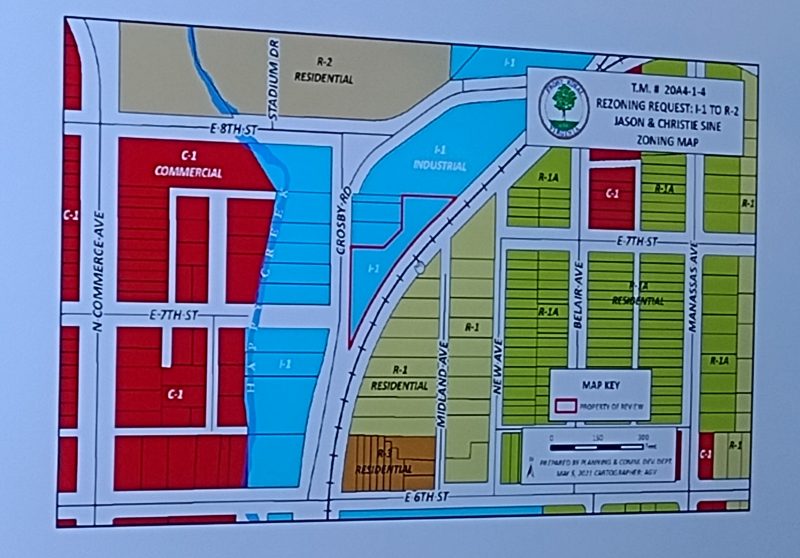
Rezoning request by Jason and Christie Sine for rezoning a parcel of property near Bing Crosby Stadium lane shows the proximity to the railroad track along Crosby Road
The Chairman then turned to the zoning Ordinance change that was requested by a resolution of the Town Council in February that directed the planning department to prepare an ordinance amendment for a public hearing and a Planning Commission recommendation for approval by the Town Council. The amended ordinance mainly rescinds or loosens some restrictions on developing apartments in the Downtown Commercial District (C-2). The Royal Examiner has reported on the previous deliberations of the commission.
In this meeting, the commissioners were presented with a revised version of the ordinance text change. Where the first draft of the ordinance allowed for the conversion of existing commercial or residential structures to increase the number of dwelling units to not more than 8, applied exemptions for minimum lot size, building height, parking space, and other restrictions to the entire downtown business district, the new version restricts those exceptions to properties fronting east Main Street from Royal Avenue to Happy Creek, Chester Street from East Main Street to East 2nd Street, and East Jackson Street from South Royal Avenue to Church Street.
One person spoke during the public hearing. Bill Barnett, a longtime developer, and property owner in the downtown spoke in favor of the ordinance. He saw it as a motivator for developers to invest in the development of underutilized second-story space for living quarters for a mixed population – seniors, young people starting out, and downtown business owners. He contrasted the situation in the early 1960s where many buildings had upstairs dwellings and shop owners and others routinely occupied apartments in the downtown.
Mr. Barnett also alluded to a presentation that he had made to the Board of Architectural review regarding an apartment concept for the old Murphy theater, for a 6-story building with 60 apartments. This appeared to come as a surprise to the commissioners, and Commissioner Marshner asked if a copy of the presentation was available. Mr. Barnett indicated he would make it available. There have not been any permit requests or any other official actions regarding a project of that kind. The idea is only in the conceptual stage, and, of course, rumors run rampant in the absence of facts.
Mr. Barnett indicated he had heard stories of 6, 60, 600, even 6,000 units. Any building project must go through a series of approvals from planning and zoning through the site development and building permits, many stages of which provide opportunities for public hearings and input. None of those things have been initiated in this case.
Once the public hearing had closed, the changes to the previously presented document seemed to stimulate more questions about the definition of “apartment development” and more fundamental questions about the practice of adding dwelling units in the downtown business district. Commissioner Merchant indicated he was neither for nor against the idea of apartments in C-2 zoned areas, but indicated that there would be many challenges.
In the absence of a town planning director, the commission agreed to postpone further action on the ordinance text amendment for a work session on June 30 to hammer out any further needed changes. The planning staff was asked if there was any news on a replacement planning director. The short answer from the planning staff: “No.”
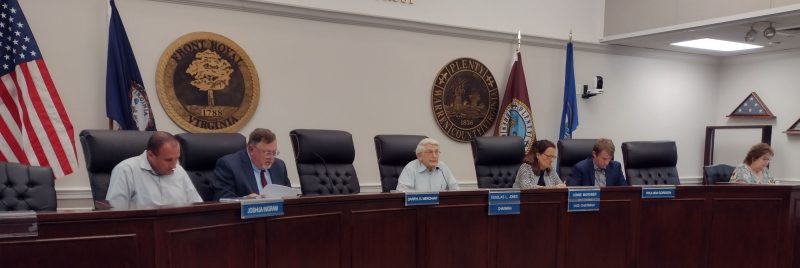
Planning Commission Chair Douglas Jones questions the planning staff about the Planning Director vacancy in the Planning and Community Development office.
Next, the commission revisited another potential hornet’s nest ordinance change, again from its previous meeting and work session. The Town Council has asked the Planning Commission to weigh in on the proposed ordinance change to the Front Royal Town Code covering Abatement of Blighted buildings. In accordance with the commission’s last meeting instructions, the planning staff produced a “red-line” revision of the ordinance for the commission to consider. The public hearing for the document revision was extremely short since no member of the public spoke.
Commissioner William Gordon addressed the issue of a time limitation when a property has been determined to be nonconforming. Shouldn’t a process be in place to bring a property into conformance during the two-year period? The committee agreed again that the wording of the ordinance was produced by the former Planning Director during his last week on the job, and that a work session by the commission would allow the right language to be crafted. The commission agreed to a Work session on June 30 and include the blighted buildings and downtown apartments’ ordinance changes on that agenda.
The commission then dealt with a brief consent agenda that included a sign permit request for Performance Sport and Spine at 1100 North Royal Avenue. Without discussion, the Consent agenda was unanimously approved. A consent agenda is a board meeting practice that groups routine business and reports into one agenda item.
Finally, the commission took up as new business another resolution from Town Council some revisions of the permitting and approval authorities for subdivisions, land development, and zoning. Commissioner Merchant pointed out several issues in the resolution that need to be clarified regarding the Planning Commission, so as before, the commission agreed to add the resolution to the June 30 Work session.
