
Opinion
Gleaning has Biblical origins, modern day applications
“Now when you reap the harvest of your land, you shall not reap to the very corners of your field, nor shall you gather the gleanings of your harvest. Nor shall you glean your vineyard, nor shall you gather the fallen fruit of your vineyard; you shall leave them for the needy and for the stranger. I am the Lord your God” – Leviticus 19: 9-10.
God was very concerned for all the people in Israel, but took special interest in the poor and the vanquished. In the Old Testament, He commanded that farmers were not to “gather the gleanings,” or harvest all the way to the edges of their fields, but to leave whatever they dropped for the poor and the immigrant in their midst.
Gleaning is the second harvesting of the land’s produce by the poor and those who had no land of their own. The crucial premise underlying this double command is Israel’s understanding that the land belonged to Yahweh. No one in Israel was a landowner in the modern sense. Each tribe and clan had its own “portion in Yahweh,” the piece of land that represented its share in the covenant with God. The land was Yahweh’s to distribute.
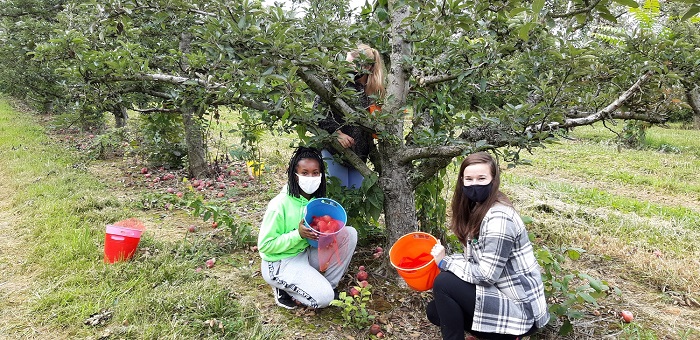
Shenandoah University Students participate in gleaning apples at Marker-Miller Orchards Farm Market, one of a variety of student centered community service programs. Photos courtesy of Tim Teates.
Allowing others to glean on the Israelite farmer’s property was the fruit of holiness. Landowners had an obligation to provide poor and marginalized people access to the means of production (the land, in Leviticus) and to work it themselves. In this sense, it was much more like a tax than a charitable contribution. Also unlike charity, it was not given to the poor as a transfer payment. Through gleaning, the poor earned their living the same way as the landowners did, by working the fields with their own labors. It was simply a command that everyone had a right to access the means of provision created by God.
Notice the difference from our more contemporary way of thinking. The Israelite farmer did not “allow” gleaning by the poor; Yahweh God commanded it. There is no charity involved, no hand out. The poor are not to be regarded as beggars or freeloaders. They are valid members of the covenant community, and they have as much right to glean as the farmer has to harvest the crops. I believe these commands regarding gleaning give us plenty to consider if we think about our own society’s attitudes toward ownership, consumption, acquisition, benevolence, and welfare.
Gleaning once was a common practice across Europe in the middle ages. Landowners would invite the poor onto their land to gather up whatever had been left un-harvested. In 18th century England, the sexton would often ring a church bell at 8 o’clock in the morning and again at 7 in the evening to alert needy families when they were invited to gather produce.

Members of Arlington Church of Christ gleaning apples in support of Arlington Assistance Food Pantry.
Fast forward to a period of austerity and increasing reliance on food banks in 21st century America. Food banks are stressed to keep up with demand. Times again are harsh for thousands of families who can’t afford a steady diet of fresh, wholesome fruits and vegetables. Yet an estimated 30 percent of all food crops go un-harvested in our nation — billions of kilograms, according to the United States Department of Agriculture (USDA). There is evidence that the market demand for perfect looking produce has resulted in fruits and vegetables with mere cosmetic blemishes rotting in fields. More produce is discarded because of harvesting schedule issues or unstable market prices. There has never been a better time to revive gleaning.
Farmers and their Local Communities Rely on Each Other
Gleaning benefits every community. People need food, particularly healthy food and farmers usually manage a surplus. Fruits and vegetables help restore health, help kids perform better in school and get people to cook it in their homes to improve their overall diets in the fight against obesity. Farmers will box up and donate food that doesn’t sell at the stand or allow gleaners to pick in the fields. Consumers want food that is without blemishes, so farmers always have products that aren’t good for sale that can be donated.
A number of farmers actually give their “first fruits” – that is, they allot a portion of their crop prior to the harvest. They feel that God has so abundantly blessed them that they want to “give back” to the community. These farmers love to share. It’s a wonderful feeling to give to people and know that they will enjoy it just as much as farmers do growing it.
Some farmers feel they have nothing to lose. The motivation has little to do with a biblical command though they are pleased that their surplus will feed the hungry. They will also pocket a tax deduction worth the value of what the farm gives away. All farmers by nature want to see the food they’re growing made accessible to everyone.
The gleaning system cited in Leviticus does place an obligation on the owners of productive assets to ensure that marginalized people have the opportunity to work for their food. No contemporary individual landowner can provide opportunities for every unemployed or under-employed worker the same as no one farmer in ancient Israel could provide gleanings for the entire district. But corporations are called out to be key players in providing opportunities for work. Perhaps we working people are also called to appreciate the service that business owners perform in their role as job-creators in their respective communities.
Gleaning Collects Food for Needy and Eliminates Food Waste
It used to be that gleaning was simply tolerated, that it was legally accepted but had some sort of indignity attached. Currently gleaning is becoming more popular because the sheer quantity of the bounty that doesn’t get consumed is incredibly immense. For farmers, it is a matter of reducing waste.
In the United States, food waste is estimated at between 30-40 percent of the food supply. This assessment, based on estimates from the USDA Economic Research Service of 31 percent food loss at the retail and consumer levels, corresponded to approximately 133 billion pounds worth of food in 2010.
The Environmental Protection Agency (EPA) in 2017 alone, estimated that almost 41 million tons of food waste was generated, with only 6.3 percent diverted from landfills and incinerators for composting. EPA estimates that more food reaches landfills and incinerators than any other single material in our everyday trash, constituting 22 percent of discarded municipal solid waste. Food waste includes uneaten food and food preparation scraps from residences or households, commercial establishments like restaurants, institutional sources like school cafeterias, and industrial sources like factory lunchrooms.
Local non-profit organizations in Virginia are successfully building a network that will take food which would not make it to market for a variety of reasons and distribute it to local agencies that are feeding the hungry. Supply and demand is the first rule of the deal, say farmers. And if you have more supply than you have got demand, then it’s going to go to waste.
Top 6 Reasons Why You Should Volunteer for Gleaning
- Get involved in a mission opportunity that will make a big difference in your local community without taking up a lot of your precious free time.
- Teach your children about hunger, about our blessings and the importance of becoming involved in serving others. Here in Virginia, 13 percent of children, approximately 247,000, are food insecure (No Kid Hungry Virginia, 2017).
- Establish an opportunity for your family to work together, drawing you closer and providing lots of dinner discussion opportunities.
- Provide local families (your neighborhood) in need with fresh, nutritious fruits and vegetables at no cost to them. (Food pantries usually stock only non-perishable items which typically have less vitamins and antioxidants).
- In the process of serving, you will be served. Your heart will be lifted as you know you’ve made a difference in peoples’ lives in your local community.
- Salvaging unused crops prevents perfectly fine produce from getting plowed under, sent to the local dump site or allowed to perish.
Mark P. Gunderman
Stephens City, Virginia