
EDA in Focus
High drama on day two of Sayre defamation suit against McDonald
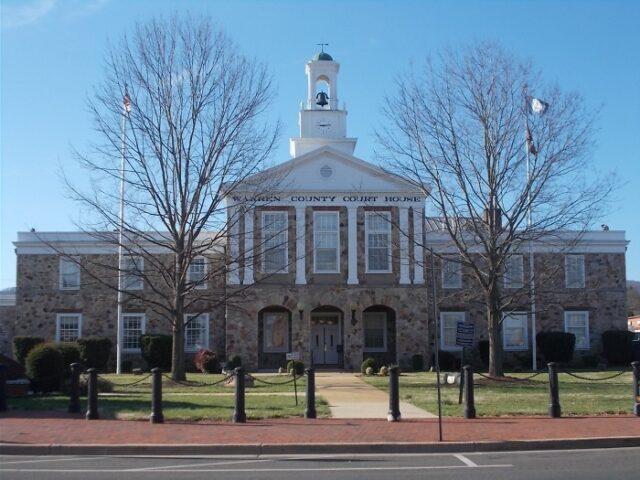
The Warren County Courthouse continues to be ground zero for EDA-related activity. Royal Examiner File Photos/Roger Bianchini
As Royal Examiner reported on September 11, that day Shenandoah District Supervisor Tom Sayre was awarded $20,000 of $25,000 in damages he was seeking in a General District Court defamation civil suit against former Front Royal-Warren County Economic Development Authority Executive Director Jennifer McDonald.
Sayre awarded $20,000 in defamation suit against former EDA director
While an overview of the case and Judge Ian Williams’ decision and damages ruling was presented in that linked story, there was quite a bit of courtroom drama that led up to that decision that went unreported due to time constraints. We will endeavor to fill in some of that detail now. And with neither side in the case requesting a court reporter for day two of the trial, this is the best you’re going to get.
As Sayre took the stand to open day two of his defamation lawsuit against McDonald there soon were tears from the plaintiff upon recalling the moment he discovered he had been implicated in a series of alleged criminal incidents targeting McDonald and the EDA headquarters.
Sayre based his $25,000 General District Court claim of defamation of character upon the presence of his office cell phone number and the instruction “Do not call Tom during business hours” on a crumpled note McDonald pointed out to Warren County Sheriff’s Office responders to her June 15, 2017 report of an act of vandalism at her home.
Sayre contended that the typed note, as well as the alleged criminal incidents to which it appeared linked, was fabricated either by McDonald or at her direction as a means to deflect attention from her activities as the EDA’s chief executive that led to her December 2018 resignation and current civil and criminal legal problems. Those problems include being a primary defendant in civil suits brought by the EDA and Town of Front Royal seeking recovery of as much as $20 million and $15 million, respectively; as well as 28 felony criminal indictments stemming from the EDA financial fraud investigation launched in September 2018.

Backdoor men – on April 16 it was not an illegal entry with no signs of forced entry when the FBI and VSP searched the EDA office complex, including the former executive director’s office which was locked down since her Dec. 20 resignation.
Though you might think it would be the defendant crying in this circumstance, it was the plaintiff’s tears that began shortly into direct examination by his attorney Tim Bosson. Asked how he found out he had been implicated in criminal activity targeting McDonald and the EDA, Sayre began to recall an August 2017 phone call from former Royal Examiner Editor Norma Jean Shaw telling him he needed “to protect” himself due to the above-cited references in the vandalism scene note.
“I was in the kitchen,” Sayre began haltingly, as he glanced over his shoulder from the witness chair toward his wife seated behind press row. Sayre’s testimony halted for several minutes as he tried to regain control of his emotions, sobbing gently at times.
Those tears eventually evolved into sometimes confrontational cross examination exchanges with McDonald attorney Lee Berlik that led to admonitions from the bench to Sayre not to critique Berlik’s questions to him: “These are yes and no answers – you were doing real well there for about eight seconds,” Judge Williams told Sayre at one point during the plaintiff’s nearly two-and-a-half hours on the stand.
The eight seconds of court-approved exchange between Berlik and Sayre referenced by Williams was Sayre’s reply to the question, “Did you ever tell the police that Mr. Bianchini (yes, this one) was suspected of cutting the brake wires on your car?”
After a slight pause Sayre replied, “I’m going to answer no,” elaborating that he had three suspects to what he testified was discovered to be sliced brake wires causing warning lights to come on and the vehicle not to start as his wife attempted to leave their property in their Chevy Traverse several years ago.
It would not be the only reference to your humble reporter during the day’s testimony and closing arguments. That is due to Bianchini’s (I hate referring to myself in the third person) day one testimony that McDonald told him details of the vandalism the afternoon of June 15, 2017, during a lengthy meeting at her office. It turned out that conversation came five to six hours before McDonald reported the stone-throwing vandalism of her home at 9:02 p.m. that evening. Also drawing attention to this reporter were the plaintiff’s day one introduction of a series of texts and emails between him and McDonald regarding the vandalism event at her home and her private investigator’s research into the incident.
They were messages largely concerning a potential suspect supposedly connected to Sayre as a past criminal client, who was approached about wearing a wire to draw an admission from Sayre to his involvement. McDonald’s Private Investigator Ken Pullen testified there was neither an ID’ed suspect nor any plan for wiring a suspect during his day one testimony on August 2.
Asked by Berlik during cross examination if he had feared for his safety or that he might be murdered, Sayre explained that he feared McDonald or associates might kill him for crossing the then EDA executive director concerning the Workforce Housing Project. During a June 2017 county board-EDA work session Sayre and fellow county supervisor Archie Fox had questioned McDonald and EDA board Chairman Greg Drescher about the process of that project.

Archie Fox and Tom Sayre were skeptical of some answers given by McDonald and EDA board Chair Greg Drescher concerning the rationale and process of the EDA Workforce Housing project at a June 6, 2017, work session. However, such questions had been on table from media and one council source for eight months.
It was a project that bore questioning, as it evolved from a reported 2014 $10 “gift” from McDonald’s aunt and uncle for whom the EDA executive director maintained a real estate broker’s license and job, to a $445,000 “moral obligation” purchase of 3-1/2 acres by the EDA upon disclosure a previously unmentioned federal tax credit deadline had not been met in 2017. Of course Sayre and Fox weren’t the first to question that and other recent EDA projects. Councilwoman Bébhinn Egger and Royal Examiner had begun asking questions, particularly about Workforce Housing and the ITFederal project over the previous year.
First impression of EDA reply: 383 pages later what have we learned?
“There are people who get knocked off if they know too much,” Sayre explained, referencing the 1983 murder of Front Royal Police Sgt. Dennis Smedley, and another apparently fatal incident involving a local physician he identified as “Doctor Lind”.
“She talked about killing me … that she missed an opportunity to ‘take me out’,” Sayre told Berlik, adding of the still unsolved Smedley murder, “There is a theory he knew too much about drugs in the community.”
The give and take between McDonald’s attorney and Sayre led to Berlik’s closing argument that because the plaintiff believed something in his mind did not mean it was true, or that his client had caused those beliefs to formulate.
Berlik argued that Sayre’s fears were stoked more by Shaw’s phrasing of her warning phone call to him, the recollection of which led to Sayre’ initial battle with his emotions on the stand, more so than the actual presence of his number and the instruction “don’t call Tom during business hours” on the typed note pointed out by McDonald to first responders at the home vandalism scene.

This social media photo of Tom Sayre and Jennifer McDonald during the ITFederal ground breaking ceremony was referenced by Sayre during his testimony – he said it illustrated what he perceived to be a good working relationship with McDonald at the time.
Berlik also questioned whether Sayre had suffered any actual damage from the note and its contents. While Sayre testified he had gone from full-time legal practice to part-time in the wake of the note’s discovery, Berlik elicited the information that his salary at job he took upon cutting back his legal practice, as Human Resources Director at Seton Home School, paid him $93,000 to $95,000 with subsequent Cost Of Living (COLA) increases. However Sayre insisted he had taken about a $10,000 loss of income hit due to his employment shift.
Berlik also referenced previous testimony from witnesses who all indicated they did not believe Sayre’s reputation had been impacted in the community by the alleged conspiracy note.
Sayre countered that he had run into a woman during his current campaign for re-election who said she would not vote for him because of a belief he had been involved in the alleged incidents targeting McDonald. Asked her name by Berlik, Sayre could say only that she lived “up on Freezeland Road”.
Sayre also testified that he had a perhaps unexpected opponent in his run for re-election to the Shenandoah District Supervisors seat. Berlik asked if that opponent, identified as Walter Mabe, was running against him because he believed Sayre had been involved in a criminal targeting of McDonald.
“Where is he? … Where is the woman on Freezeland Road?” Berlik asked during closing arguments. His point to the court was that if either could provide evidence of the plaintiff’s assertion of damage to his reputation, why hadn’t they been produced as plaintiff witnesses.
“I don’t believe it happened,” Berlik said of the Freezeland Road encounter.
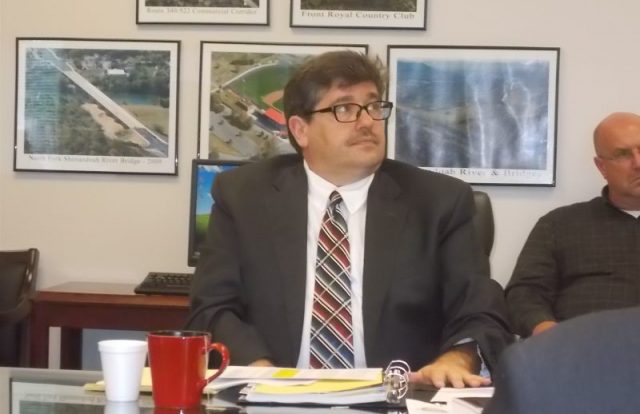
Sayre testified that Bianchini was just one of several he suspected might be involved in a brake line cutting incident on one of his vehicles several years ago. He also testified he had worked to repair the relationship with the reporter.
Berlik also questioned Sayre’s claim of emotional damage. The plaintiff said he suffered a great deal of stress and anxiety about his personal, professional and political future in the wake of information about the note circulating in the community. Sayre said he had talked to a priest, among others, though not in professional clinical treatment settings.
Defense counsel also cited a number of examples involving personal disputes with a variety of people to illustrate that the plaintiff was exceptionally thin-skinned and might take offense where others wouldn’t. Berlik pointed out that others implicated in the note, including Shaw and Michael Graham, had not filed defamation actions as a result.
Sayre attorney Bosson countered by saying the defense “eggshell” ego argument didn’t matter – that if his client was negatively impacted, as he asserted the plaintiff had illustrated he was, that was the bottom line in a defamation case.
“She was trying to destroy me – I called the BAR about it,” Sayre told Bosson on direct examination about fears for his professional future.
Noting his client has never been proved to have been the author of the vandalism scene conspiracy note, defense counsel Berlik pointed to others in the community who might have motive to attempt to set Sayre up for criminal acts out of various personal or professional conflicts with him.
Wait, what – WHO?!?
“We’re not saying Mr. Bianchini threw the rock – but they have a negative history. He had as much motive as anyone,” Berlik told the judge of testimony of past conflicts between the reporter and plaintiff including Sayre’s brake wire cutting suspicion of Bianchini and Bianchini’s filing of a 2011 stalking report involving Sayre around the time of the multi-million dollar SolAVerde tortious interference in a business contract lawsuit against Sayre and then fellow councilmen Chris Holloway and Carson Lauder.
However in his closing argument Sayre attorney Bosson pointed to the past tensions between the reporter and his client brought out by the defense as a positive for the plaintiff’s case. “In a way Mr. Berlik is our best witness – he’s gone out of his way to show Mr. Bianchini doesn’t like Mr. Sayre; so his (Bianchini’s) bias is in the opposite direction.”
Defense counsel Berlik argued that it was Sayre himself, upon being informed of the note and its contents by Shaw in August 2017, who had done the most to spread the information he was implicated throughout the community.
However plaintiff counsel countered that McDonald had played Bianchini with the “off the record” information about the note and investigation in order to get the information spread into the community.
Sayre was asked on the stand about Bianchini’s testimony that he only told four “close associates”, three professional and his long-time girlfriend, in confidence about the information he had gotten from McDonald about her PI’s investigation into the vandalism situation.
“I think he may have forgotten how many people he told,” Sayre replied. (Why is everybody picking on my memory?!? – What were we writing about?)

Bianchini reflective, perhaps pondering suing everyone who has ever questioned his memory due to all the existential emotional angst it has caused him over the years …
In the end the case revolved around two primary arguments – who was a likely author or architect of the note and the reported crimes against McDonald and the EDA offices; and were there actual damages involved, or just Mr. Sayre’s perception of damage where none actually existed.
In closing Bosson said the plaintiff didn’t have to prove McDonald herself wrote the note or threw the rock through her front door window.
“She told Mr. Bianchini that afternoon – how does she know about a crime that hasn’t happened? We are not saying she threw the brick or that she wrote the note. What we are saying is Ms. McDonald knows who threw the brick; what we are saying is Ms. McDonald knows what was in the draft note – she was the one behind it …
“This was all a scam by her to deflect attention off of herself – she may have thought it was for kicks to implicate Tom Sayre in a crime,” Bosson told the court, referencing both the home vandalism and McDonald’s report in May 2017 of a break in at the EDA headquarters.
On the stand Sayre expressed distress at being tied to racial slurs on one of the photos of McDonald and family members discovered at the EDA office after McDonald reported a break-in there on May 17, 2017, about a month before the reported vandalism at her home. The vandalism scene note referenced “Norma Jean” and “the Examiner” waiting for information supposedly taken from the EDA office that day.
At the time Shaw was exploring the large amounts of cash McDonald was using in her real estate business transactions, as well as the presence of the Sheriff as an agent on one of McDonald’s two real estate companies.

McDonald approached this reporter in January 2018 concerning his interest in a story about what she said was a three-year lucky streak at the Hollywood Casino slot machines netting her around $2 million in winnings. State Police report a different outcome, about $750,000 in losses, including what she won over that period.
“This is far from a simple case,” Judge Williams said after a 10 minute recess to formulate his ruling. He cited four elements of defamation: 1/ publication, or perhaps in this case dissemination; 2/ an actionable statement; 3/ recklessness; 4/ false and defamatory information.
Noting that both parties were public figures constantly under public scrutiny, the judge observed, “They must be thick skinned about such things – but they don’t need to be thick skinned about malice.”
Williams said the evidence must be viewed in its totality, rather than compartmentalized.
“The plaintiff has evidence that the defendant had compelling reasons to use the plaintiff as a dupe in this,” the judge said referencing EDA/County Attorney Dan Whitten’s testimony that “things were falling apart” at the time and that “the defendant had reason to keep a lid on it … She had a reckless disregard for truth” and “reason to shift attention from herself to another public figure,” Judge Williams observed.

What, me worry? Why would municipal and EDA officials worry over McDonald’s suddenly publicly-admitted gambling habit – if she’s winning, it’s not a problem, right?
Conflicting resolutions
Judge Williams then referenced the different outcome he was about to render to the not guilty verdict in McDonald’s criminal misdemeanor false police report case last October 31. Judge W. Dale Houff dismissed the case against McDonald regarding her reported vandalism of June 15, 2017, at her home. That case was initially developed by FRPD investigators based on information supplied by this reporter during a police interview the morning of June 16, 2017. After nearly a year the warrant was brought forward by the Virginia State Police on June 13, 2018.
Judge Williams said it was unfortunate the outcomes were conflicting, adding of a key witness in both trials, “Mr. Bianchini’s memory seem to have been rehabilitated.”
The reference was to McDonald criminal attorney David Crump’s October 31, 2018 cross examination question to this witness about a notation on EDA Administrative Assistant Missy Henry’s 2017 calendar about an alleged meeting Bianchini had scheduled with McDonald at 9:30 a.m. Friday morning, June 16. It was then that McDonald and her attorney asserted Bianchini was told about the vandalism of the previous evening at her home, rather than the previous afternoon as he claimed.
Like McDonald, Henry has since been indicted on criminal felony charges related to the EDA financial fraud investigation, though in Henry’s case only two indictments related to disbursement of EDA assets related to the EDA-financed B&G Goods operation in the old Stokes Mart building.
But as Bianchini testified in this defamation trial, if he admitted to an “imperfect memory” and expressed confusion on the stand last October, it was confusion about whether he had scheduled a meeting with McDonald for that Friday morning 16 months earlier, rather than confusion about the Thursday meeting.
And Judge Williams noted that two witnesses called in this defamation trial corroborated key aspects of Bianchini’s testimony. Those witnesses were former EDA Marketing Director Marla Jones and FRPD Investigator Landin Waller. Neither was called as a witness by the prosecution in McDonald’s 2018 false police report trial.
On August 2, 2019, Jones testified that Bianchini was in McDonald’s EDA office for an extended period of time behind closed doors on Thursday afternoon, June 15, 2017, around 3 p.m. She also testified that she did not see Bianchini in the office the following morning. It was that Friday morning that Jones told FRPD investigators that McDonald had told her about the vandalism; and that the two talked for much of the morning.
Also on day one of the defamation trial last month Investigator Waller confirmed that Bianchini had informed him and Captain Crystal Cline in an interview the morning of June 16, 2017, between 10:40 a.m. and 11:30 a.m. about receiving the information about the vandalism from McDonald the previous afternoon.
And as Bianchini testified on day one of this defamation trial, had he been told about the vandalism at a meeting with McDonald within an hour of arriving for his interview at FRPD’s investigative headquarters, he would not have forgotten that – “I probably would have had to go straight from the EDA office to police headquarters,” Bianchini observed on the stand during his August 2 testimony.
And as Bianchini told fellow reporter Josh Gully during a phone interview for his story on the defamation trial, “Anyone can write anything on a calendar at any time”; and that if a meeting had once been scheduled with McDonald for June 16, 2017, it had previously been cancelled.
But without the corroborating witness testimony and no redirect examination to explain his hesitancy in response to the June 16, 2017 morning meeting question posed by the McDonald defense on October 31, 2018, Judge Houff dismissed the criminal case against McDonald without the defense even having to present its case.
However 10-1/2 months later the civil litigation surrounding McDonald’s vandalism report would have a different outcome.
As previously reported, after hearing nearly 3-1/2 hours of testimony and arguments on day two of the trial, Judge Williams awarded Sayre $5,000 in damages, $15,000 in punitive damages, and $676 in court filing costs. McDonald has 10 days from the judgment to file an appeal to Circuit Court.
Settle down boys
In another ruling, Williams declined to impose sanctions on either attorney for their conduct in or out of court during this case.
“There has been some hostility in this case … at times moderate to heavy … about what a dog the opponent was,” Williams said of the attorneys, describing “braggadocio” from both sides on how tough they were going to be in seeking a successful resolution for their clients.
In fact as Bosson and Berlik argued a motions point during last Wednesday’s hearing, Judge Williams admonished them at one point, “Now both of you, sit down.”
Despite the theatrics and contentious nature of the case, Williams said, “I am not inclined to sanction either side in this case.”
Bosson argued for some sanction against Berlik for attempting to bury the plaintiff in motions filing in the case’s earlier days. In fact during a March hearing the number of motions filings and legal hours spent on the case led the judge to question how much money the two sides were spending in a case with a maximum recovery cap of $25,000.
“It’s very curious – but I’m giving you more time to arrange the deck chairs on the Titanic,” Williams famously observed of the hours and expense of the case on March 30 when he put a lid on further motions hearings.
In fact costs were a point of testimony during Sayre’s lengthy cross examination last week. Berlik asked the plaintiff if his legal costs had reached $77,000. Sayre replied, “No, they are much less than that,” estimating them at $6,000.
Following the trial’s adjournment outside the courthouse Bosson explained to the media that he had taken a flat up-front fee of $6,000, with a percentage of the award granted by the court. Typical percentage arrangements could add another $6,000 to Sayre’s legal fees.
While Bosson indicated he and his office had actually put $77,000 worth of legal time into the case, he said he had taken the reduced fee arrangement because he thought it was the right thing to do for his client in this particular legal circumstance.

Tom Sayre, left, and attorney Tim Bosson outside the courthouse following awarding of $20,000 in Sayre’s $25,000 defamation suit against Jennifer McDonald. How much did you say you were making at that human resources director’s job, Bosson may be have been thinking.

Virginia Joins States Challenging Trump Admin Regulations That Limit Free Birth Control Access

Update: Charlotte Swanson Smith (1951 – 2025)

Why We are Challenging the Republican Mass Meeting

Bruce Norman Showman (1954 – 2026)

EDA Relaunches Small Business Loan Program to Help Warren County Entrepreneurs Access Capital

Targeted Exercises to Improve Your Putting

The Hidden Risks of House Hunting Solely Online

Choosing the Right Cleaner for Every Surface in Your Home

New Church Among Consent Items at County Planning Commission Meeting

Warren County GOP Mass Meeting Results Challenged After Allegations of Voting Irregularities

‘This Is About Equity’: In Richmond, Virginia Workers, Lawmakers Push for Inclusive Labor Rights for All

After Five Years of Attempts, Virginia On Track to Set Up a Prescription Drug Affordability Board

New Drug Take-Back Box at Warren County Sheriff’s Office Offers Safe Way to Dispose of Medications

‘Feeding Our Neighbors’ Continues Local Effort to Provide Free Meals in Front Royal

Blair David Eller (1963 – 2026)

Writing Workshop at Samuels Public Library Aims to Help Community Communicate More Clearly

Simple Steps to Reduce Wildfire Risk Around Your Home

Lyme Disease Cases Continue to Rise as Tick Season Returns

County Receives 5 More FY-27 Budget Overviews Prior to Closed Meeting on Administrator Search & Business Expansion

Belle Grove Opens March 21 With First Public Viewing of Memorial Quilts Honoring Enslaved Individuals

Iran At a Crossroads: Democracy, Monarchy, and the Lessons of the 1950s

Federal Judge Upholds Ruling That Certain Ex-Felons Should Not Automatically Lose Voting Rights

Virginia Lawmakers Explore Autonomous Technology for Transportation

Misconceptions About Multiple Sclerosis
