
Local Government
New hospital gets final rezoning OK – but is the ‘Birth Local’ fight over?
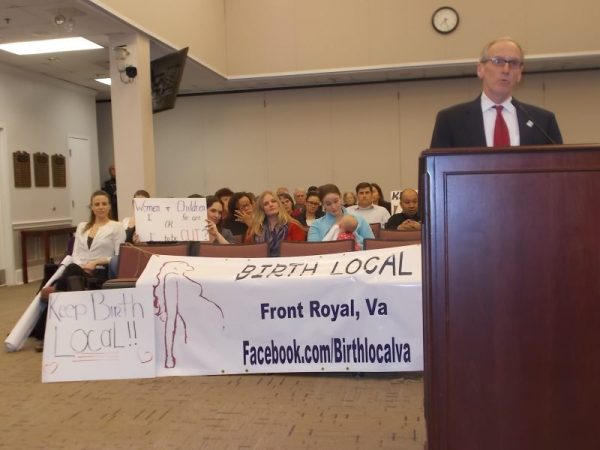
FRONT ROYAL – Faced by a half-meeting room full of supporters of “Birth Local” efforts to alter the course of Valley Health’s plan to, not only eliminate birthing services in its new hospital, but also shut them down in a week (May 1) in the current Warren Memorial Hospital, a torn Front Royal Town Council gave second and final-reading approval of the rezoning that will enable Valley Health’s construction of a nearly $100-million new Warren Memorial Hospital.
As it was at the March 26 first reading approval, the April 23 second vote was 5-0 with one recusal – Jacob Meza due to his management position with Valley Health. But before that already once-delayed, final vote council heard from 15 speakers during the public concerns portion of the meeting, 13 asking council to further delay final rezoning approval to apply additional pressure to bring about a change of Valley Health’s plan to further centralize birthing services at its main regional hospital, Winchester Medical Center.
The other two speakers were Valley Health President and CEO Mark Merrill and WMH President and Valley Health Vice-President Floyd Heater, who stood by the company’s rationale and statistics supporting their decision on exclusion of local birthing
services. That decision, they reiterated, is based on an average of less than a birth a day – about 330 a year – at WMH.
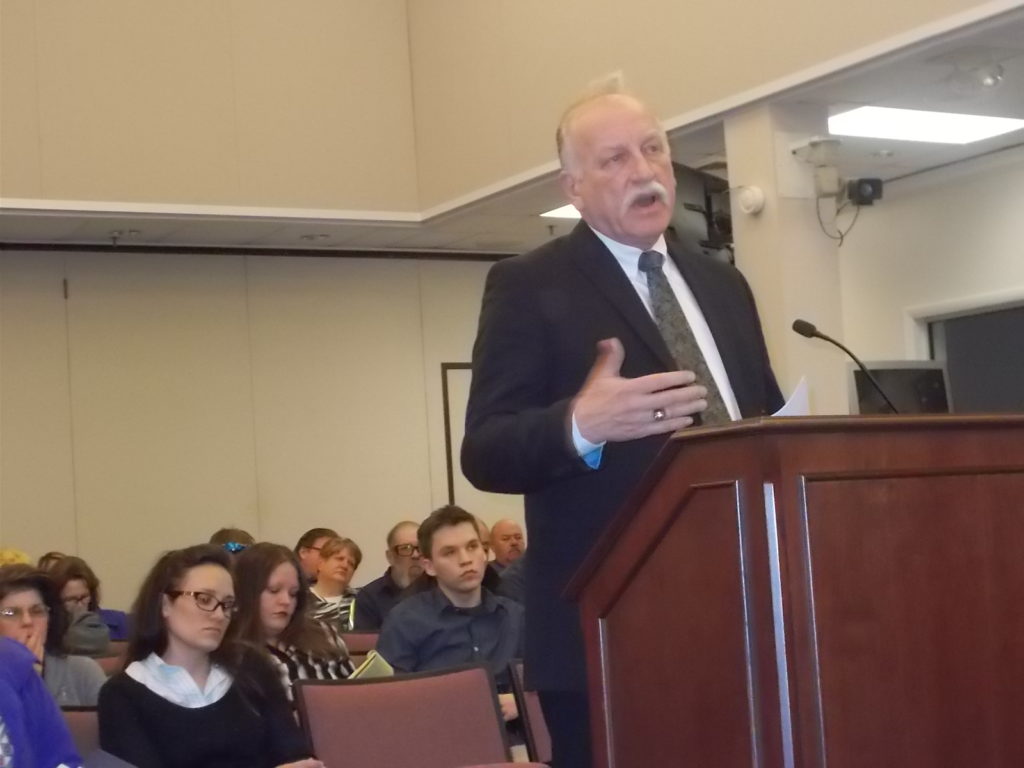
As he did here at the public hearing, on Monday WMH President Floyd Heater explained the Valley Health side of the story. File Photo/Roger Bianchini
Warren Memorial President Heater added that currently six of 10 pregnant women in the county choose not to utilize WMH; and that a third of those pregnancies already make the decision to utilize Winchester Medical Center to give birth.
However, as some speakers pointed out, that hospital is some 23 miles northwest of the current WMH on Front Royal and Warren County’s north side; and much further – an hour or more travel time – from southern and eastern portions of Warren County. Critics of Valley Health’s decision also argue that the elimination of local services will most negatively impact women with less financial resources, including transportation, who are more bound by circumstance and need to giving birth locally.
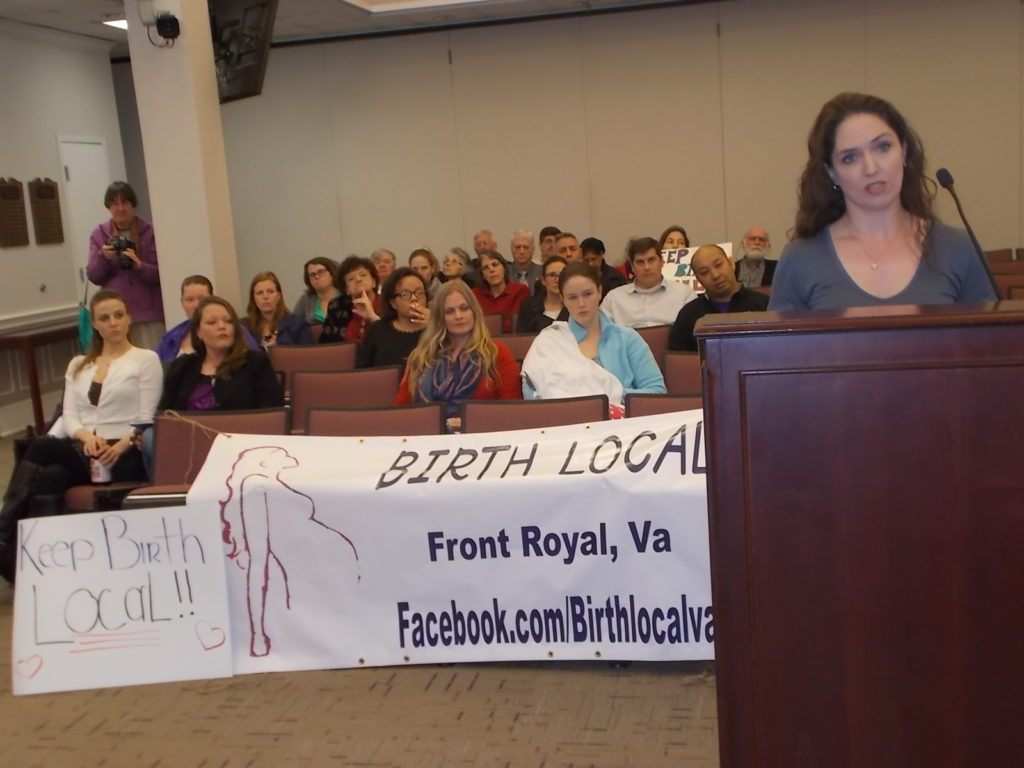
‘Birth Local’ co-founder Melanie Salins questioned not only maternity, but multiple planned departmental and space cutbacks in the new hospital’s plan.
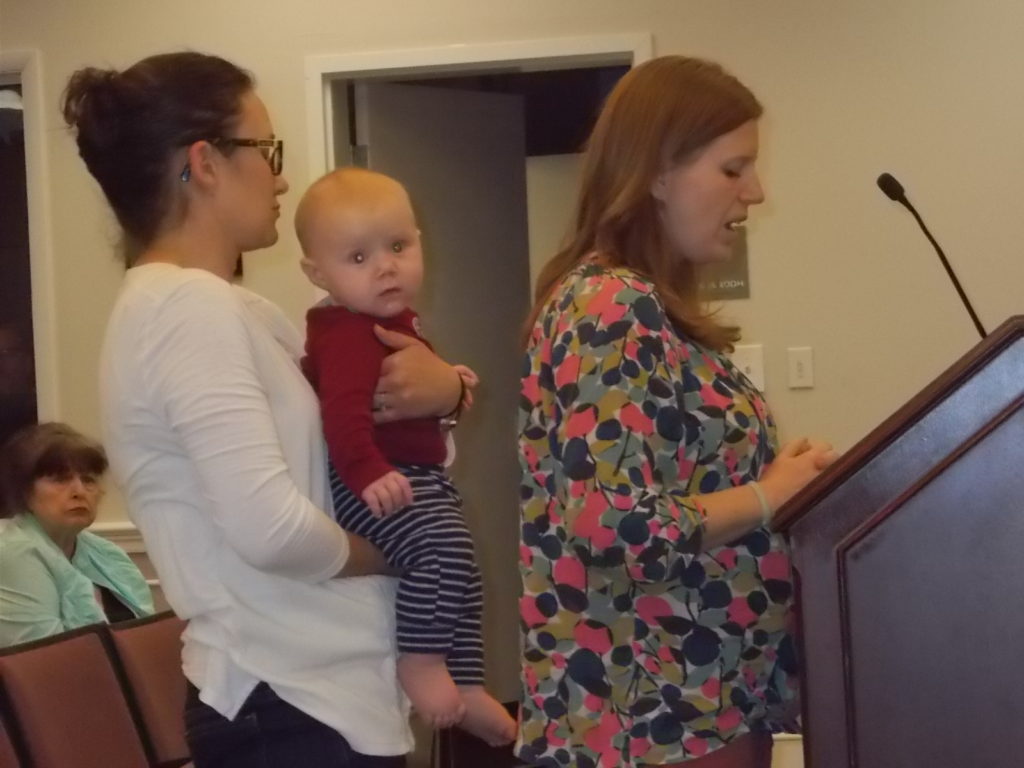
As Naomi Zapetta gives a personal account of the delivery of 7 of her 8 children at WMH, a friend holds the result of one of those successful local birthing stories.
As they have at past public appearances before the town and county government, “Birth Local” founders Melanie Salins, Michelle Matthiae and some supporters focused on statistics indicating negative health consequences of reduced birthing services in rural locations. But increasingly a faith-based, pro-life contingent has been drawn to their cause – and on Monday night that support peaked, both prior to the 7 p.m. meeting and during public comments to council.
About 40 minutes prior to the 7 p.m. start of the council meeting a contingent of about 20 people from the local Catholic community rallied at the main entrance to the Warren County Government Center under the banner of the Knights of Columbus to pray the rosary in support of keeping birthing services local. And inside several of those participating in that prayer vigil rose to speak in support of the “Birth Local” cause.
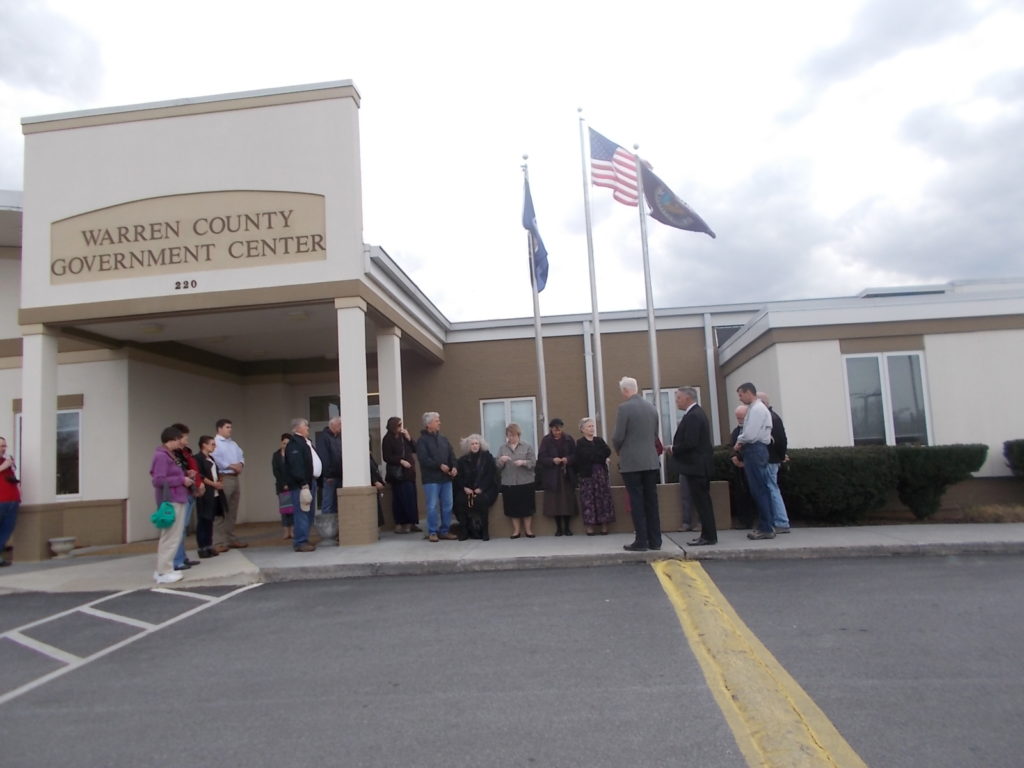
The Knights of Columbus rallied supporters of ‘Birth Local’ to say the rosary outside the WCGC prior to Monday’s meeting and final rezoning vote.
Some of those speakers invoked a “pro-life” message, pointing to protection of the community’s weakest members; others challenged councilmen on a higher-than-earthly calling to do what they believe is right, rather than what may be secularly legal regarding the parameters of municipal rezoning decisions.
As prior to the March 26 first vote of approval and again on April 9 when council did vote to delay a second-reading vote of approval, council continued to express sympathy with the “Birth Local” cause. In fact, at an earlier point in the meeting an amended Resolution seeking that Valley Health and WMH “reconsider their decision to discontinue the labor and birthing center at both the existing and new Warren Memorial Hospital” was passed by a 5-0 margin (Meza recusing) on a motion by John Connolly, seconded by William Sealock.
However, also as at previous points in the approval process council members noted that what they were voting on was not agreement or disagreement with the Valley Health decision on what will or will not be included in the new hospital, but rather on “whether an applicant is in compliance with a community’s comprehensive plan and zoning purposes”. That comp plan and zoning purpose obviously includes facilitation of continued quality community health care services in an appropriate location.
Despite ‘Birth Local’ advocates question as to whether Valley Health’s plans will provide that ongoing quality health care, the aforementioned council Resolution also noted that the “Town Council and Front Royal enthusiastically supports the rezoning request of Valley Health Systems for a new Warren Memorial Hospital.”
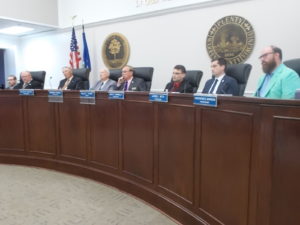
The town council approved a Resolution asking for Valley Health’s reconsideration of its birthing decision while expressing its ‘enthusiastic support’ for the rezoning, which it then also approved.
Consequently as with the March 26 first vote of approval, while perhaps all five councilmen voting on the matter sympathized with their constituents’ concerns, they all again voted to approve the rezoning request to Mixed Commercial Development (MCD)
from the current Residential Suburban (RS) and Agricultural One (A-1) zoning for Valley Health’s 147-acre parcel off Leach Run Parkway. After a brief silence upon the mayor’s call for a motion, Councilman Sealock made the motion to approve, seconded by Vice-Mayor Eugene Tewalt.
The most telling pre-vote comment was made by Councilman Connolly. Perhaps speaking most directly to his fellow Catholics in the crowd who urged a decision of belief above law, the Christendom College alumnus recalled the oath of office he took as a town councilman.
“I know it’s very easy to come before council and say ‘It doesn’t matter – break Virginia law – see if you can get away with it.’ But there is one particular hang up for me that prevents me from taking that attitude; and that is when I was selected to town council I went down to the courthouse and I raised my hand to God and I swore an oath that I would uphold the law. So my predicament is if I break the law, I break an oath I have sworn to God. That is very troubling to me and I cannot do that,” Connolly concluded in explaining his coming “yes” vote on the rezoning application.
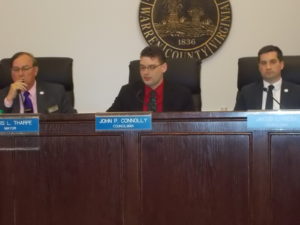
Flanked by Mayor Tharpe, left, and Councilman Meza, neither of whom had to vote, John Connolly explains his dilemma in being asked to put personal preferences above the law in a rezoning vote.
During discussion of the Resolution urging further negotiations on the local birthing issue, Connolly noted his “disappointment” in Valley Health’s decision, a decision he called “shortsighted”; and he continued to urge movement toward a “creative alternative” to the outright elimination of birthing services in the community.
Is the fight over?
Following the vote and a recess in the meeting called by Mayor Hollis Tharpe, Royal Examiner asked Valley Health President and CEO Mark Merrill after all he had heard from both council and citizens that night would he be open to continue negotiations on some sort of meaningful compromise even though the rezoning was now accomplished. Merrill said he and Valley Health were open to continuing such discussion.
Told of Merrill’s comment, “Birth Local” co-founder Michelle Matthiae expressed some skepticism, noting that in recent weeks she had “reached out twice” to Valley Health and its CEO for further dialogue with no reply.
With Valley Health appearing fully committed to its decision not to add a maternity unit until they believe local birthing statistics at WMH justify it economically, some have suggested the most viable compromise would be Valley Health providing some necessary support for continued birthing services here through a third party medical provider dealing in such services.
One person involved in previous discussion between the two sides cited a Valley Health response that such a multi-faceted solution would be “too difficult”. Valley Health critics have publicly wondered “too difficult” or “too compromising” to what they feel is an emerging and more financially-motivated Valley Health monopoly on regional health care.

Tough crowd – Valley Health CEO Mark Merrill explains his company’s perspective on hospital cutbacks as the ‘Birth Local’ side of the room listens skeptically.
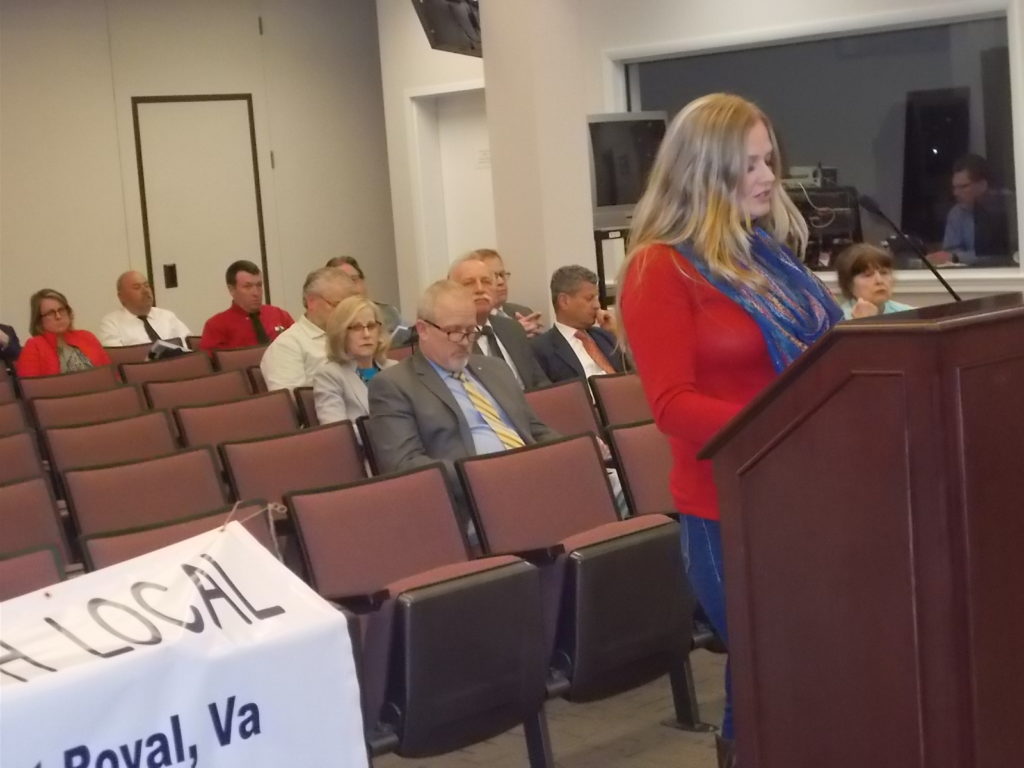
‘Birth Local’ co-founder Michelle Matthiae called council’s tough spot ‘a moral crossroads’. She also late expressed skepticism at an ongoing Valley Health promise of continued negotiations on a compromise solution

New Church Among Consent Items at County Planning Commission Meeting

Warren County GOP Mass Meeting Results Challenged After Allegations of Voting Irregularities

‘This Is About Equity’: In Richmond, Virginia Workers, Lawmakers Push for Inclusive Labor Rights for All

After Five Years of Attempts, Virginia On Track to Set Up a Prescription Drug Affordability Board

New Drug Take-Back Box at Warren County Sheriff’s Office Offers Safe Way to Dispose of Medications

‘Feeding Our Neighbors’ Continues Local Effort to Provide Free Meals in Front Royal

Blair David Eller (1963 – 2026)

Writing Workshop at Samuels Public Library Aims to Help Community Communicate More Clearly

Simple Steps to Reduce Wildfire Risk Around Your Home

Lyme Disease Cases Continue to Rise as Tick Season Returns

County Receives 5 More FY-27 Budget Overviews Prior to Closed Meeting on Administrator Search & Business Expansion

Belle Grove Opens March 21 With First Public Viewing of Memorial Quilts Honoring Enslaved Individuals

Iran At a Crossroads: Democracy, Monarchy, and the Lessons of the 1950s

Federal Judge Upholds Ruling That Certain Ex-Felons Should Not Automatically Lose Voting Rights

Virginia Lawmakers Explore Autonomous Technology for Transportation

Misconceptions About Multiple Sclerosis

Five Reasons to Consider a Career in the Community Sector

Frederick County Cattle Carrier Crash – Animals Still Reported At Large

‘Grow Up’: Former Republican Delegate Defends Civil-Rights-Themed Mailers in Redistricting Fight

Virginia One Step Closer to Probation Reform With Bills Headed for Spanberger’s Desk

Merit Versus Reality: Town Council Weighs Priorities Against Finance

Blue Ridge Wildlife Center Patient of the Week: American Beaver

POLICE: 7 Day FRPD Arrest Report 3/9/2026

Discover Rotary with the Rotary Club of Warren County
