
Local News
Passions Flare at Warren County School Board Meeting Over Curriculum and Policy Disputes
A routine work session for the Warren County School Board on February 19 quickly escalated into a heated debate over classroom content, school policy enforcement, and the board’s role in ensuring transparency for parents and the community.
At the center of the discussion was board member Melanie Salins, who attempted to amend the agenda to include a discussion on what she described as a “biased curriculum” being taught at Warren County Middle School. She also sought to move a discipline report to align with the School Resource Officer’s (SRO) report and insisted that a third employee be included in a closed-session disciplinary discussion for allegedly displaying a Pride flag in a classroom.

School Board members Tom McFadden and Melanie Salins.
Her motion was met with resistance from board members Antoinette Funk, Andrea Lo, and Kristen Pence, setting off a tense back-and-forth that highlighted deep divisions within the board.
Debate Over Curriculum and Transparency
Salins pushed for discussion, arguing that complaints about the middle school curriculum had been circulating for over a week and needed urgent attention.
“We have parents coming to us with concerns,” she said. “We have to be willing to have these hard conversations.”
She cited multiple complaints from members of the local Republican Party, who alleged that an eighth-grade civics lesson had misrepresented the Republican National Committee’s (RNC) platform. She expressed concern that failure to address the issue could lead to legal repercussions.
“If we do not take action tonight, the next step will be to hear from an attorney from the RNC,” she warned. However, board member Andrea Lo questioned the timing of the request.
“I do feel like that sounds a little bit last-minute,” Lo said. “I feel like maybe that’s something we could talk about for a future meeting. I don’t know about putting people on the spot who haven’t prepared for that discussion.”
Salins, however, countered that the board had already received information about the issue and should be prepared to discuss it. “It wasn’t one day. It’s continued,” she said, pointing out that an email sent before the meeting confirmed that the lesson was still being discussed in classrooms. “We cannot continue for another 10 days, two weeks, however long, before we have this conversation.”
Lo and Funk suggested that concerns over a single lesson should be handled at the school level, not by the board. “If there’s a problem with the lesson, that would be something for the principal to address with the staff member,” Funk said.
Salins argued that the issue was more serious than just one lesson. “The root of the issue with this lesson was the teaching of factually untrue information presented as if it were fact and cited as being taken directly from the RNC platform,” Salins said.
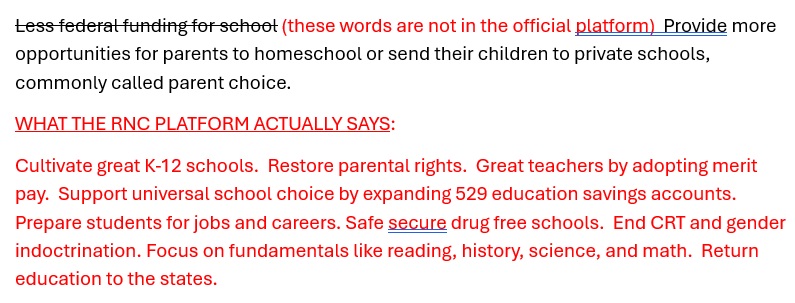
According to Salins, the material presented to students contained factual inaccuracies, misleading summaries, and omitted critical details from the official RNC platform. Below are the key discrepancies she identified, taken from the materials:
Education Policy: The lesson claimed Republicans support “less federal funding for schools,” but the RNC platform actually emphasizes parental choice, expanding school options, and restoring education decisions to states.
Immigration: The lesson stated that Republicans support “mass deportation” and “removing undocumented people” while strengthening ICE. The RNC platform, according to Salins, focuses on enforcing immigration laws to reduce crime, targeting known gang members and drug dealers, and returning trafficked children to their home countries.

Energy Policy: The material given to students summarized the RNC stance as “increase oil drilling to outproduce the rest of the world.” Salins says the actual platform advocates for expanded energy production across multiple sources, including natural gas and coal, while streamlining permitting processes.

Healthcare: The lesson allegedly mentioned “single-payer healthcare,” a policy typically associated with Democrats, when summarizing Republican views. The RNC platform, according to Salins, promotes healthcare competition, affordability, and Medicare protection.

Economic Policy: The lesson included statements about “placing tariffs on importing countries” and “cutting federal spending means taking money out of services.” Salins contends that the RNC platform actually prioritizes tax cuts, reducing regulations, strengthening domestic manufacturing, and ensuring financial stability for seniors.

Additionally, Salins pointed out that the lesson omitted several major issues outlined in the RNC platform, such as housing affordability, higher education costs, veteran care, religious liberty, and election integrity. The platform states, “REDUCING higher education costs.” One word change can change meaning. For example, the teacher’s lesson stated the RNC was “anti-immigrant.” The RNC is NOT anti-immigrant. They are anti-ILLEGAL immigration.

Salins argues that civics education should focus on how government works rather than influencing students toward any political ideology. She has called for greater accuracy in classroom materials and adherence to Virginia’s Standards of Learning (SOL), which do not require teaching party platforms.

She also raised concerns over a survey distributed to students without parental consent. A survey was given without parental notification or consent that asked political questions as well as questions about religion and race,” she said. “We should not be trying to create conflict between our middle school students in class.”
The Pride Flag Controversy
Another point of contention was Salins’ insistence that a teacher displaying a Pride flag in the classroom should be included in the closed-session disciplinary discussion.
She argued that displaying the flag was a violation of school policy and needed to be addressed immediately. “I just want to clarify—so you’re content to not discipline an employee in direct violation of policy?” she asked the board.
Funk responded, stating that board members had different interpretations of the policy and that she stood by the agenda as written. “I’m content with the vote that we have,” Funk said.
Salins, frustrated with the response, replied, “I’m glad that you’ve stated as such.”
Tensions Rise Over FOIA Concerns
Beyond the disagreements over curriculum and policy, Salins raised a larger concern: she believed that the way the issue was being handled violated Virginia’s Freedom of Information Act (FOIA) laws.
“To be clear, the entire board had been made aware of the issue in the civics class for well over a week,” Salins explained. “I was told it would be added to the agenda, but it was placed under the ‘closed session’ items. Discussion of lesson plans and curriculum does not qualify for a FOIA exemption to allow it to be discussed in closed session.”
She further stated that she had alerted School Board Chair Pence that morning about the legal issue, explaining that while disciplinary actions could be discussed in private, the curriculum itself had to be debated publicly. “I believe the manner in which this entire issue was discussed in closed session is a violation of FOIA law,” Salins said.
A Deeply Divided Board and a Community Watching Closely
The tension in the room was evident. At one point, laughter from the audience prompted Pence to call for order. Salins said, “I don’t get intimidated by people who are laughing and making fools of themselves.”
Ultimately, the board voted 3-2 against Salins’ proposed agenda changes, with Funk, Lo, and Pence voting against them, while Salins and Thomas McFadden voted in favor.

School board members Andrea Lo and Antoinette Funk.
Despite the setback, Salins and McFadden made it clear they would continue pushing for answers and action. “How many times do we hear constantly, ‘The board doesn’t do anything’?” Salins asked. “Well, let’s take action.”
Meanwhile, Funk and the majority of the board emphasized the importance of careful deliberation and process. “I believe we are interpreting things differently,” Funk said. “And my interpretation and understanding of the processes to which we have at this point, I’m content with this vote that’s on the floor.”
With no resolution reached, the debate over curriculum content, political influence in classrooms, and school policy enforcement remains a pressing and divisive issue in Warren County.
Watch the discussion on this Royal Examiner video by Mark Williams.

Business Growth Series: Why Good Businesses Still Struggle to Grow

Brownies with Mini Chocolate Easter Eggs

Shenandoah Downs Opens 11th Season April 11 with Tribute to Roger Hammer

We Don’t Know Everything About DNA

How PAAS Came to Dominate the Easter Egg Dye Tradition

Spanberger Signs Bipartisan School-Safety, Student Support Bills Into Law

Melanie J. Pomeroy (1958 – 2026)

David Benjamin Heller (1990 – 2026)

1776 Wasn’t Just About Independence

Three-Tiered System for Urban Agriculture Based on Lot Size Takes Shape at Town Planning Commission Work Session

Child Abuse Awareness Month Brings Focus to Reporting, Prevention in Warren County

National Dental Hygienists Week: Is Your Oral Care Routine Optimal?

The Coin That Traveled Through Time and Space

One “What If?” Question Is Changing the Future of Farming

AA Speaker to Explain Recovery Program at United Methodist Men’s Dinner
Jeannette M. Hyland (1944 – 2026)

Allen William Derflinger II (1959 – 2026)

Warehouse Clerk: A High-Demand Job—Even With Robots

FDA Cracking Down on Compounded GLP-1 Drugs

“Christmas in April” or Overspending? Budget Draws Criticism

Court Ruling Voids Prince William Data Center Rezoning, Raising Stakes for Local Debate

Spanberger Signs First Bills Targeting Healthcare, Housing and Energy Costs

Blue Ridge Singers Spring Concerts to Showcase Powerful Blend of Voices and Brass
What Counts as “Good Policy” Depends on Who’s in Power
