
Local News
School Board approves new head lice policy
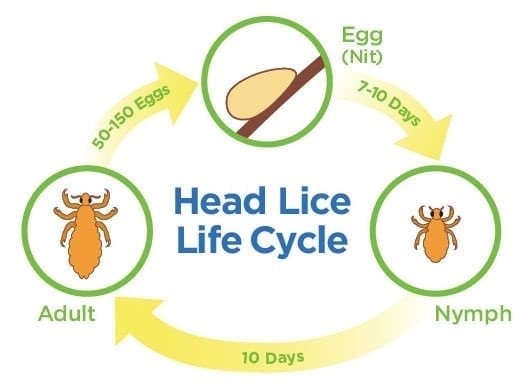
Head lice have three forms: the egg (also called a nit), the nymph, and the adult. Photo from Lice Clinics of America.
Warren County Public Schools (WCPS) now has new regulations in place for managing pediculosis, commonly known as the infestation of head lice.
“It is the position of the school system that the management of lice should minimally impact students and minimally impact their attendance,” WCPS Director of Special Services Michael Hirsch told members of the Warren County School Board during their Wednesday, October 16 regular meeting. “So, we looked at our policy because we review all of our policies on a regular basis” to update them.
Hirsch outlined for School Board members what lice can and cannot do.
“They can’t hop; they can’t fly. The only way they transfer is by direct contact,” he said, adding that it’s “very, very uncommon” for lice to transfer between people via clothing, scarves, coats, hats and other personal items, like combs and brushes.
The most common way lice transfer is by head-to-head contact, said Hirsch.
“They can be a nuisance. They do not spread disease,” he said. “Personal hygiene and cleanliness in the home and the school has absolutely nothing to do with head lice.”
In reviewing the policies of surrounding school districts, Hirsch said WCPS was found to be the only school division with a no-nit policy, meaning if a student has live nits or lice, he or she must be sent home.
There are school divisions that allow live lice, while others permit live lice and nits, he said.
“That made us think very hard … about if we’re on target and supporting our students in the most effective way possible,” said Hirsch. “After a considerable amount of discussion with our nurse team, as well as the administration, we’re recommending that we do allow a nit policy for the students, but not a live lice policy.”
Hirsch recommended to the School Board a policy stating that if lice are suspected, a student will be sent to the nurse for diagnosis. If live lice are not present, then the student goes back to class. If there are some nits, then “our nurses are such caring, wonderful professionals, they’re going to get rid of them,” he said. “They do it every day. And they’ll contact the parent and talk about an action plan.”
Additionally, if there are live lice present, WCPS staff will ask the student to be sent home with both educational literature and free lice treatment kits, courtesy of WCPS and several of its community partners.
“We don’t want any financial burden to fall on the parents to have to deal with this,” Hirsch added.
Following treatment, the proposed policy states that a student may return to school and check in with the nurse. If there are nits, a new action plan will be created with them, but the student will be allowed to return to class.
“If a student has nits, we’ll try to get rid of them right there at the nurse’s office in a private, confidential way,” said Hirsch, “but we’ll allow the student to stay in school because we know that the best place for a student to be is in school.”
School Board Chairwoman Catherine Bower asked how much time infected WCPS students were missing school. Hirsch answered: “significant amounts.”
“There are a lot of various factors,” he said. “But it’s not hygiene; it’s not people being unclean. Sometimes it’s maybe just knowledge about how to get rid of them or the ability to follow through and get rid of them.”
“We just can’t have them missing school and that was the big impetus in having this conversation,” Hirsch added.
Bower said some parents were concerned about the current policy and how it compared to policies in other nearby areas.
Hirsch confirmed that WCPS did get some letters from “very informed and concerned parents about the policy and we take their concerns very seriously.”
A motion to approve the WCPS lice regulations change was made by School Board member James Wells with a second by School Board member Donna McEathron. The members unanimously approved the change, with Chairwoman Bower, along with board members Arnold Williams Jr., C. Douglas Rosen, Wells, and McEathron, voting yea.
Some facts about lice…
Both the American Academy of Pediatrics and the National Association of School Nurses advocate that “no-nit” policies, which require a child to be free of nits before they can return to schools, be discontinued because:
* Many nits are more than ¼-inch from the scalp. Such nits are usually not viable and very unlikely to hatch to become crawling lice, or may in fact be empty shells, also known as ‘casings;’
* Nits are cemented to hair shafts and are very unlikely to be transferred successfully to other people;
* The burden of unnecessary absenteeism to the students, families and communities far outweighs the risks associated with head lice; and
* Misdiagnosis of nits is very common during nit checks conducted by non-medical personnel.
Who is at risk for getting head lice? Head lice are found worldwide. In the United States, infestation with head lice is most common among pre-school children attending childcare, elementary schoolchildren, and the household members of infested children. Although reliable data on how many people in the U.S. get head lice each year are not available, an estimated six million to 12 million infestations occur yearly among children ages 3 to 11 years. Infestation with head lice is much less common among African Americans than among persons of other races, possibly because the claws of the head louse found most frequently in the U.S. are better adapted for grasping the shape and width of the hair shaft of other races.
Source: Centers for Disease Control and Prevention (CDC)

‘Feeding Our Neighbors’ Continues Local Effort to Provide Free Meals in Front Royal

Blair David Eller (1963 – 2026)

Writing Workshop at Samuels Public Library Aims to Help Community Communicate More Clearly

Simple Steps to Reduce Wildfire Risk Around Your Home

Lyme Disease Cases Continue to Rise as Tick Season Returns

County Receives 5 More FY-27 Budget Overviews Prior to Closed Meeting on Administrator Search & Business Expansion

Belle Grove Opens March 21 With First Public Viewing of Memorial Quilts Honoring Enslaved Individuals

Iran At a Crossroads: Democracy, Monarchy, and the Lessons of the 1950s

Federal Judge Upholds Ruling That Certain Ex-Felons Should Not Automatically Lose Voting Rights

Virginia Lawmakers Explore Autonomous Technology for Transportation

Misconceptions About Multiple Sclerosis

Five Reasons to Consider a Career in the Community Sector

Frederick County Cattle Carrier Crash – Animals Still Reported At Large

‘Grow Up’: Former Republican Delegate Defends Civil-Rights-Themed Mailers in Redistricting Fight

Virginia One Step Closer to Probation Reform With Bills Headed for Spanberger’s Desk

Merit Versus Reality: Town Council Weighs Priorities Against Finance

Blue Ridge Wildlife Center Patient of the Week: American Beaver

POLICE: 7 Day FRPD Arrest Report 3/9/2026

Discover Rotary with the Rotary Club of Warren County

Maureen Cora (Cooper) Valdez (1942 – 2026)

President Trump Secures Trillions in New U.S. Investments as Companies Expand American Manufacturing

Judge Blocks Some of Trump DOJ’s Sweeping Changes to Immigration Appeals

Front Royal Women’s Resource Center to Host ‘Dare to Dream’ Luncheon March 28

Virginia’s Congressional Republicans Urge Trump Admin to Review Legislation to Tighten Oversight of VMI
