
Local Government
Town closed session personnel discussion motions may violate FOIA law on ‘subject’ disclosure
Executive Director of the Virginia Freedom of Information (FOIA) Council Alan Gernhardt says his agency is of the opinion that the closed session motions related to personnel issues made by the Front Royal Town Council on January 27 and February 3, are legally challengeable by State FOIA statutes for full disclosure of the exempted purposes allowing that discussion to occur behind doors closed to the public. Those motions were read into the public record by Lori Cockrell and Jacob Meza, respectively, and apparently reflect language long used by the town council.
A check of Royal Examiner video of the January 27 and February 3 closed session motions verified that the personnel portions were read as printed on the agenda cover sheets: “I move that Council convene and go into Closed Meeting for the following purposes: … (other topics regarding pending legal or real estate transactions specified) “Discussion and consideration of assignment, appointment, promotion, performance, demotion, salaries, disciplining, or resignation of specific public officers, appointees, or employees of any public body, pursuant to Section 2.2-3711. A. 1. of the Code of Virginia.”
At issue for the FOIA Council is the vagueness of the reference to “employees of any public body”.

There was a FOIA and Ethics seminar at the Va. Inland Port on Dec. 9. It was attended by new members of the WC Board of Supervisors and EDA Board and staff, but no Town Council or staff. – Well, the EDA hosted it … Royal Examiner File Photos by Roger Bianchini
What attracted Royal Examiner’s attention to this wording was a closed session motion regarding personnel matters made by the Warren County Board of Supervisors on February 4. Following language identical to the Town motion regarding “the assignment, appointment, promotion, performance, demotion, salaries, and resignation of a specific public officer of the public body;” was added, “I further move that the discussion be limited to the Community Policy Management Team.”
The absence of that qualifying portion in the Town motions led us to call Director Gernhardt of the Virginia FOIA Council in Richmond. He explained that such motions have three essential requirements by FOIA law: to identify a subject; a purpose; and the State Code exemption allowing the public body discussion to take place outside the public purview, behind closed doors.
Gernhardt referenced State Code Section 2.2 – 3712 in support of a the FOIA Council contention that such a vague designation as “employees of any public body” does not do enough to satisfy identification of the “subject” of that personnel discussion.
While acknowledging that FOIA law allows excessive detail on specific personnel situations to be excluded to protect personnel interests and privacy, he referenced past Attorney General (AG) Opinions and case law to support the FOIA Council opinion that an excessively vague description of the personnel “subject” as worded in the Town of Front Royal motions do not comply with FOIA requirements to justify adjourning to closed session for the cited personnel discussion.

To litigate or not to litigate, that seems to be the question quite often lately.
The FOIA Council is an instructional and advisory body on FOIA law and parameters for state municipal and economic development officials, as well as a resource for the media and other citizens.
Its perspective on “subject” disclosure is explained on their website, regarding previous inquiries on similar situations in other jurisdictions.
“As previously opined by this office, a motion to convene a closed meeting must contain all three elements (subject, purpose, and citation) in order to comply with FOIA; a motion that lacks any of these elements is insufficient under the law. We have previously observed that there is often confusion in differentiating between the subject and the purpose of a closed meeting. Conceptually, it may be helpful to think of the subject as what the meeting is about, while the purpose is why the meeting is to be held.
“This office has previously opined that when identifying the subject of a closed meeting, the subject need not be so specific as to defeat the reason for going into closed session, but should at least provide the public with general information as to object of the discussion,” the FOIA Council states.
Look at it this way: acceptable “subject” disclosure could be the “Illegal Ancient Aliens Department”; acceptable purpose would be “the assignment, appointment, promotion, performance, demotion, salaries, and resignation” thereof; while acceptable withholding of information would be “allegations of alien slave trade trafficking within the Illegal Ancient Aliens Department”.
However, Town Attorney Doug Napier said many attorneys working employment or municipal law have a differing opinion on exactly where Virginia law, case histories and past AG’s opinions come down on the issue.
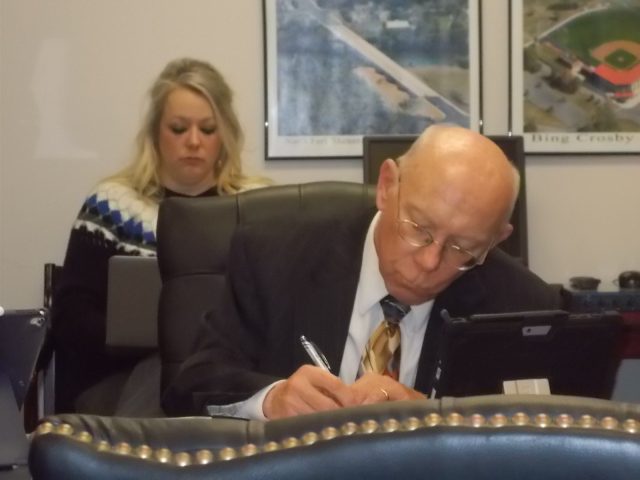
Town Attorney Doug Napier says FOIA law is a multi-dimensional minefield of potential litigation if you get it wrong.
“If a motion is worded in such a way as to give a person’s identity away, I’d say you not do it … It is a gray area of law and a balancing act – you want the public to know as much as possible, but if a personal identity is involved you must be careful, it’s tough,” Napier admitted, adding that were a departmental identity included that was a one-person department, naming the department would essentially identify the person. Then if that person was terminated the following day, the public perception would be that person “must have done something wrong”.
Napier noted that he had voluntarily “conflicted” out of advising the town council on the recent budget-related personnel terminations, noting, “I wanted to be taken out of the loop, I work with some of these people every day.” He said council contracted an attorney he did not name who “specializes in employment law – so I would assume these things were done by the book.”
That may depend on whose book was being read.
Contacted about the closed session motions, Interim Town Manager Matt Tederick said he believed they had always been worded that way, certainly since he came on board as interim mayor in late May 2019 following the resignation of Hollis Tharpe.
“No one is trying to do anything inappropriate – we’re trying to do things by the book,” he said, observing that the Town’s FOIA personnel discussion motion wording originated with Town Attorney Napier and predated recent, controversial personnel developments tied to his FY 2021 Town Budget proposal.

‘We’re trying to do things by the book,’ Interim Town Manager Tederick says – the remaining question is whose book?
However as observed by Napier above, what the Virginia FOIA Advisory Council sees as “by the book” and how some municipal attorneys or their bosses may “read the book” are often at odds.
From the FOIA Council’s perspective “employees of any public body” does not meet the FOIA requirement for specificity as to the “subject” of a closed meeting. Mr. Napier and other municipal attorneys may disagree or chose to err on the side of caution to avoid possible employee litigation for revealing confidential personnel records.
However, as FOIA Council Executive Director Gernhardt told us, litigation sometimes comes from the other side – the public complaining that required FOIA information to justify going behind closed doors is being withheld by elected officials and their staff.
But if the departmental staff or staffs discussed in closed session January 27 and February 3 are unknown, what is known are the staff repercussions in proximity to those dates.
Two days after the January 27 closed session personnel discussion, Interim Town Manager Tederick has publicly disclosed a series of conversations informing Planning Director Jeremy Camp, Community Development Director Felicia Hart, Town Engineer Robert Brown, Council Clerk Jennifer Berry and Planning Department staffer Matt Farace that their services were no longer needed and their terminations were imminent, if not immediate.
Prior to the February 3 closed session, Tederick presented an FY 2021 Budget to council recommending no staff salaries for the Tourism Department in the coming fiscal year that begins July 1.
If Mr. Tederick’s public statements on the reasons for the recommended terminations and future staffing cuts being tied solely to budgetary concerns and a desire to reduce Town operational expenses is taken at face value, it is hard to see Napier’s caution on violating personnel privacy statutes as coming into play on either date in question. Unless of course those decisions had already been made and the personnel matter of the 27th did not relate to those looming terminations.
And were that true, it leads us to the same FOIA compliance question on whatever date those terminations were discussed in closed session, assuming they were. – It is hard to know when they were discussed since the Town closed session motions do not specify the personnel subject to be discussed, which is at the heart of the issue.
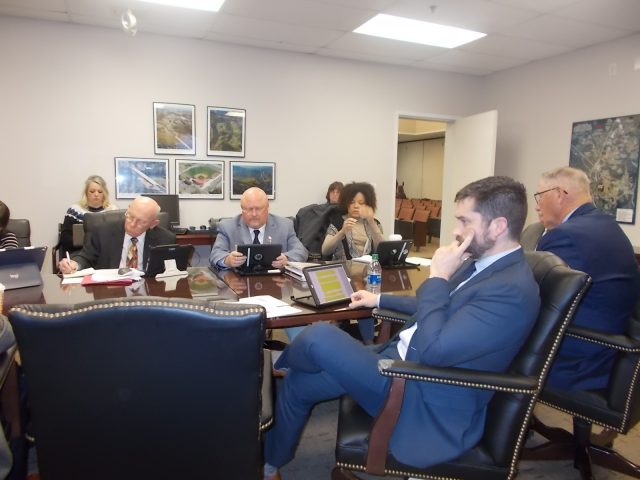
Town Council in open work session mode on Jan. 27, prior to adjourning to closed session to discuss personnel, among other things. Council Clerk Jennifer Berry on the job at back left, was not invited to stay for that discussion.
So, if intentionally or unintentionally, motions to discuss recommended staff terminations behind closed doors were made concealing FOIA-required information whenever those discussions occurred, where does that leave the Town, those employees, as well as town citizens angered by the action and perceived backwards process behind it?
The short answer is that would be up to a judge were a legal challenge of the adjournment to closed session regarding personnel matters on either of the above or any other dates, to be upheld by the courts.
“The public body must still identify the subject in order to make a proper motion to convene a closed meeting. Determining whether any particular motion meets the statutory requirements depends on the facts of each situation and requires a case-by-case analysis,” the FOIA Council notes in its website discussion of previous cases.
Consequences?
We asked Gernhardt about possible consequences of citizen litigation challenging the closed session discussion of the budget-related terminations or any matter found to have been adjourned to without proper FOIA disclosure.
Conceivably, Gernhardt told us the judge could rule the closed meeting or portions of it did not occur and any consequent votes taken are declared void.
Situations have occurred where the judge ordered depositions on the closed meeting’s content from participants and then made those depositions a public record of the illegally convened closed session.
Should plaintiffs prevail, judges have ordered the municipality to pay the plaintiff’s legal expenses. And in some cases, judges have imposed civil penalties of $2,000 to $5,000, ordering the municipality to pay those amounts into the State Literary Fund.
So, it appears the payoff would largely be one of principal and directing future content of Town closed session motions; possibly making the content of a closed meeting ruled illegally convened a matter of public record, as would be any vote or council consensus voiced behind closed doors on such things as terminations.

To litigate or not to … Will anyone choose to legally challenge the Town’s interpretation of FOIA law as it applies to identifying the ‘subject’ of closed meeting personnel discussions?
Tourism, the Visitors Center, staff futures and outsourcing – what does the present and future hold?

‘Feeding Our Neighbors’ Continues Local Effort to Provide Free Meals in Front Royal

Blair David Eller (1963 – 2026)

Writing Workshop at Samuels Public Library Aims to Help Community Communicate More Clearly

Simple Steps to Reduce Wildfire Risk Around Your Home

Lyme Disease Cases Continue to Rise as Tick Season Returns

County Receives 5 More FY-27 Budget Overviews Prior to Closed Meeting on Administrator Search & Business Expansion

Belle Grove Opens March 21 With First Public Viewing of Memorial Quilts Honoring Enslaved Individuals

Iran At a Crossroads: Democracy, Monarchy, and the Lessons of the 1950s

Federal Judge Upholds Ruling That Certain Ex-Felons Should Not Automatically Lose Voting Rights

Virginia Lawmakers Explore Autonomous Technology for Transportation

Misconceptions About Multiple Sclerosis

Five Reasons to Consider a Career in the Community Sector

Frederick County Cattle Carrier Crash – Animals Still Reported At Large

‘Grow Up’: Former Republican Delegate Defends Civil-Rights-Themed Mailers in Redistricting Fight

Virginia One Step Closer to Probation Reform With Bills Headed for Spanberger’s Desk

Merit Versus Reality: Town Council Weighs Priorities Against Finance

Blue Ridge Wildlife Center Patient of the Week: American Beaver

POLICE: 7 Day FRPD Arrest Report 3/9/2026

Discover Rotary with the Rotary Club of Warren County

Maureen Cora (Cooper) Valdez (1942 – 2026)

President Trump Secures Trillions in New U.S. Investments as Companies Expand American Manufacturing

Judge Blocks Some of Trump DOJ’s Sweeping Changes to Immigration Appeals

Front Royal Women’s Resource Center to Host ‘Dare to Dream’ Luncheon March 28

Virginia’s Congressional Republicans Urge Trump Admin to Review Legislation to Tighten Oversight of VMI
