
Local Government
Town Planning Commission Recommends Approval of Proposed Data Center Ordinance
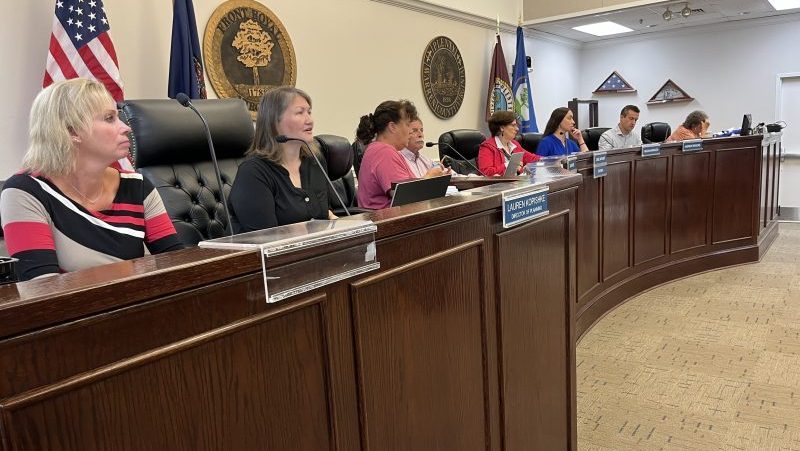
At their Wednesday, September 17 meeting, the Town Planning Commission voted to recommend the proposed data center ordinance, with Commissioner Megan Marrazzo dissenting. Even Marrazzo acknowledged the promethean efforts of staff and commission combined to bring this item to fruition, researching extensively in tandem with legal counsel on how to produce the best set of performance standards possible. The public hearing for this item reflected a public that is fully aware of the unique dangers that a data center would potentially bring to this community, and a desire, therefore, to buttress what is already a robust document to make it even stronger. Many insights into procedure, regulatory mechanisms, and the wider context of living in Front Royal, along with everything that means, were shared as the evening progressed.
Town Planning Commission Recommends Approval of Proposed Data Center Ordinance
Defined in the proposed ordinance, a data center is a use where digital information is processed, transferred, and/or stored, occupying 10,000 square feet or more, where the majority of that space is occupied by computers, servers, telecommunications, and related equipment, including supporting equipment. This use has been famous in its twenty-seven-year history in Northern Virginia for its commanding presence and exorbitant consumption of resources. The effort described by Deputy Zoning Administrator John Ware in his presentation to the commission was one born out of a desire to learn from mistakes, benefiting from the trials and errors of other municipalities, states, and even countries to set up speed bumps, as it were, to keep the data center industry from running roughshod over Front Royal.
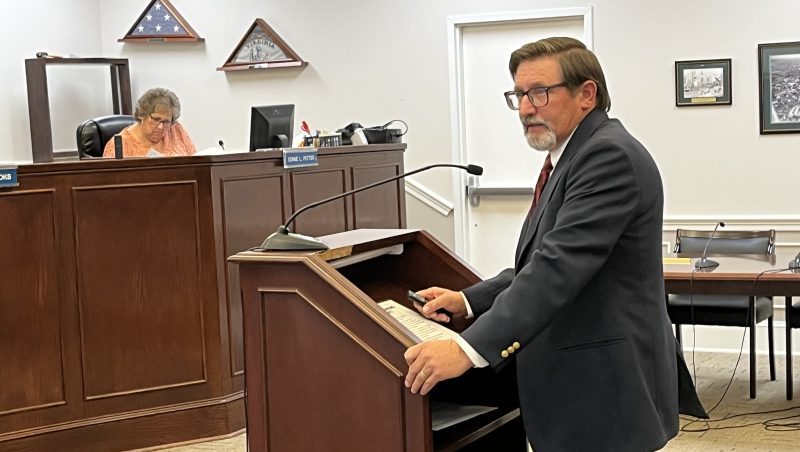
Deputy Zoning Administrator John Ware presents the bulk of the evening’s business to the commission.
This is a many-faceted issue, and the evening’s discussion reflected that. It bears mentioning that Virginia is a Dillon Rule state, meaning that the locality has whatever power is granted to it by the General Assembly; therefore, the locality cannot prohibit something that the state allows, and the state does indeed allow data centers. “As any first-year law school student will tell you,” one citizen remarked, “if you try to ban data centers outright… You will get sued and you will lose in court.” Indeed, the courts have tended to favor the property owners in these cases. The question then becomes: will we have data centers rammed down our throats, or will we develop intelligent procedures and regulatory mechanisms to make the arrival as unobtrusive as possible? Even dispassionate journalism ends at the point where a spade is a spade, and left-hitting protesting does not deserve to be entertained as a viable approach to reality. While some people may choose to rage against the dying of the light, their refusal to go gentle into that good night seems to be based more on a personal preference than a well-articulated position. Performance standards are the stuff of conservatism.

(Above) and (below), two of more than ten people who addressed the commission regarding the data center proposed ordinance being considered and voted upon that evening.

Ware emphasized that there is no application before the commission. This set of standards, covering everything from setbacks to regulations on the use of potable water, is a proactive measure, restricting data centers to the Industrial Employment District (I-2) by special-use permit. This proactive measure would offset the type of existential crisis Front Royal has witnessed with the proliferation of vape shops, where an undefined use crept in with the absence of any performance standards to regulate the use, and proceeded to spawn like a family of wild rabbits. The I-2 restriction puts any potential data center in one of two places: the former Avtex site by the Shenandoah River or the Happy Creek Industrial Park.
The latter is a more likely location as staff may not recommend the former for a variety of reasons, including but not limited to the Comprehensive Plan’s reservation of that area for conservation. That very ability to determine the most appropriate location is an advantage the proposed ordinance would bequeath to the Town Council, should they choose to uphold the commission’s recommendation.
In response to Marrazzo’s concerns about the standards not having yet reached the maximum state of maturity that could be possible, Vice-Chairman Allen Neel, in conjunction with comments from Planning Director Lauren Kopishke, emphasized the review process that will allow the commission and the council to vet and solve problems as they arise. Because technology is advancing so rapidly, the process is naturally fluid and will call for wisdom and discernment from the respective bodies. The point is that said bodies ought to have a framework for making those judgment calls. And now they potentially have it.
Click here to watch the Front Royal Planning Commission Meeting of September 17, 2025.