
Local News
UPDATE: Valley Health announces Crisis Measures in response to surging COVID-19 cases in our region
(Editor’s note: On Sept. 24, Royal Examiner receive the following clarification from Valley Health regarding implementation of the “Crisis Measures” described in their original release below: Clarification: The only procedures being temporarily postponed are at Winchester Medical Center and Warren Memorial Hospital, and are elective or non-emergency cases that will not require an inpatient stay. All patients impacted will be notified by their physician or the hospital.)
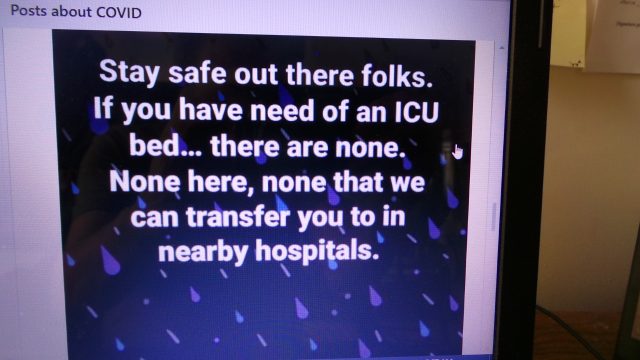
In response to an inquiry about medical staff social media reports of surging COVID-19 numbers filling regional hospital Emergency Rooms and Intensive Care Units, Royal Examiner received a press release from Valley Health on Wednesday afternoon, September 22, announcing “Crisis Measures” being implemented to deal with the pandemic surge. Read the press release in its entirety below the two social media posts that began our inquiry. And remember, as noted in the below caption, the current Coronavirus surge that has now upped the number of lives taken to 687,459 nationwide; 12,634 dead in Virginia; and 68 fatalities in Warren County, is being called “a pandemic of the unvaccinated or not fully vaccinated”.
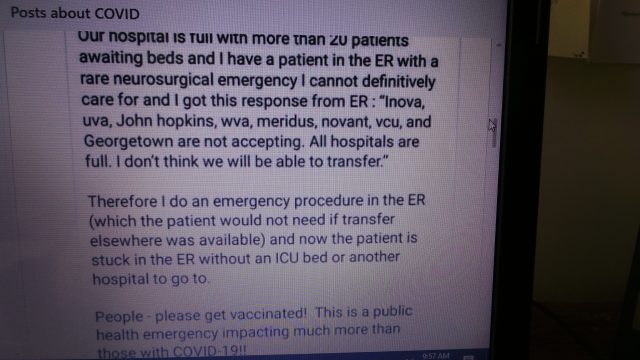
Two social media posts forwarded to Royal Examiner, both addressing a regional ER and ICU space crisis impacting more than just COVID-19 Coronavirus pandemic patients. Is it time for some to rethink weighing online conspiracy theories above scientific and medical analysis? The Phase 4, Delta-variant driven COVID surge has been called ‘a pandemic of the unvaccinated’ with 98% to 99% of initially reported cases, hospitalizations and deaths coming among the un-vaccinated or not completely vaccinated.
Winchester, VA, September 22, 2021 – Valley Health is treating an increasing number of COVID-19 patients and now the health system’s resources are being stretched significantly.
“Our caregivers have worked double shifts, nights, weekends and holidays to save patients and fight COVID-19 in our community. They have shown remarkable resiliency, but they, like all of us, are growing tired. We are asking our community to pull together and help end the spread of this virus,” said Mark Nantz, President and CEO of Valley Health.
Valley Health’s six hospitals are currently treating 140 patients for COVID-19, about 85% of whom are unvaccinated. According to Iyad Sabbagh, MD, Chief Physician Executive, the most severely ill patients are unvaccinated, underscoring the importance of COVID-19 vaccination.
“The data and scientific evidence overwhelmingly points to the safety and efficacy of COVID-19 vaccination,” said Dr. Sabbagh. “I implore residents to get vaccinated, continue to follow masking recommendations and consider implementing social distancing measures such as canceling events where the virus could easily spread. The Delta variant we are now confronting is more contagious than previous versions of this virus and is spreading rapidly in our community.”
According to Dr. Sabbagh, the daily count of hospitalized patients, their acuity level, and vaccination status changes quickly and makes it challenging to provide an accurate snapshot of how many community members are being treated across the system at any point in time.
“Within hours, our count can change dramatically. We are also seeing an increase in the number of patients being dishonest about their vaccination status, which makes it hard to share that data with our community,” Dr. Sabbagh said. He noted that patients fear they will not receive care if they share with staff that they are unvaccinated.
“Our job is to care for every individual who comes to us,” Sabbagh asserted. “While we want the public to know that vaccination is the best way to stop the spread of COVID, we also want them to know that we’re here to care for them, regardless of their vaccination status. It is our mission as healthcare providers.”
Valley Health previously reported that 97% of its caregivers have either been vaccinated or been granted medical or religious exemptions. Additionally, the health system has been very successful in recruiting new staff to fill vacancies left by employees who chose not to comply with the vaccination requirement. Valley Health has seen an increase in new hires, and overall has had a net gain of staff since announcing the policy in July.
“Our challenge is not staffing due to our COVID-19 vaccine requirement. Our challenge is the sheer number of severely ill COVID-19 patients presenting for care at our hospitals,” commented Nantz.
Valley Health’s response to the patient surge includes bringing on additional resources and implementing measures to care for patients and protect staff:
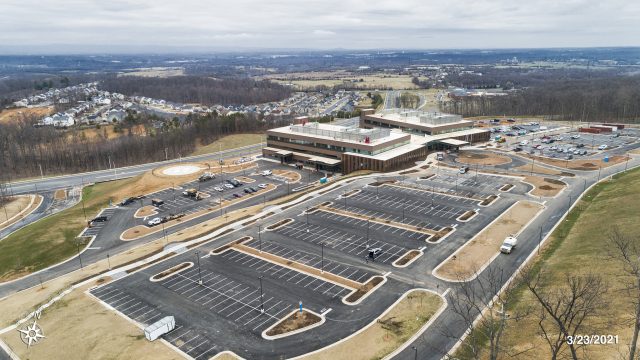
Parking lots may be empty, but not so on the inside. The new Warren Memorial Hospital is one of many regional Valley Health and non-Valley Health medical facilities dealing with a ‘crisis’ of space driven by rising COVID-19 Delta-variant numbers. Courtesy Photo Valley Health
Additional ICU Capacity Added
With all available ICU beds filled last Friday, WMC opened an additional unit to accommodate the number of severely ill patients needing care. As of Sunday, there were 23 COVID positive patients in the Emergency Department with limited bed availability, and all ICUs in the region were taking 24 hours or more to accept transfers.
Hospital Visiting Curtailed
Patient visitation at Valley Health’s six hospitals is being curtailed to reduce the risk of transmission between visitors, patients and caregivers. In the last several weeks, Valley Health has seen an increase in disruptive visitor behavior, including refusal to abide by masking requirements while visiting.
Visitation exceptions are being made at Winchester Medical Center for Labor and Delivery, Mother/Baby, Pediatrics and NICU, and at all facilities for special circumstances including end-of-life care, on a case-by-case basis. Visit www.valleyhealthlink.com/visitation for updates and details.
Elective and Non-Essential Surgeries Postponed
This week, all Valley Health hospitals and outpatient surgery centers will begin postponing elective and non-essential procedures and surgeries. This will not impact procedures and surgeries for patients whose condition is emergent or urgent, as determined by their physician. This decision was made after thoughtful consideration and is consistent with the guidance being provided by governmental, clinical, and regulatory organizations.
“Our top priorities are to protect our care team and all those we are caring for,” said Dr. Sabbagh. He expressed appreciation to Valley Health’s caregivers during the COVID-19 pandemic. “I’ve been so impressed with our team’s commitment, resourcefulness and resiliency,” he said.
“We are still all in this together,” Nantz reflected. “We can help our coworkers, patients, families and friends respond safely, rationally and thoughtfully to create the best possible outcomes. We can listen to one another, be thoughtful, kind, and understand that we are dealing with this crisis together, not separately.”
Visit valleyhealthlink.com/coronavirus for updates on Valley Health visitation policies and other service adjustments.
Valley Health is a nonprofit health system serving a population of more than 500,000 in the Northern Shenandoah Valley of Virginia, the Eastern Panhandle and Potomac Highlands of West Virginia, and western Maryland. As a healthcare provider, employer, and community partner, Valley Health is committed to improving the health of the region. The system includes six hospitals, more than 60 medical practices and Urgent Care centers, outpatient rehabilitation and fitness, medical transport, long-term care, and home health. www.valleyhealthlink.com
(From a Valley Health Press Release)
