
State News
Virginia Senate Panel Advances Gun Safety Bills Once Vetoed by Youngkin
Democratic lawmakers on Monday advanced a sweeping slate of gun safety proposals — many of them previously vetoed by former Gov. Glenn Youngkin — as they test whether Virginia’s new Democratic governor, Abigail Spanberger, will take a more favorable view of firearm restrictions.
Over nearly four hours, the Democratic-led Senate Courts of Justice Committee approved more than half a dozen bills tightening rules on assault-style firearms, gun storage, concealed carry reciprocity, ghost guns, and weapons in public spaces, while rejecting the lone Republican proposal that would have increased mandatory minimum sentences for repeat firearm offenses.
All of the votes fell along party lines.
The meeting came exactly one week after hundreds of gun rights activists gathered around Capitol Square on Martin Luther King Jr. Day for the annual Lobby Day rally, where speakers warned that Democrats were reviving an aggressive gun control agenda after several years of vetoes under Youngkin.
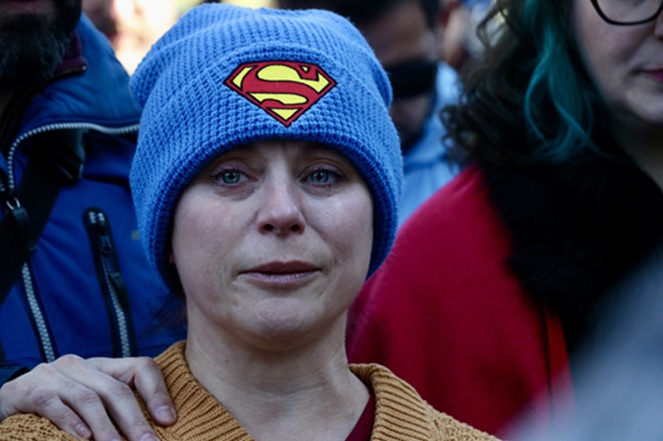
Richmond resident Emily Turner, a friend of the late Adam Turck, who died from gun violence, sheds a tear while participating in a litany outside of Virginia’s state Capitol on Jan. 19, 2026. (Photo by Charlotte Rene Woods/Virginia Mercury)
That rally drew a larger crowd than recent years, reflecting heightened tension as Democrats now control the governor’s office and both chambers of the General Assembly.
Because of time constraints, the committee did not take up an additional package of gun-related proposals that remain pending.
Philip Van Cleave, president of the gun rights group Virginia Citizens Defence League, sharply criticized the committee’s actions, arguing that Democrats were targeting lawful gun owners rather than violent offenders.
“While Democrats have bills to weaken laws on violent criminals, they like and support every bill that in any way infringes on the ability of law-abiding citizens to protect themselves,” Van Cleave said in an email Monday afternoon.
“For years, Democrats said, ‘No one wants to take your guns, we just want reasonable gun control.’ They do want to take our guns away, and the committee reported out bills that do just that with the most popular long guns in America. There is only one reason that a government would want a disarmed population, and that’s to force its will upon that population.”
Assault weapons and large-capacity magazines
On a 9-5 party-line vote, the committee approved Senate Bill 749, sponsored by Sen. Saddam Azlan Salim, D-Fairfax, which would prohibit the importation, sale, manufacture, purchase, possession, or transfer of assault firearms and large-capacity ammunition feeding devices, with limited exceptions.
The bill would create Class 1 misdemeanor penalties but would not retroactively criminalize firearms already legally owned.
Assault firearms manufactured before July 1, 2026, would be exempt, along with antique firearms, permanently inoperable weapons, and manually operated firearms. Exceptions would also apply to law enforcement, military use, and certain transfers between immediate family members.
“Currently, there are so many assault weapons in circulation. This approach will gradually take the weapons off the street without retroactively making it a crime to own a weapon that was legally purchased,” Salim said.
Opponents framed the bill as unconstitutional.
“That’s the purpose of the Second Amendment. That’s why we have firearms — to fight against a tyrannical government,” said Sen. Mark Peake, R-Lynchburg. “And this bill is a direct infringement on the Second Amendment to fight against a tyrannical government.”
Southwest Virginia resident Carla Poff, speaking against the bill, said, “I find this to be a ‘blank’ violation of our Second Amendment.”
Supporters countered that similar laws have survived legal challenges.
Lori Haas of the Johns Hopkins Center for Gun Violence Solutions noted that the Fourth Circuit Court of Appeals recently upheld Maryland’s stricter assault weapons ban. “I think we’re in good standing constitutionally,” Haas said.
Firearms in public college buildings
The committee also advanced SB 272 by Sen. Creigh Deeds, D-Charlottesville, limiting where firearms may be carried in buildings owned or leased by the commonwealth, including public colleges and universities.
The bill narrows an existing exemption so that firearms would be allowed in higher-education buildings only for approved curricular or institutional activities, such as ROTC programs. Violations would be misdemeanors.
“This bill has been introduced three times, in 2023, 2024, and 2025. This is the fourth time,” Deeds said. “It’s passed the Senate, all three times, it passed both houses, and was vetoed.”
Deeds first introduced the legislation following the 2022 University of Virginia shooting that killed three students.
Opponents argued the measure would leave students vulnerable. “Students have a right to self-defense,” said Eric Nolen, who spoke against the bill.
Safe storage in homes
Lawmakers approved SB 348, sponsored by Sen. Jennifer Boysko, D-Fairfax, requiring firearms and ammunition to be stored in locked containers when a minor or prohibited person is present in the residence. Violations would be a Class 4 misdemeanor, and dealers would be required to post notices explaining the law.
“Every single time I’m carrying this bill, there has been a fatality of a small child,” Boysko said, citing recent shootings involving children in Newport News, Chesterfield County and Norfolk.
Previous iterations of the bill had twice been vetoed by Youngkin.
Assault weapons in public spaces
The committee passed SB 312 by Sen. Adam Ebbin, D-Alexandria, expanding Virginia’s prohibition on carrying certain semi-automatic firearms in public places, including streets and parks.
“This was inspired by an incident at the Old Town Farmer’s Market,” Ebbin said, referring to people openly carrying assault-style firearms in Alexandria.
He also cited the 2017 Charlottesville Unite the Right rally and research showing higher casualty rates in mass shootings involving such weapons.
Opponents argued that the bill is overly broad. Sen. Mark Obenshain, R-Harrisonburg, said it would criminalize most modern pistols and “would not last five minutes under any constitutional scrutiny.”
Ghost guns and unserialized firearms
On another party-line vote, lawmakers advanced SB 323, also sponsored by Ebbin, targeting so-called ghost guns and unfinished firearm components. The bill would prohibit manufacturing, selling, or possessing unserialized firearms or unfinished frames and receivers, with delayed effective dates to allow compliance.
“This bill is about keeping guns out of the hands of children, or people prohibited from guns, and traffickers,” Ebbin said.
John Weber of the National Rifle Association argued the bill is unworkable, saying, “There is no process set up to acquire a serial number for a firearm.”
Firearms left in vehicles and concealed carry reciprocity
The committee approved SB 496, sponsored by Sen. Dave Marsden, D-Fairfax, requiring handguns left in unattended vehicles to be stored in locked, hard-sided containers out of view.
“This is where young people are getting these guns,” Marsden said, citing thefts from vehicles as a major source of illegal firearms.
Republicans warned the bill could criminalize victims of theft. Sen. Glenn Sturtevant, R-Chesterfield, said it “essentially criminalizes behavior when someone has been robbed.”
Lawmakers also passed SB 115, sponsored by Sen. Stella Pekarsky, D-Fairfax, tightening Virginia’s recognition of concealed handgun permits issued by other states.
“Basically, it says you can’t just go down to Texas and pay a couple of bucks and then get a concealed weapon permit all around Virginia,” said Senate Majority Leader Scott Surovell, D-Fairfax, the committee chair.
Republican bill rejected
The committee defeated SB 78, sponsored by Sen. Danny Diggs, R-York, which would have increased mandatory minimum sentences for repeat firearm offenses.
“What deters crime is knowing you’re going to get caught,” Surovell said, arguing that harsher penalties alone are ineffective.
Most of the Democratic-backed bills now head to the Senate Finance Committee to determine their fiscal impact.
by Markus Schmidt, Virginia Mercury
Virginia Mercury is part of States Newsroom, a nonprofit news network supported by grants and a coalition of donors as a 501c(3) public charity. Virginia Mercury maintains editorial independence. Contact Editor Samantha Willis for questions: info@virginiamercury.com.

Targeted Exercises to Improve Your Putting

The Hidden Risks of House Hunting Solely Online

Choosing the Right Cleaner for Every Surface in Your Home

New Church Among Consent Items at County Planning Commission Meeting

Warren County GOP Mass Meeting Results Challenged After Allegations of Voting Irregularities

‘This Is About Equity’: In Richmond, Virginia Workers, Lawmakers Push for Inclusive Labor Rights for All

After Five Years of Attempts, Virginia On Track to Set Up a Prescription Drug Affordability Board

New Drug Take-Back Box at Warren County Sheriff’s Office Offers Safe Way to Dispose of Medications

‘Feeding Our Neighbors’ Continues Local Effort to Provide Free Meals in Front Royal

Blair David Eller (1963 – 2026)

Writing Workshop at Samuels Public Library Aims to Help Community Communicate More Clearly

Simple Steps to Reduce Wildfire Risk Around Your Home

Lyme Disease Cases Continue to Rise as Tick Season Returns

County Receives 5 More FY-27 Budget Overviews Prior to Closed Meeting on Administrator Search & Business Expansion

Belle Grove Opens March 21 With First Public Viewing of Memorial Quilts Honoring Enslaved Individuals

Iran At a Crossroads: Democracy, Monarchy, and the Lessons of the 1950s

Federal Judge Upholds Ruling That Certain Ex-Felons Should Not Automatically Lose Voting Rights

Virginia Lawmakers Explore Autonomous Technology for Transportation

Misconceptions About Multiple Sclerosis

Five Reasons to Consider a Career in the Community Sector

Frederick County Cattle Carrier Crash – Animals Still Reported At Large

‘Grow Up’: Former Republican Delegate Defends Civil-Rights-Themed Mailers in Redistricting Fight

Virginia One Step Closer to Probation Reform With Bills Headed for Spanberger’s Desk

Merit Versus Reality: Town Council Weighs Priorities Against Finance
