
State News
Watchdog group releases exposé of wood-pellet manufacturing process
In a report released on Thursday, April 26, the Environmental Integrity Project exposes an alleged “green” energy operation prevalent throughout the U.S. South that not only does not do what it claims – produce a carbon-neutral energy source – but which also has been documented with myriad permitting violations to avoid environmental protection standards in its production process, not to mention a track record of fires and explosions in its manufacturing process.
The industry which bill itself as a “green” is wood-pellet manufacturing. It is an industry the report notes has grown tenfold in the U.S. since 2009 based on some flawed premises promoted on both sides of the Atlantic Ocean. And one company – Enviva Biomass – with a prominent industry footprint across the South is singled out for special scrutiny in the report. Enviva Biomass operates one wood-pellet plant in Virginia with plans to add a second in the state.
So yes Virginia, we are a part of this story.
An introductory note from Environmental Integrity Project Director of Communications Tom Pelton notes, “The Environmental Integrity Project’s report uses federal and state records to document a 50 percent violation rate by the wood pellet manufacturing industry, including at the Enviva Biomass wood pellet plant in Southampton County, Virginia, about 40 miles west of Norfolk, where plant operators actually removed pollution control equipment to evade upgrade requirements.”
Of the wood pellet production process itself Pelton adds, “Workers clear-cut forests to manufacture wood pellets to burn as an allegedly ‘carbon neutral’ fuel that, in reality, is not at all ‘neutral’ or ‘green’ because it releases millions of tons of carbon dioxide pollution, along with soot, nitrogen oxides, VOC’s (volatile organic compounds) and other pollutants.
“Despite this unhealthy record, the Trump Administration and Congress recently approved federal legislation to subsidize further rapid growth of this industry. In Virginia, a new wood pellet factory is now being proposed just outside of Danville.”
Hmm, “subsidize” – that means federal tax dollars being spent to support development within a private industry. Theoretically such subsidies are granted for a common national good, as in improved national health; an improved national environment; or shored up national defense.
Wonder which one of the wood-pellet industry’s MO’s of: clear-cutting forests; failing to adhere to environmental regulations while dumping high levels of toxins into the atmosphere; or having a history of manufacturing process fires and explosions injuring workers falls under our collective national interest?
(NOTE: The Environmental Integrity Project (EIP) is a 15-year-old nonprofit, nonpartisan organization, based in Washington D.C., dedicated to enforcing environmental laws and holding polluters and governments accountable to protect public health.)
PRESS RELEASE
Report Finds Rapidly Growing ‘Green’ Energy Industry Releases Dangerous Air Pollution Across the South
Half of Wood Pellet Plants in U.S. Violate Pollution Limits or Fail to Install Required Emissions Control Equipment
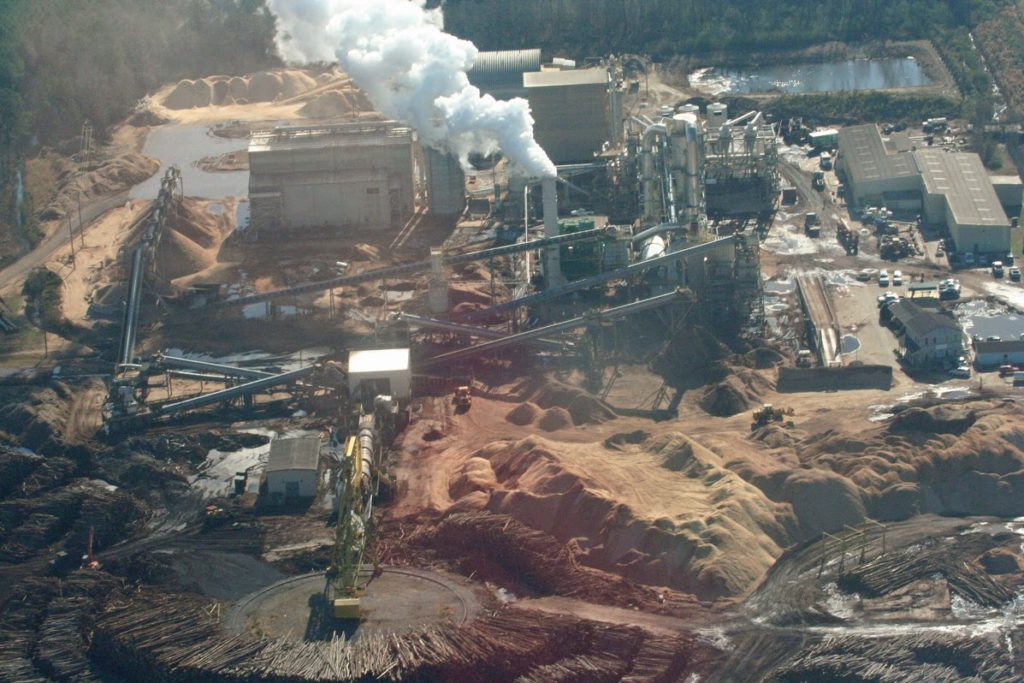
The Enviva wood-pellet plant at Ahoskie, NC
Washington, D.C. – A booming new industry that cuts down forests in the U.S. South to generate electricity in Europe, under the false pretense that burning wood pellets is carbon neutral, releases vast amounts of dangerous and illegal air pollution, including in Virginia, according to a new report by the Environmental Integrity Project.
The report’s authors examined federal and state records for 21 wood pellet plants from Virginia to Texas and concluded that one third of them (7 out of 21) violated their permits in 2017 by releasing illegal amounts of air pollution, while another four had faulty permits issued by states that failed to require pollution control equipment required by the federal Clean Air Act.
Overall, more than half of the wood pellet plants (11 out of 21) either failed to keep emissions below legal limits or failed to install required pollution controls, according to the report, “Dirty Deception: How the Wood Biomass Industry Skirts the Clean Air Act.” The federal budget bill signed by President Trump on March 23 contains a provision that encourages more burning of wood pellets like this for electricity, with an inaccurate claim that the “biomass” industry is good for the climate.
“With the Trump Administration and Congress now encouraging this crazy notion that clearcutting forests is helpful to the environment, it’s important that we have an accurate accounting of just how much air pollution these wood pellet plants actually produce,” said Patrick Anderson, an attorney with Powell Environmental Law, which wrote the report for EIP.
“The records show that the biomass industry releases not only millions of tons of greenhouse gases, but also tons of soot particles that can trigger asthma and heart attacks, as well as carcinogens and smog-forming pollutants,” Anderson said. “This is not ‘clean’ energy, by any measure.”
In Virginia, one pellet plant owned by the Enviva company is currently operating in Southampton County, about 40 miles west of Norfolk. And the company has now proposed building a second facility in Virginia, just outside of Danville. Because of the amount of air pollution it releases, the Southampton plant, by law, should have installed additional pollution control equipment or reduced its emissions to meet the requirements of the federal Clean Air Act, according to the report. But rather than doing this, Enviva actually removed its technology for reducing volatile organic compounds (VOCs), and switched to processing hardwoods instead of softwoods.
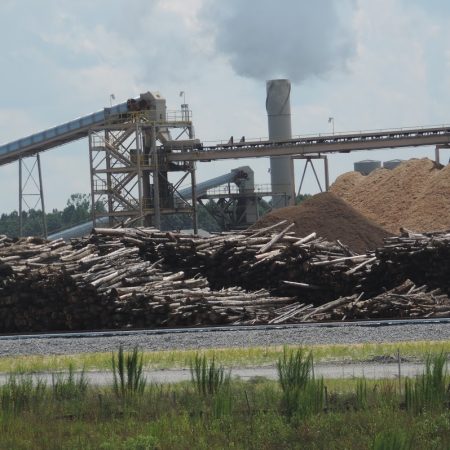
Another view of Enviva Southampton, Va.
While switching woods did allow Enviva Southampton to begin complying with the legal VOC limit, it is far from environmentally sound given the larger ecological footprint of cutting down hardwood trees. Worse, of particular importance to nearby residents the removal of the VOC control equipment means Enviva Southampton is no longer controlling its hazardous air pollutant emissions in any way. According to federal and state records, the plant releases at least 245 tons per year of VOC’s (which contribute to smog), 88 tons per year of soot (fine particle pollution, which can trigger asthma and heart attacks), as well as 56 tons per year of carbon monoxide, 163 tons per year of nitrogen oxides (which feed algal blooms and low-oxygen “dead zones” in the Chesapeake Bay), and 160,535 tons per year of carbon dioxide (which contributes to global warming).
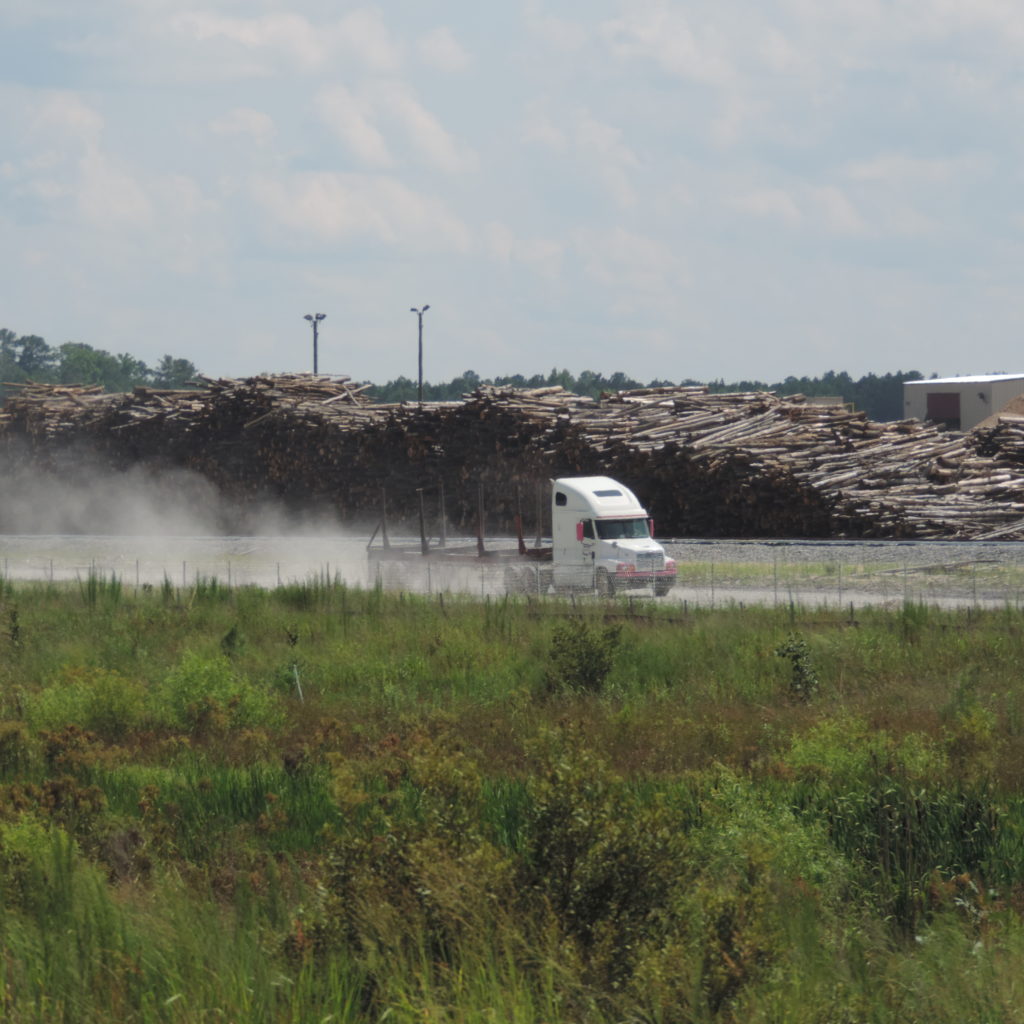
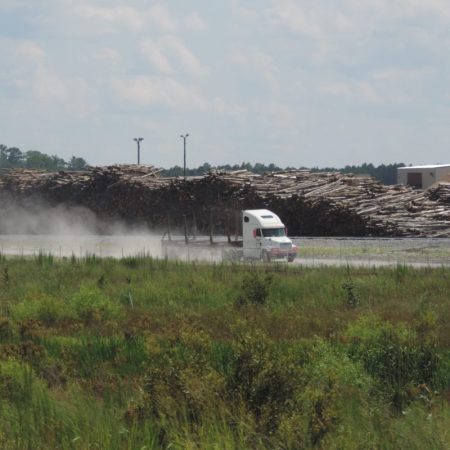
More fuel on the fire – an empty log truck leaves its load behind at Southampton
“It is important that we closely monitor and maintain high standards of air quality from all emission sources especially those located near underserved and vulnerable populations that have higher rates of asthma and respiratory disease,” said Garry Harris of the Center for Sustainable Communities in Virginia. “Forest are also a critical part of our interdependent ecosystem and must be protected.”
Nationally, the wood pellet industry has grown almost 10-fold in the U.S. since 2009. It is being driven by a loophole in the European Union’s carbon accounting system that is based on the mistaken notion that burning wood is carbon neutral and therefore good for the climate, because replanted trees absorb carbon dioxide. In fact, replanted trees take many decades to grow enough to absorb as much carbon dioxide as the trees cut down for the industry, and not all the saplings survive.
In the midst of the industry’s fast growth, reports have come out about the carbon dioxide released by biomass facilities. But little attention has been paid to the high levels of toxic and dangerous air pollutants from wood pellet manufacturing plants, emissions that can trigger a wide array of health and environmental problems.
The Environmental Integrity Project (EIP) investigation found that the 21 U.S. wood pellet mills currently exporting to Europe emit a total of 16,000 tons of health-threatening air pollutants per year, including more than 2,500 tons of particulate matter (soot), 3,200 tons of nitrogen oxides, 2,100 tons of carbon monoxide, and 7,000 tons of volatile organic compounds. These plants also emit 3.1 million tons of greenhouse gases annually, according to the study.
Other key findings of the report:
* Of the 15 largest operating wood pellet facilities, at least eight have had fires or explosions since 2014, including at factories in North Carolina, Georgia, Arkansas, Alabama, and Texas that released large amounts of air pollution or injured employees.
* At the Enviva Biomass wood pellet plant in Southampton County, Virginia, plant operators actually removed the pollution control equipment to evade upgrade requirements and switched from processing softwood to hardwood, which results in more carbon dioxide pollution and other harmful environmental impacts.
* A factory northeast of Houston owned by German Pellets has emitted nearly ten times its permitted limits of volatile organic compound pollution since it began operation in 2013, releasing 580 tons per year. Rather than require the facility to comply with legal limits, Texas officials are proposing to simply raise the limits to let the facility continue to emit dangerous levels of pollution.
“It’s time for states to pump the brakes on an industry that has been deceiving investors, decision-makers, and communities from day one — whether it’s misleading the public about their wood sourcing, evading community input in the permitting process, or skirting clean air quality standards,” said Emily Zucchino of the Dogwood Alliance, a nonprofit that works to protect Southern forests and communities from destructive industrial logging. “State governors and agencies need to do right by communities, instead of allowing companies like Enviva to continue to grow unchecked which harms public health, forests and the climate.”
One of the most troubling trends in the wood pellet industry discussed in the report is that facilities that should face the most rigorous air permitting standards are actually the least controlled and dirtiest.
Under a Clean Air Act program called “new source review,” new or modified major sources of air pollution are required to reduce emissions to the level achievable by using the best available control technology.
Contrary to that legal requirement, states allow construction of the country’s largest wood pellet manufacturing plants without controls, or with inadequate controls, for volatile organic compounds (VOCs), an air pollutant that causes smog and respiratory problems.
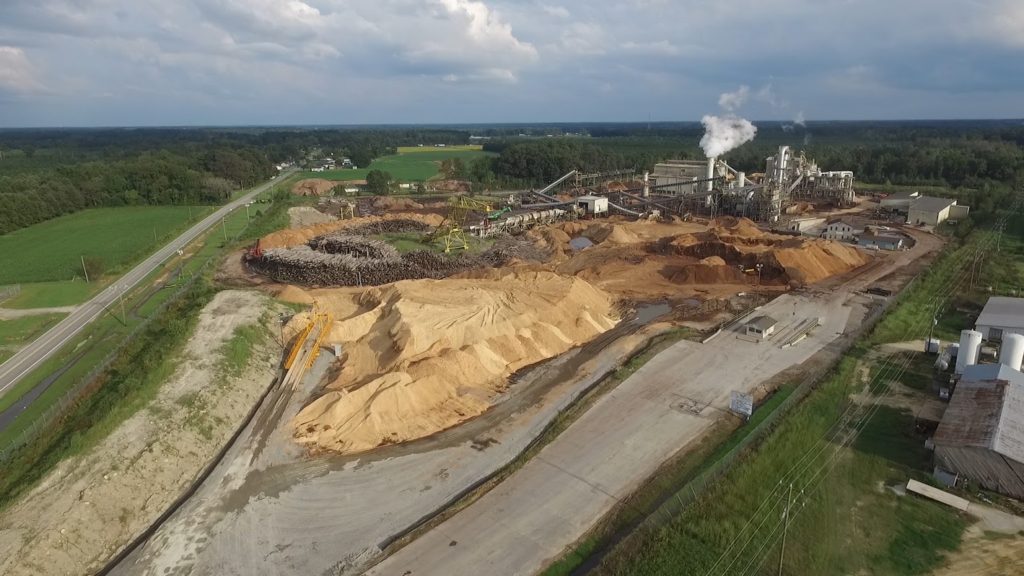
A longer aerial shot of Enviva Ahoskie
This is despite the fact that extremely effective VOC controls capable of reducing emissions by 90 to 95 percent are in widespread use at similar wood pellet manufacturing plants. For instance, in North Carolina, wood dryers at two recently permitted wood pellet factories owned by Enviva Biomass emit nearly six times more VOCs and 50 to 60 times more hazardous air pollutants than comparable facilities with appropriate pollution control systems.
“This industry is creating a public health hazard that can easily be avoided – because we already have the technology available to filter and capture this air pollution,” said Keri N. Powell, co-author of the EIP report and Director of Powell Environmental Law. “The solution is for states to enforce the law and require wood pellet plants to install the best available technology.”
In other instances, states allow facilities to emit air pollution well beyond legal limits for years at a time, according to the “Dirty Deception” report. In Mississippi, Florida, and North Carolina, state permitting authorities continue to allow wood pellet manufacturing plants to emit well above a 250 ton per year threshold before facilities are required to install air pollution controls.
For example, the Drax wood pellet plant in Amite County, Mississippi, near McComb, emits more than 900 tons per year of VOCs – more than three times the amount that normally triggers a requirement for the installation of best available pollution control equipment.
The report makes several recommendations for addressing the problem, including:
1) Requiring states to reexamine existing air permits for wood pellet plants in light of new testing that shows much higher emissions of volatile organic compounds and hazardous air pollutants.
2) Require that all major sources of air pollution to install the best available control technology.
3) Require annual emissions testing for volatile organic compounds and hazardous air pollutants from all of the major emission points at pellet mills.
4) Reduce the risk of fires and explosions by requiring wood pellet facilities to comply with their duty under the federal Clean Air Act to design and maintain safe facilities.
Read the entire 45-page report here.
QUOTES FROM LOCAL RESIDENTS CONCERNED ABOUT THE INDUSTRY:
Mississippi: “It is past time for the Mississippi Department of Environmental Quality to step up and protect the public health and safety of Mississippians from this pollution source as required by law,” said Louie Miller, State Director of the Sierra Club’s Mississippi Chapter. “Mississippi should not be known as the ‘cheap date’ for polluting industries.”
Florida: “When you sit down by the port and watch the Enviva company unload its wood pellets, you notice wood dust flying everywhere,” said Henry Lawrence, a Panama City, Florida, resident who lives three blocks from the factory. “It gets in your nose, it gets in your eyes, it makes you start coughing. It’s not safe to breathe.”
Alabama: “While the wood biomass industry masquerades as ‘renewable energy,’ these plants are releasing dirty pollution into the air we breathe,” said Michael Hansen, Executive Director of a Birmingham-based nonprofit called Gasp that is devoted to fighting for clean air. “Air pollution is the single greatest environmental risk factor for premature death and disease in the world — and those hurt the most are kids, seniors, pregnant women, and people suffering from chronic diseases.”
Georgia: “Georgians have first-hand experience with the dangers posed by this industry,” said Vicki Weeks, Georgia State Coordinator for the Dogwood Alliance. “Their plants are typically sited in poor rural areas where communities with little access to effective health care are being hard hit by their unchecked air pollution.”
North Carolina: “The non-stop pollution, dust, noise, and truck traffic the Enviva pellet mill brings to Northampton County is a grave injustice to this community,” said Belinda Joyner founder of Concerned Citizens of Northampton County, in North Carolina. “They have no respect for the people who live here, and they give nothing back – so we demand action.”
South Carolina: “Entire communities across the South are waking up to the damage these rapacious pellet companies are doing to our environment,” said Alectron Dorfman, chairman of Lakelands Citizens for Clean Air. “In the Lakelands area of Greenwood and Laurens Counties, the dramatic increase in production and pollution at the Enviva plant in Columbo is cause for great concern among our citizens for the quality of our air and the future of our forests.”
Texas: “Residents who live in Woodville, TX, near the pellet factory have grave concerns about the repeated fires at the plant, and they report health problems that went away once it closed,” said Robin Schneider, Executive Director of Texas Campaign for the Environment. “It’s time for environmental officials to take this bull by the horns and treat these issues with the seriousness that they deserve.”

New Church Among Consent Items at County Planning Commission Meeting

Warren County GOP Mass Meeting Results Challenged After Allegations of Voting Irregularities

‘This Is About Equity’: In Richmond, Virginia Workers, Lawmakers Push for Inclusive Labor Rights for All

After Five Years of Attempts, Virginia On Track to Set Up a Prescription Drug Affordability Board

New Drug Take-Back Box at Warren County Sheriff’s Office Offers Safe Way to Dispose of Medications

‘Feeding Our Neighbors’ Continues Local Effort to Provide Free Meals in Front Royal

Blair David Eller (1963 – 2026)

Writing Workshop at Samuels Public Library Aims to Help Community Communicate More Clearly

Simple Steps to Reduce Wildfire Risk Around Your Home

Lyme Disease Cases Continue to Rise as Tick Season Returns

County Receives 5 More FY-27 Budget Overviews Prior to Closed Meeting on Administrator Search & Business Expansion

Belle Grove Opens March 21 With First Public Viewing of Memorial Quilts Honoring Enslaved Individuals

Iran At a Crossroads: Democracy, Monarchy, and the Lessons of the 1950s

Federal Judge Upholds Ruling That Certain Ex-Felons Should Not Automatically Lose Voting Rights

Virginia Lawmakers Explore Autonomous Technology for Transportation

Misconceptions About Multiple Sclerosis

Five Reasons to Consider a Career in the Community Sector

Frederick County Cattle Carrier Crash – Animals Still Reported At Large

‘Grow Up’: Former Republican Delegate Defends Civil-Rights-Themed Mailers in Redistricting Fight

Virginia One Step Closer to Probation Reform With Bills Headed for Spanberger’s Desk

Merit Versus Reality: Town Council Weighs Priorities Against Finance

Blue Ridge Wildlife Center Patient of the Week: American Beaver

POLICE: 7 Day FRPD Arrest Report 3/9/2026

Discover Rotary with the Rotary Club of Warren County
