
Local News
“We’re All Storytelling Creatures”: Graphic Novelist Ben Hatke Inspires Skyline Middle School with Creative Wisdom and Local Heart
In a powerful meeting of imagination and education, Ben Hatke, internationally acclaimed graphic novelist and New York Times bestselling author, spent the day at Skyline Middle School, guiding students through the art of visual storytelling and leaving behind more than just tips on how to draw comics.
Hatke, a longtime Warren County resident, is the author and illustrator of hit graphic novels such as Zita the Spacegirl, Mighty Jack, and Nobody Likes a Goblin, and he’s no stranger to the classroom. He’s presented his “Three Secrets of Visual Storytelling” at schools and events around the world—from Canada to Europe and across the U.S. But this visit was personal.
“This was a super local visit for me,” Hatke said. “Most of the time I’m flying somewhere or up at dawn to hit the road, but today I just came down the street. It’s great to be home and share something I care deeply about with students in my own community.”
Hatke’s presence at Skyline Middle School resulted from a chance discovery by Amanda Heavner, a library assistant and proud mom of a Hatke fan.
“My 10-year-old son ‘CJ’ was reading one of Ben’s books and noticed in the author bio that he was from the Shenandoah Valley,” Heavner said. “He said, ‘Mom! He’s local!’ So we started Googling. I was amazed to find out just how close he actually was.”
She brought the idea to school librarian Sally Meredith, and the rest is a small but inspiring piece of literary history.
“We had no idea we had this kind of talent in our own backyard,” Meredith said. “Ben’s visit has been one of the most engaging and inspiring author programs we’ve had.”
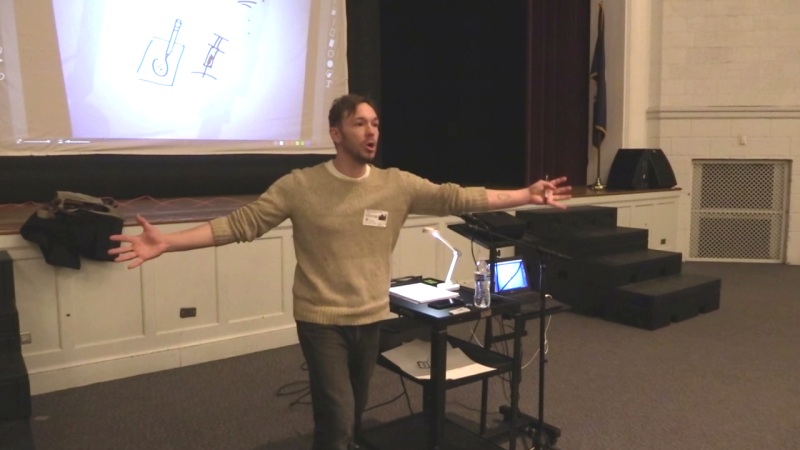
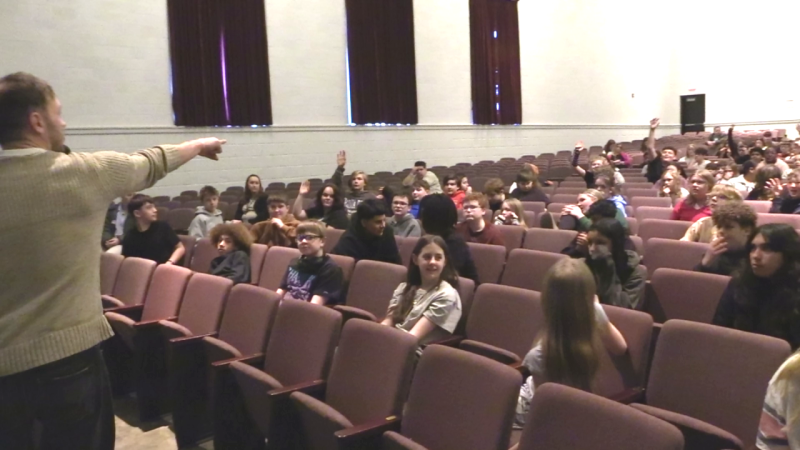
Ben Hatke presents his interactive visual storytelling program at Skyline Middle School, engaging students with live drawing and creative discussion. Below, Hatke takes a question from a student, encouraging curiosity and participation while sharing insights into the art of storytelling. Photos and video by Mark Williams, Royal Examiner.
Teaching the Secrets of Visual Storytelling
Standing in the auditorium at Standing Skyline Middle School, Hatke launched into his workshop-style presentation with warmth, humor, and live sketching. As he drew characters and examples in real time, students leaned in, watching stories take shape before their eyes.
Hatke’s presentation focused on three “secrets” of visual storytelling, which he described not only as a method for comics but also as tools for any kind of narrative creation.
Secret 1: “Two Pictures, One Story”
Hatke began with a deceptively simple concept: how our brains create meaning from images.
He drew a picture of a hand reaching for a button. Then another image: an erupting volcano.
“Now what happened?” he asked the room.
A chorus of student voices answered: “The button made the volcano explode!”
“Exactly,” Hatke smiled. “Our brains make that connection automatically. That’s storytelling—your mind fills in the gap. And what’s fascinating is that the story doesn’t live just in the image—it lives between the images. That’s where your imagination kicks in. That space is the most important place in comics. And in all storytelling.”
Secret 2: “The Power of Gesture”
Hatke shifted focus to emotion and body language, demonstrating how a character’s feelings can be shown without a single word.
“Gesture is one of my favorite tools,” he explained. “Body language is a universal human language. You can show sadness, fear, confidence—all through posture and line.”
As he drew a hunched, wide-eyed figure with trembling knees, he asked students what the character was feeling.
“Scared!” they shouted.
“Right,” Hatke said. “Now, if I added a speech bubble that said, ‘I’m scared,’ that would actually be less powerful. Your drawing already told the story. That’s how you save space for more important words—or let the art speak for itself.”
He encouraged students to observe how lines, shapes, and even the tilt of a head can carry deep emotional weight.
“I think we read gestures faster than we read words,” he added. “Your brain can decode emotion in a line drawing faster than you can read the word ‘angry.’ That’s powerful.”
Secret 3: “Drawing from Life”
Hatke’s final “secret” was less about technique and more about purpose.
“To be a great storyteller, you have to draw from life—not just with a pencil, but with your eyes, with your experiences, with your heart,” he said.
He emphasized the importance of creators being observers of the world—not just replicating what they see, but understanding what they feel.
“The best stories aren’t the ones that copy other stories,” he said. “They come from your own life. The happy moments, the weird ones, the sad ones—they all matter. That’s your material. That’s your voice.”
Hatke then held up a sketchbook, filled with personal observations—trees, hands, facial expressions.
“These are real things from the real world,” he said. “They help me keep my imagination grounded. I always say, every creative person should carry a notebook and go out into the world with a curious mind.”
Inspiration that Lasts
The students weren’t the only ones inspired. Hatke’s visit helped kick off the school’s new makerspace—a creative lab where students can write, draw, design, and explore hands-on learning.
“Middle schoolers can be a tough crowd,” librarian Sally Meredith admitted, “but they were hooked from the moment Ben started drawing. This is exactly the kind of inspiration we need to ignite creativity.”
Students asked Hatke questions ranging from his favorite superheroes—“Hawkeye or Green Arrow, definitely,” he replied—to how he got started as an author.
“Honestly, it started with good teachers,” Hatke said. “I was the kid drawing during class, and instead of yelling at me, my teachers encouraged it. One of them even sat with me after school to help me learn to draw faces. That made all the difference.”
One seventh-grade girl approached Hatke afterward to share a character she’d been developing. She had already named the character and begun illustrating it.
“She was so excited, and I could tell this wasn’t just a passing interest—this meant something to her,” said Hatke. “That’s the kind of moment I live for.”
Local Talent, Global Reach
Though Hatke’s work has reached readers around the globe—including a short Hawkeye story for Marvel—he remains deeply connected to Front Royal and the Shenandoah Valley. His life, he says, informs his stories.
“All storytelling is rooted in the human experience,” he said. “Even if you’re writing about space girls and goblins, what you’re really writing about is curiosity, courage, fear, friendship—real emotions.”
Hatke closed with a reminder that every student has something to say.
“We’re all storytelling creatures,” he told the students. “Your experiences matter. Your voice matters. And the world needs your stories—told in your way.”
The Legacy of a Local Visit
What started as a fanboy moment for a 10-year-old reader became a full-circle moment for a community. Skyline Middle School’s library now proudly features a Ben Hatke display, and his original artwork from the visit will stay in the library as a reminder that creativity—and success—can come from just down the street.
“We’re so thankful to Ben for coming,” said Amanda Heavner. “This wasn’t just a presentation. It was a spark. And I think it lit something in a lot of kids today.”
For those students, maybe this will be the story they remember when they write their own books.
And maybe one day, they’ll say it started with a drawing… and a visit from a guy named Ben.
About the Author
Ben Hatke is the author and illustrator of over a dozen books, including the #1 New York Times bestselling Zita the Spacegirl trilogy, the Eisner award-winning Little Robot, and the picture books Julia’s House for Lost Creatures and Nobody Likes a Goblin.
His most recent work includes 2023’s Reynard’s Tale, a richly-illustrated folkloric trickster tale for adults, and the graphic novel Things in the Basement, which was hailed by Publishers Weekly as “a fantastical, dreamily atmospheric katabasis.”
Ben lives, works, and practices archery in Virginia’s Shenandoah Valley. He is always happy in a canoe.
Learn more at www.benhatke.com.

New Church Among Consent Items at County Planning Commission Meeting

Warren County GOP Mass Meeting Results Challenged After Allegations of Voting Irregularities

‘This Is About Equity’: In Richmond, Virginia Workers, Lawmakers Push for Inclusive Labor Rights for All

After Five Years of Attempts, Virginia On Track to Set Up a Prescription Drug Affordability Board

New Drug Take-Back Box at Warren County Sheriff’s Office Offers Safe Way to Dispose of Medications

‘Feeding Our Neighbors’ Continues Local Effort to Provide Free Meals in Front Royal

Blair David Eller (1963 – 2026)

Writing Workshop at Samuels Public Library Aims to Help Community Communicate More Clearly

Simple Steps to Reduce Wildfire Risk Around Your Home

Lyme Disease Cases Continue to Rise as Tick Season Returns

County Receives 5 More FY-27 Budget Overviews Prior to Closed Meeting on Administrator Search & Business Expansion

Belle Grove Opens March 21 With First Public Viewing of Memorial Quilts Honoring Enslaved Individuals

Iran At a Crossroads: Democracy, Monarchy, and the Lessons of the 1950s

Federal Judge Upholds Ruling That Certain Ex-Felons Should Not Automatically Lose Voting Rights

Virginia Lawmakers Explore Autonomous Technology for Transportation

Misconceptions About Multiple Sclerosis

Five Reasons to Consider a Career in the Community Sector

Frederick County Cattle Carrier Crash – Animals Still Reported At Large

‘Grow Up’: Former Republican Delegate Defends Civil-Rights-Themed Mailers in Redistricting Fight

Virginia One Step Closer to Probation Reform With Bills Headed for Spanberger’s Desk

Merit Versus Reality: Town Council Weighs Priorities Against Finance

Blue Ridge Wildlife Center Patient of the Week: American Beaver

POLICE: 7 Day FRPD Arrest Report 3/9/2026

Discover Rotary with the Rotary Club of Warren County
