
Local Government
County Planning Commission Deadlocked on Runyon’s Shenandoah Valley Golf Course Over-55 Housing Project
The Warren County Planning Commission, still short a member while it waits for a replacement for a Shenandoah District member after the May resignation of former Commissioner Greg Huson, waded into a controversial rezoning request at its Wednesday, July 12 regular meeting at the County Government Center.

A packed and expectant audience for a rezoning request for a 103-acre parcel on the grounds of the Shenandoah Golf Club for the development of an over-55 community of 286 single-family homes. Applicant Richard Runyon, front row, confers with his representative, Chris Mohn of Greenway Engineering. Royal Examiner Photos Stephen Sill
The marathon meeting lasted for more than 3 hours largely due to a public hearing of a hotly contested rezoning request:
Shenandoah Club Properties, LLC – A request to amend the Warren County Zoning Map and rezone approximately 103.86+/- acres from Agricultural (A) to Suburban Residential (SR) for a Planned Residential Development for 286 single-family dwelling units for active adults/age restricted and to rezone approximately 11.9 +/- acres from Agricultural (A) to Commercial (C), the residual 76.75+/- acres would remain zoned Agricultural (A). The property is located at 134 Golf Club Circle in the Shenandoah District; the total acreage of the parcel is 195.64+/- acres.

The Applicant is proposing to rezone the majority of the parcel in order to construct 286 age-restricted dwelling units, a 15,000-square-foot fine dining restaurant, and two additional recreational lodging units. Additionally, the applicant intends to retain a 9-hole golf course and existing clubhouse facilities. Runyon anticipates the development to be complete and in operation by 2028. The Royal Examiner earlier published a background story on Runyon and his plans here. An unusual factor in this request is that the requested zoning would make a 12-acre section of the development commercial to permit the restaurant and potentially other facilities part of the project. The applicant is proposing the remaining 76 acres of Agricultural land will be retained as a 9-hole golf course or other open space used for recreational purposes. When fully built out, the development proposed would roughly double the population of Rockland Village.
Incompatibility with the Comprehensive Plan and Zoning Ordinance
Planning Director Matt Wendling told the Commission that the subject property is adjacent to the Rockland Historic District but is not part of it. The golf course construction began in 1963, prior to a Warren County Zoning Ordinance. Director Wendling explained that the Suburban Residential (SR) zoning requested requires a minimum lot size of a quarter acre and can only apply to developments of 50 acres or larger. Warren County’s Supplemental Regulations direct that planned developments should harmonize with adjacent properties. In the Planning Staff Comments for the Commission, there are several issues with the proposal.
The rezoning request is not compatible with the Future Land Use map of the existing Comprehensive Plan since this property is designated Agricultural in the current and Future Land Use maps. If the Zoning request were to be approved, the Planning Commission and Board of Supervisors would need to amend the Future Land-use map to comply with Chapter 4 of the Comprehensive Plan. Further, the Planning staff noted that the subject property has no adjacent Commercial zoned properties and that portion of the request could be considered Spot Zoning. In a 1994 memo, Former County Attorney Douglas W. Napier wrote, “Spot Zoning is the singling out of a small parcel of land for a use clarification inconsistent with that of the surrounding area for the benefit of the owner and to the detriment of others. The term describes a zoning amendment which is invalid because it is not in accordance with a comprehensive or well-developed plan.” The memo continues, “What appears to be spot zoning may be legal where the rezoning is for the public good… “

The question is, is this rezoning “for the public good?”
The current commercial uses are accessories to the approved conditional use permit for the existing Golf Course and Bed & Breakfast.
According to the Planning Department staff summary, the “Rockland Village Center” concept, as proposed, would redefine the traditional village image as noted in the Comprehensive Plan with the focus on the planned residential development, which is not consistent with the surrounding rural areas. The summary also noted that the traffic study provided by the applicant did not extend from the intersections of Rockland Road and Fairground Road to Winchester Road to the west but included the intersection of Rockland and Fairground roads. Also not included were the intersections of Fairground Rd., Milldale Rd., and Morgan Ford Rd., which are principal access roads to the Rockland Community and subject property, all of which are two-lane rural roads that cross intersections with Norfolk Southern Railroad and the Morgan Ford Bridge. According to that summary, there are plans for a fly-over bridge to be built on Rockland Road at the railroad intersection adjacent to Rockland Park, which may impact traffic flow through that portion of the road. See an earlier Royal Examiner story here.
Finally, the applicant included an environmental impact study which has been provided to the Virginia Department of Health for comment, but comments have not yet been received. Overall, the Planning Department’s summary reflected significant doubt about the appropriateness of the rezoning.

Chris Mohn of Greenway Engineering then presented an overview of the proposal and discussed the measures being taken to provide water and sewer for the development via existing onsite wells and a new wastewater treatment facility. The plan calls for a drinking water demand of 100,000 gallons per day at peak, and the site’s current permitted capacity is 144,000 gallons per day. The golf course, currently 27 holes, would be reduced to 9 holes. During the irrigation season, the current golf course’s 5 wells pump from 150,000 to 333,000 gallons per day from the aquifer during the irrigation season. The application asserts that the reduction in size of the golf course will “significantly reduce” the water consumption but doesn’t say how much.
Mohn asserted that the quarter-acre lots depicted in the preliminary site plan are in accordance with the standards for Suburban Residential zoning and are essential to an HOA-managed and age-restricted community for ease and efficiency of management. In essence, this proposal yields a density of 1.5 dwellings per acre of development. According to Mr. Mohn, this aligns with the R-1-zoned properties immediately adjoining the site. The remaining 9 holes of the golf course will be operationally integrated with the 36 holes comprising the former Bowling Green site, which the applicant recently purchased.
“The analysis of this proposal that was provided with the application indicates that its impact on the surrounding community will be minimal and that any impacts can be mitigated by the proposed proffers and the final site design.”
County Zoning Ordinances require that developments must be served by central water and sewage treatment facilities. In this case, the applicant is proposing that onsite community water and sewage treatment facilities will be provided that meet the standards of the State Environmental and Health Departments. Sewage treatment effluent discharge would be highly treated as gray water and recycled for irrigation purposes. This method will “largely eliminate the use of groundwater for irrigation purposes at the site,” Mohn said.

Outrage and Staunch Opposition
At the public hearing, more than 30 speakers opposed to the rezoning offered their input to the commission to reflect on the proposal’s incompatibility with the County’s Comprehensive Plan, the unique rural setting, the agricultural heritage of the area, and the relatively isolated location from essential services such as medical, Fire & Rescue, and law enforcement.
Susan Bowen of Gentley Farm was concerned about the loss of the rural character of Rockland and the precedent that would be set for future suburban sprawl.
Many speakers painted a picture of how their rural setting would be destroyed, and past efforts at the conservation of agricultural land would be wasted. The view shed of existing homes surrounding the existing golf course would be changed by the addition of new homes. Another common theme was fears that the new dwellings would draw down the water source for all the residents. Unconvinced by the assertions in the proposal that the development would provide a net reduction in the current water consumption at the site, several speakers cited experiences with wells running dry in the past. Speaker Wayne Chatfield described the underground karst formations that create caves and sinkholes as the water table rises and falls.

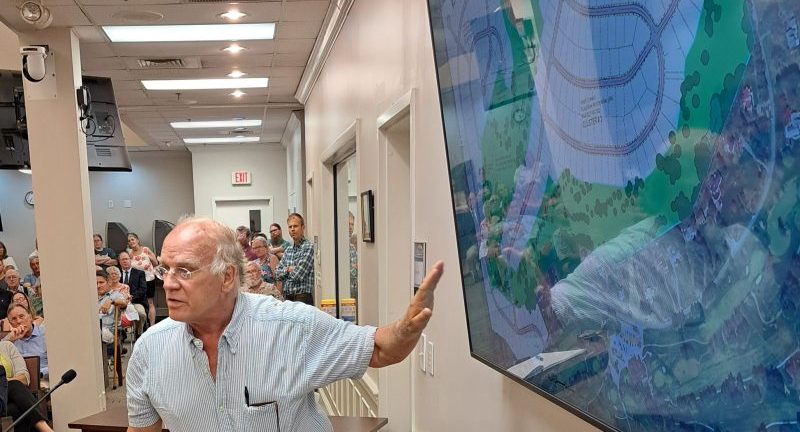
Local farmer Wayne Chatfield shows the County Planning Commission the proximity of his farm to the proposed 55-plus housing development and describes the potential effects on his operation. Chatfield said, “High-density development and farming do not go together well”
Opponents of the proposed rezoning outnumbered supporters 35-5.
Despite the applicant’s assertions, to the Royal Examiner and elsewhere, on his efforts to minimize negative impacts and that his plan will reduce existing on-site water use and traffic flow in and out of the site, other comments ranged from concerns about increased traffic, loss of a rural environment, effects of treated sewage discharge, insufficient or unsafe access, to motives ascribed to the applicant “…and his developer friends to make a quick buck”. A petition containing more than 750 names was presented to the commission opposing the development.
Dozens of letters from citizens regarding the rezoning were presented as part of the commissioners’ meeting package. Notable was one in support of the project, quoted in part here from local businessman and community supporter George McIntyre, who is also an adjacent landowner and farmer:
“Change comes; we all know this. This exemplary effort for a community of age 55+ golf course residents will only complement Rockland with this professional, well-planned project. It is reasonable, it will not go outside the existing boundaries of Runyon’s property. It will leave a legacy of wise community improvements for all to cherish. The request for commercial rezoning for a restaurant, shops, emergency care, and other beneficial needs in our area was agreeable with the opponents. The opposition wanted these amenities. This project will continue to support our community, as all of us have and do. Runyon, like many others, is a giver, not a taker,” McIntyre wrote.
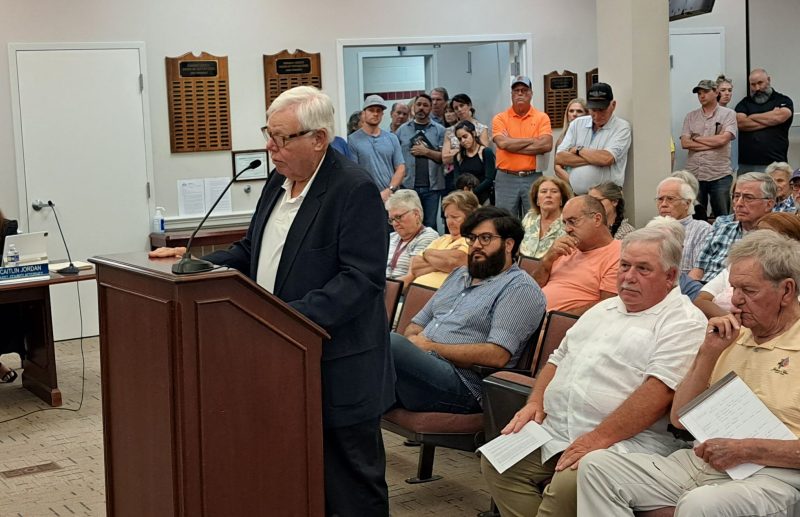
Front Royal Resident and golfer Mickey Taylor address the County Planning Commission to support Richard Runyon’s Shenandoah Club LLC request to rezone the majority of the 197-acre Shenandoah Country Club to enable a 286-home over-55 housing development. A vocal crowd opposed to the rezoning applauded the Commission’s eventual deadlocked 2-2 denial vote.
Several other residents on hand were also supportive of the rezoning proposal. Local resident and golfer, Mickey Taylor expressed unreserved support for the proposal, citing long association with the golf club and personally with the applicant. “Richard entered into this effort to improve the area correctly, thoughtfully, and properly,” Taylor said.
Other speakers applauded the employment opportunities, increased options for senior living, and a thoughtful design that preserves some open and forested areas as a shield from surrounding homes. Donna Lopes, a resident, supported the proposal as a way to preserve golfing opportunities while allowing a well-maintained development as an improvement over unrestricted unmaintained properties with junk cars or RVs. Other speakers cited the history of the property and the vision of the original developer, Linwood Morrison.
At the end of the nearly 2-hour public hearing during which Chairman Richard Myers had to several times remind the crowd of the prohibition on applause during public presentations, Vice Chairman Henry stated that a typical unrestricted housing development with 3-bedroom homes does not produce enough tax revenue to pay for the schools. “Typically, the county is at a negative net, which raises everybody’s taxes.” A discussion followed regarding whether the over-55 designation, seen as minimizing the number of school-age children tied to the development, is enforceable and how other communities in the area manage it. The Proffer statement portion of the application defines it as follows:
“[Age-restricted] shall mean all occupied residential units shall be occupied by at least one person fifty-five (55) years of age or older, and all other residents must reside with a person who is fifty-five (55) years of age or older, and be a spouse, a cohabitant, an occupant’s child of nineteen (19) years of age or older or provide primary physical or economic support to the person who is fifty-five (55) years of age or older.
“Notwithstanding this limitation (i) a person hired to provide live-in, long term, or terminal health care of a person who is fifty-five (55) years of age or older for compensation may also occupy a dwelling during any time such person is actually providing such care; and (ii) guests under the age of fifty-five (55) shall be permitted for periods of time not to exceed sixty (60) total days in any calendar year. (b) If title to any lot shall become vested in any person under fifty-five (55) years of age by reason of descent, distribution, foreclosure, or operation of law, the age restriction set forth in this Section 1 shall not work a forfeiture or reversion of title, but rather, such person thus taking title shall not be permitted to reside on such Lot until such person shall have attained fifty-five (55) years of age or otherwise satisfies the requirements as set forth herein. (c) Notwithstanding the foregoing limitations, a surviving spouse shall be allowed to continue to occupy a dwelling without regard to age. The foregoing limitations shall apply to any tenant who resides in any dwelling offered for lease by the Owner thereof.”
Vice-Chairman Henry told the commission that there is no farming going on on that parcel. It is zoned Agricultural with a Conditional Use Permit for commercial activity – a golf course. It uses a tremendous amount of water. There are no cows, no hay. It is not in a conservation easement. By right, it could be broken up into residential lots – a lot fewer, but it could be done. “The only thing I can really knock it for is the traffic, but here we have a letter from VDOT that doesn’t kill it.”
Chairman Myers observed that he was yet to see a bale of hay produced by a golf course. This comment lightened the mood of the audience, who were clearly fatigued by the length of the meeting. “What does concern me is the medical facilities. Whether you go to Warren Memorial or to Winchester, you have to cross a railroad track. If I’m in an ambulance with a heart attack, I don’t want to be waiting at a railroad crossing.”
Commissioner Kaylee Richardson weighed in: “A lot of people are coming here; from where? The city? That is my question. I understand development, I understand business, I understand. But is this the right place?” Commissioner Kersjes questioned the VDOT declaration of “no impact.” Current trips are 827, and projected are 3,700. “That’s one every 30 seconds!”
After some further discussion, Commissioner Richardson offered a motion to recommend the denial of the rezoning application, seconded by Commissioner Scott Kersjes. The Commission deadlocked on a 2-2 vote, with Richardson and Kersjes voting to recommend denial and Vice-Chairman Henry and Chairman Myers voting against the recommendation of denial. The deadlocked vote effectively denies the proposal the approval of the Commission, forwarding it to the Board of Supervisors without a recommended action.
The Chairman then called a 5-minute recess, allowing the majority of the crowd to vacate the room.
SVGC Related and Rushmark Rockland Rd. LLC business
Shenandoah Club Properties, LLC – A request to amend the Future Land Use Map in the Warren County Comprehensive Plan to designate portions of the property at 134 Golf Club Circle as Suburban Residential and Commercial on the map. The amendment request was provided in concert with a rezoning application for the Property to establish 103. 86± acres of Suburban Residential (SR) District zoning for the development of age-restricted dwelling units and 11.9± acres of Commercial (C) District zoning containing the existing clubhouse, lodging units, and associated improvements. The proposed Commercial zoning would enable the establishment of a sit-down restaurant in the existing clubhouse facility that would be open to the public, as well as the addition of lodging units to the site. The remaining 76.75± acres of the Property are proposed to remain in some form of open space use, with current plans involving the operation of a 9-hole golf course on the acreage.
In view of the action of the commission on the rezoning request, the commission, on a motion by Commissioner Richardson, Seconded by Commissioner Kersjes, voted unanimously to recommend the denial of the request to amend the County Comprehensive plan. A final decision now rests with the County Board of Supervisors.
Rushmark Rockland Road, LLC has resubmitted a request to amend the Warren County Zoning Map and rezone 46 acres from Commercial (C) to Industrial (I) and rezone 1.87 acres from Residential One (R-1) to Commercial (C). The properties are located at 8561 Winchester Road in the North River district. The total acreage of the parcels is approximately 77.59+/- acres. During the public hearing, there was one speaker, Chris Gullickson of the Virginia Inland Port, who supported the rezoning and said that the property could provide an advantage. The commission, on a motion by Vice Chairman Henry, Seconded by Commissioner Kersjes, voted unanimously to recommend approval.
Rushmark Rockland Road, LLC. This is a resubmittal of a request for a conditional use permit for a building in excess of 50,000 square feet in the Route 340/522 Highway Corridor Overlay District. The properties are located at 8561 Winchester Road in the North River Magisterial District and are included in the rezoning request to Industrial (I). With no public speakers or other discussion, on a motion by Vice Chairman Henry, Seconded by Commissioner Kersjes, The Commission voted unanimously to recommend approval.
Rushmark Rockland Road, LLC has resubmitted a request to amend the Future Land Use Map in the Warren County Comprehensive Plan to designate the properties at 8561 Winchester Road as Industrial (I) and Commercial (C). According to Rushmark’s submission, The Warren County Comprehensive Plan’s Future Land Use Map designates the land north of Front Royal along the Route 522/Route 340 corridor as almost exclusively commercial and industrial, especially so on the eastern side of that highway. The commercially designated properties in the Comprehensive Plan tend to be centralized closer to Interstate 66, and the industrially designated lands are concentrated to the north. The Property sits at the edge of the commercially designated lands to the south and the industrial lands to the north. Some of the commercially designated properties to the south have been successfully developed for commercial uses, but the commercial market has failed for more than twenty years to support similar development envisioned by the Comprehensive Plan on the Property. The Applicant asserts that the Industrial designation will facilitate the development of marketable improvements. On a motion by Chairman Henry, Seconded by Commissioner Kersjes, The Commission voted unanimously to recommend approval.
The remaining actions of the commission will be covered in a separate story. The commission adjourned at 10:40 p.m.



VDOT: Warren County Traffic Alert for August 24 – 28, 2026

Warren County School Board Reviews Visitor Rules, Special Education Support and Summer Meal Growth

Every Community Needs Champions

Fauquier Health to Join Bon Secours Mercy Health Network

Historical Travels: Beaver Lake, Utah

Why Your Birthday Is Worth Celebrating at Any Age

How Much Is Too Much?

When Leadership Forgets Who Wears the Servant’s Cloak

Sanders “Ray” Rowe (1940 – 2026)

Virginia State Police Report $8.5 Million in Drug Seizures During Weekly Operations

Front Royal Lifts Voluntary Water Conservation Restrictions After Recent Rainfall

Virginia Health Department Improves Nursing Home Inspection Backlog, Reforms Sanction Criteria for Facilities

After Eastern Groundwater Report Detailed Aquifer Concerns, Virginia Lawmakers Consider Policy Shifts

Rachel Judith Brandon Sears (1944 – 2026)

Ingrid Jolly (1944 – 2026)

Royal Shine Builds on Detailing Legacy With New Name, Same Focus on Quality

Business Growth Series: Overthinking Is Slowing Your Business Down

Feds’ Proposal to Alter Head Start Could ‘Dismantle’ Program in Virginia, Parents and Advocates Say

Freedom 250 Grand Prix Brings First INDYCAR Race to National Mall

Judge Affirms Ruling in Favor of Former Felons in Voting Rights Lawsuit

ORDER OF PUBLICATION: In the Circuit Court for Warren County, Virginia

Coolidge on Education and Careers

Gourmet Halloumi Burgers Bring Bold Flavor to the Summer Table

Warren County Supervisor Charged With Assault and Battery Following Meeting
