
Local News
Poverty stricken African nation leaves indelible mark on Front Royal visitor

Rotarians and Adedease Junction village children, some of whom appear to be rubbing Rotarian Michael Williams’ head for luck. Courtesy Photos/Rotary International
When Michael Williams of Front Royal landed in Ghana, a small republic on the African continent’s Gulf of Guinea, he realized just how lucky he’d been in life to be born in the United States, albeit, as he said, in a poor, rural area of Fauquier County 52 years ago.
“It just grabbed me,” Williams said of his arrival in Adedease Junction (population 100) on a sweltering day a couple of weeks ago on a Rotary International mission to help the local folks dig a well.
Williams was one of eight Rotarians from Virginia, West Virginia and Florida who traveled some 13,000 miles to dig a functioning well to provide the village with drinkable water under the auspices of a Rotary International Global Grant. They did, and Williams arrived home February 9, a man with a mission accomplished, as well as a new mission to be realized.

For nearly a quarter century, Williams worked with children on the staff of Randolph-Macon Academy, and for years as a volunteer counselor at a summer camp for needy children – Camp Alkulana in Millboro Springs, 45 miles west of Staunton. At Adedease Junction, Williams, a family man and preacher to boot, fell in love with the African children of the 20 families who lived there in near to abject poverty. The “broomi (white man)” became a friend to them all. After experiencing a short period in which he earned their trust, the “broomi” with the bald pate was accepted and loved back by the kids in the village.
“Generally, despite the poverty and all of that, these were happy kids, happy parents, lovely people making the best of their lives; the men working mainly as farmers and families living off the land,” Williams said of what he encountered.
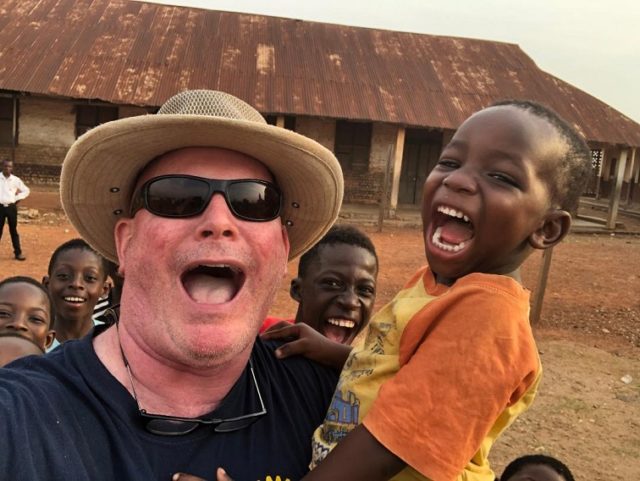
Michael Williams self-described ‘favorite moment’ of his 13 days in Ghana with the Rotary International mission to bring a safe, central well to Adedease Junction, population about 100.
He noted that “Papaya” – bananas (“the sweetest I’ve ever eaten”) and almonds are common to the area. Incomes average about $200 a month. Villagers police themselves, Williams said, adding there appears to be no significant crime, at least in Adedease Junction.

“There were chickens and goats running everywhere … for the time being, I never want to see another chicken!” Williams joked. Mostly, he said, the people live in mud huts without electricity, little access to water and no “bathrooms” as we know them. To fetch water, villagers must walk, depending where they live, from one hundred yards to one thousand yards to fill a pail.
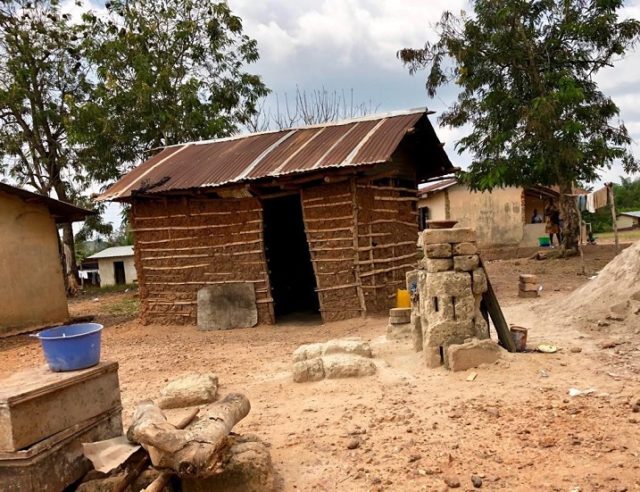
A typical home in Adedease Junction
The official language of Ghana is English “but not English as we know it,” Williams told his listeners with a laugh. The mother tongue is interspersed with tribal languages, including Zulu.
While he and his companions fashioned the new well – heretofore villagers depended on a hole in the ground producing water of questionable quality – Williams glanced over his shoulder at the nearby local elementary school house, an area with no electrical power, a thatched roof, in which two teachers teach 70-80 kids from first to sixth grade in four partitioned rooms.

To some degree all structures are open to the elements that at various times of the year are saturated with monsoon rains. Temperatures range from 75 to more than 100 humid degrees. The country is about 350 miles from the equator.

The existing elementary school house
Meanwhile, the Rotary working group lived in hotel accommodations about 60 miles from the village. As a chauffeur back home, Williams delighted in describing traveling over unpaved, pot holed roads in a borrowed ambulance with a volunteer driver who drove, well, fast!
His personal mission: to return home and raise sufficient funds ($40,000) to complete a six-room school house with concrete block walls, electrical cooling (solar panels), access to water, and to provide equipment necessary to effective teaching. He wants to get the job done by April 2020.

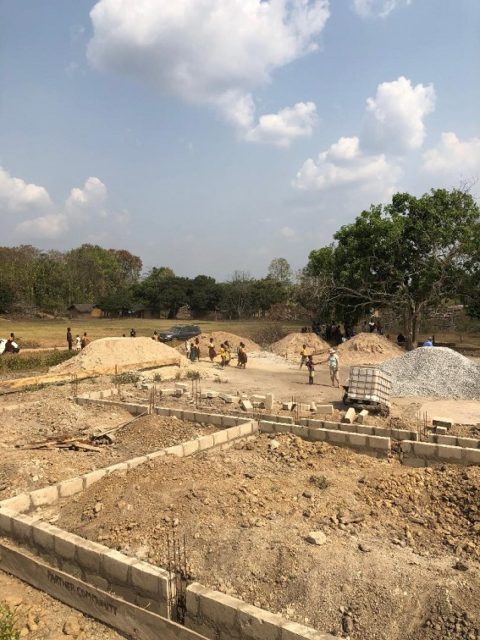
The new elementary school site
Within days of returning from his first, and possibly last, trip to Africa, Williams has a half-dozen presentations to local clubs already lined up (one more got in line while Williams, in a colorful Zulu shirt, was interviewed for this article and briefed friends on his experiences at a weekly meeting on the second floor of the Virginia Beer Museum February 12).
Williams is a member of the Rotary Club of Warren County.

Our intrepid international adventurer Michael Williams, left, being interviewed about his experience by our equally intrepid reporter Malcolm Barr Sr. – Courtesy Photo/Skip Rogers




‘From the Consent of the Governed’

Cardinals Host Strasburg Express Sunday, July 5 at Bing Crosby Stadium

Minnie Cassandra Stribling McDaniel (1956 – 2026)

The Signer Who Paid the Price

Right Trees Can Make Windbreaks Stronger and Longer Lasting

The Declaration of Independence at 250

Coolidge’s 1926 Warning Still Echoes Nearly a Century Later

VDOT: Warren County Traffic Alert for July 6 – 10 2026

Business Growth Series: If You’re Not Creating Opportunities, You’re Losing Them

Virginia Launches Nation’s First Court-Ordered Speed Limiter Program for Reckless Drivers

Virginia’s Reproductive Rights Amendment Faces Legal Challenges Over Procedural Step, Language

Cities, Towns in Virginia and Across the Nation Revive Teen Curfews Amid Summer Crowds

Tick Bites Are Surging in the US This Year. Here’s What To Know.

Three Founders – One Day – One Destiny

Samuels Public Library Unveils Packed July Schedule for Children, Teens and Adults

Quiz: 250 years of American history

The Founder Who Actually Freed All Slaves

July 1 Marked Statewide Start of a Ban on the Use of Certain Plastic Foam Foodware Containers

Technology Business Versus Data Center: Town Planning Commission Deep Dives into Definitions

Celebrate Independence Day Close to Home

Middletown Announces Grand Marshals for America 250 Independence Day Parade

Virginia Braces for Dangerous Heat Wave Ahead of Fourth of July Weekend

Cardinals Host Woodstock River Bandits Friday, July 3 at Bing Crosby Stadium

Medicaid Again to Cover Non-Abortion Care at Planned Parenthood as GOP Ban Ends
