
Opinion
If WW II’s was the ‘greatest generation’ – how will those since be remembered?
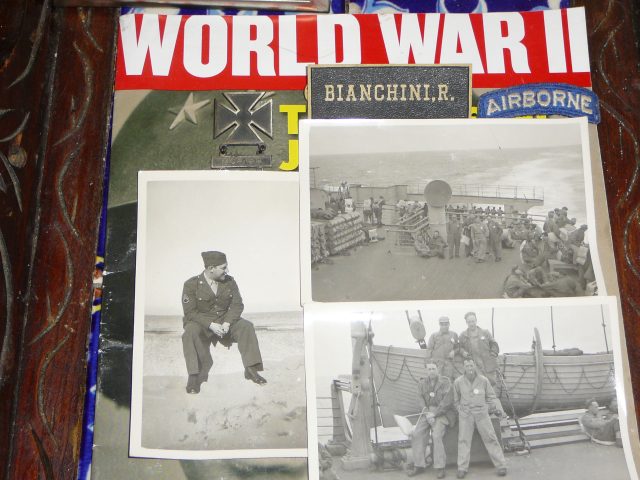
A collage of Roger Bianchini Sr.’s military pins, patches and photos, the latter while being transported across the Atlantic to enter the war front against European fascism – RB Sr. is solo at left, top right at the lifeboat, and at far right of group standing at stern looking toward camera. Photos personal collection or public domain
Memorial Day, May 31; D-Day, June 6; and the Fourth of July – the memories of a nation and people’s commitment and sacrifice swell up in a five-week span commemorating the best the American nation has to offer.
As a part of what is sometimes referred to as the “greatest generation” my late father was a veteran of World War II. A mortar unit staff sergeant, he landed at Utah Beach on that “Longest Day”- June 6, 1944. Later he went on to fight with General George S. Patton’s Third Army during the Battle of the Bulge. As recounted in the 1979 movie “Patton” starring George C. Scott in a remarkable performance as the main character, during that battle that repelled the German counterattack following the invasion of the European mainland, Patton’s Third Army moved more men and equipment farther in the least amount of time than any army in history. And Patton and his Third Army’s movement and counterattack during which my father was wounded assured the Allies would not be driven back into the sea from which they had come on June 6, 1944.
My father carried a piece of shrapnel next to his spine for the rest of his life from a wound received during that decisive battle for Europe. And he carried his memories of the war against European fascism almost as close to the vest as that piece of shrapnel by his spine. He also carried a deep respect for Patton, his final battlefield commanding officer, that he said was not uncommon among the men Patton commanded.
Today I find myself missing the character and commitment of that “greatest generation” and its leadership as the nation now grapples with the evolution of its own homegrown corporate neo-fascism. It was a threat of domestic origin predicted in 1944 by Vice President Henry Wallace as the battle against European fascism ground inexorably forward.

Vice President Henry Wallace was prescient in 1944 in predicting how the threat of fascism would rise in post-World War II America.
“The really dangerous American fascists are not those who are hooked up directly or indirectly with the Axis (Germany-Italy-Japan), the FBI has its finger on those,” Wallace told The New York Times in an interview published April 9, 1944.
“The dangerous American fascist is the man who wants to do in the United States in an American way what Hitler did in Germany in a Prussian way. The American fascist would prefer not to use violence. His method is to poison the channels of public information. With a fascist the problem is never how best to present the truth to the public but how best to use the news to deceive the public into giving the fascist and his group more money or more power.
“They claim to be super-patriots, but they would destroy every liberty guaranteed by the Constitution. They are patriotic in time of war because it is to their interest to be so but in time of peace they follow power and the dollar wherever they may lead.”
The flow of history
Sixteen years later the distinctly American evolution of that domestic threat first cited in 1944 by a sitting vice president was termed “the military-industrial complex” by President Dwight D. Eisenhower during his Jan. 16, 1961 farewell address to the nation.
Fifty years ago during the height of a nuclear-armed “Cold War” with the Soviet Union, Eisenhower, who had commanded all Allied troops on the European front during World War II, called what he had initially termed “the military-industrial-congressional complex” the greatest threat to the security of this nation – not the Soviet Union, not nukes, not illegal immigrants but our own homegrown form of corporate and money-driven fascism.
“This conjunction of an immense military establishment and a large arms industry is new in the American experience. The total influence – economic, political, even spiritual – is felt in every city, every Statehouse, every office of the Federal government,” Eisenhower observed. “We recognize the imperative need for this development. Yet we must not fail to comprehend its grave implications. Our toil, resources and livelihood are all involved; so is the very structure of our society.
“We must never let the weight of this combination endanger our liberties or democratic processes. We should take nothing for granted. Only an alert and knowledgeable citizenry can compel the proper meshing of the huge industrial and military machinery of defense with our peaceful methods and goals, so that security and liberty may prosper together.”

In an era before radical partisan ideologies hijacked American politics, Republican President Dwight D. Eisenhower echoed in 1961, Democratic Vice-President Wallace’s warning of 1944 about the danger of evolving political, industrial and military institutions on the American landscape.
What were first, Democrat Wallace and then Republican Eisenhower warning us against?
Inherit the whirlwind
Look around you – it’s here, driven most prominently by corporate-owned news stations (poisoned channels of public information) and a bought-and-paid-for Congressional majority dedicated to stamping out every basic social and economic security for all but those at the top of the economic food chain.
The American neo-fascists we have been warned about since 1944 and 1961 are an economic elite reflective of those who throughout history have sought to control wealth and power in order to shape the fate of nations and peoples to their personal and shortsighted benefit – they are not prone to compromise because wealth and the “might” it purchases “makes right”.
It is not an elite identified by royal blood or Divine Right, but simply by the acquisition of great wealth. So logically, it is an elite that would have you measure individual and spiritual value by the acquisition of wealth. And despite assertions to the contrary, it is not a Christian elite. In fact, if Jesus said “it is harder to pass a camel through the eye of a needle, than for a rich man to enter the kingdom of heaven” I’d say it’s more a satanic cult than anything else.
Eisenhower, who removed “Congressional” from his description of the threat from within so as not to appear to be making a partisan attack on a Democratic Congress, lauded his and that Congress’s efforts to work together for the good of the nation.
“The Congress and the Administration have, on most vital issues, cooperated well, to serve the nation well rather than mere partisanship, and so have assured that the business of the nation should go forward. So my official relationship with Congress ends in a feeling on my part, of gratitude that we have been able to do so much together,” Eisenhower observed.
It is a political sentiment far from the new partisan mantra of no compromise, but rather partisan ideological victory over all. Such partisan “victory” will eventually come at the expense of every average American – but never at the expense of the politician’s billionaire corporate sponsors.
As he prepared to become a private citizen after eight years in the White House, Eisenhower looked toward the future, telling the American public, “Down the long lane of the history yet to be written America knows that this world of ours, ever growing smaller, must avoid becoming a community of dreadful fear and hate, and be, instead, a proud confederation of mutual trust and respect. Such a confederation must be one of equals. The weakest [nations] must come to the conference table with the same confidence as do we, protected as we are by our moral, economic, and military strength. That table, though scarred by many past frustrations, cannot be abandoned for the certain agony of the battlefield.”
Legacy
What has changed in the last half century since career soldier and Republican President Dwight David Eisenhower preached not just a national, but international equity in shaping all our futures?

This photo by the AP’s Paul Vathis on display at D.C.’s Newseum, was taken April 22, 1961 as Eisenhower visited President Kennedy at Camp David as the Bay of Pigs crisis was in its sixth day. ‘They looked so lonely,’ the photographer wrote of the two presidents. Could they have already discussed what CIA operative E. Howard Hunt would later write about – his alteration of a presidential document signed by Eisenhower authorizing the infiltration of 40 U.S. ‘advisers’ into Cuba to aid anti-Castro rebels, so that Kennedy would be presented with ‘authorization’ of a 4000-man invasion?
Perhaps the only change is the arrogance with which corporate super wealth, buoyed by its hired political lackeys and mercenary guns (military-industrial-congressional complex), wages its economic world conquest against enemies both domestic and abroad.
I fear that if this generation of Americans doesn’t rise to the challenge and just say a resounding NO to the lies, to the legalized graft and corruption, to the bigotry, and self-serving political hypocrisy, all the heroism and sacrifice of that past “greatest generation” of which my father was a part will have been for naught.
If the generation that fought and defeated the rise of European fascism in the 1940s is remembered as this nation’s greatest, will those that sat idly by as our own corporate fascists casually walked over us and the world in banker’s pin-striped suits be remembered as our worst?
(An earlier draft of this personal memoir was published in June 2011 in The Warren County Report.)