Looking Back
The Year Without A Summer : “Eighteen Hundred & Froze To Death”
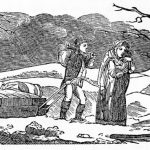
The year 1816 was known as “ The Year Without a Summer” in New England because six inches of snow fell in June, and every month of that year had a hard frost.
Temperatures dropped to as low as 40 degrees F. in July and August as far south as Connecticut. People also called it “Eighteen Hundred and Froze to Death” and the “Poverty Year.”
The Year Without A Summer had a far-reaching impact. Crop failures caused hoarding and big price increases for agricultural commodities. People went hungry. Farmers gave up trying to make a living in New England and started heading west. Politicians who ignored the melancholy plight of their constituents found themselves voted out of office.
Most scientists agree that what most likely caused the bizarre weather in The Year Without a Summer was the monumental explosive eruption of the volcano Mt. Tambora in Indonesia in April 1815, the year before. Said to be the loudest explosion in recorded history—even slightly surpassing that of Krakatoa in August 1883— the volcano put out such a volume of dust, ash, and chemical cloud high into the atmosphere that it lowered worldwide temperatures by half a degree; while that may not seem much, the global cooling was responsible in the U.S., for frosts and cold weather which ravaged the New England growing season, prompting cries of a “year without a summer”, and migration into western territories and states. Plunging temperatures also broke the monsoon cycle in Asia, sending India into famine and triggering a cholera epidemic of unprecedented severity.

The dust and ash clouds in the high atmosphere also produced some of the most spectacular sunsets ever witnessed, with most of them of green or violet hues. There were warm days in the spring of 1816, but they were followed by cold snaps. In Salem, Mass., for example, it was 74 degrees F. on the 24th of April. Within 30 hours the temperature dropped to 21 degrees F.
Thomas Robbins, the East Windsor, Conn., bibliophile, noticed the late spring of 1816. He wrote in his diary, “the vegetation does not seem to advance at all.”
On the 12th of May, strong winds and freezing temperatures from Canada killed the buds on fruit trees. Inch-thick ice formed on ponds and streams from Maine to upstate New York. By the end of May, corn plants froze in central Maine.
Then, on the 6th of June 1816, six inches of snow fell on New England. Clockmaker Chauncey Jerome of Plymouth, Conn., wrote in his autobiography that he walked to work that day wearing heavy woolen clothes, an overcoat, and mittens.

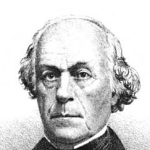
Chauncey Jerome
Snow flurries fell in Boston the next day, the latest ever recorded. The snow was 18 inches deep in Cabot, Vt., on the 8th of June. Three days later, on the 11th of June, a temperature of 30.5 degrees F. was recorded in Williamstown, Mass. Frozen birds dropped dead in the fields; in Vermont, some farmers who had already shorn their sheep tried to tie their fleeces back on, but many froze to death anyway.
Benjamin Harwood, a Bennington, Vt., farmer, wrote in his diary for the 11th of June that “…it rained all night, then it began to snow from 8 a.m. to 2 p.m. The tops of all the mountains on every side were crowned with snow. The most gloomy and extraordinary weather ever seen.”
And then it got warm again.

Temperatures seesawed up and down throughout the Year Without a Summer, bringing hope on warm days that the crops could be harvested after all. Then sharp cold spells brought new despair. On the 22nd of June, for example, temperatures reached 101 degrees F. in Salem, Mass. But the 4th of July was quite cool. Our Plymouth, Conn., clockmaker observer Chauncey Jerome noted in his autobiography that it was hard to feel patriotic while watching men play quoits in overcoats. Then a northwest wind brought a three-day cold spell, with 30-degree cold temperatures in northern New England, and 40 degrees F. in Hartford and New Haven.
The frost destroyed the bean crop in Franconia, N.H., and bean, cucumber, and squash crops in Kennebunkport, Maine. Young plants grew so slowly they were vulnerable to frost, and farmers harvested so little hay they had to either slaughter their livestock or feed them oats and corn. As depressing as the second severe cold spell was, the drought which enveloped most of the United States, including New England, seemed worse. “I never saw our streets so dry,” complained a minister in East Windsor, Conn.
Gov. William Jones of Rhode Island issued a proclamation designating a day of public ‘Prayer, Praise and Thanksgiving,’ noting the “coldness and dryness of the seasons” and the “alarming sickness.” In New Hampshire, Gov. William Plumer believed the weather was divine Providence’s judgment in the earth and urged people to humble themselves for their transgressions. Fears of famine began to grow during the Year Without a Summer.
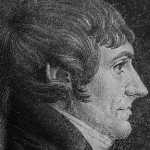
William Plumer

He blamed God for the Year Without a Summer.
Early August was sunny and warm. Farmers planted new crops, hoping the growing season might last beyond the first frost in October. But on the 13th and 14th of August, a cold spell froze the corn crop on farms north of Concord, N.H.
Less than a week later, on the 20th of August, at Amherst, N. H., a short but violent storm struck, signaling a steep drop in temperature of 30 degrees within a few hours. It snowed that day in Vermont; in Maine, farmers wrapped rags around their plants to protect them.
In some of the New England states, at least the wheat, rye, and potatoes were holding up, staving off famine. In Ashland, N.H., Reuben Whitten was able to grow wheat on his south-facing farm. He shared what he had with his neighbors. After he died thirty years later, in 1847, his neighbors paid for his gravestone and later erected a monument that read, in the spelling of the local stonecutter :

“A pioneer of this town. Cold season of 1816 raised 40 bushils of wheat on this land whitch kept his family and his neighbours from starveation.”
Hopes of salvaging what remained of the corn crop were dashed by another severe frost on the 28th of August. In Maine and New Hampshire, farmers cut-up whole fields of corn for cattle and horse fodder. Writing in his diary in Kittery, Maine, Rev. William Fogg summed up the Year Without a Summer: “Crops cut short and a heavy load of taxes.”
There were reports of people eating raccoons, mackerel, and pigeons.
As is usual in early Autumn in New England, the days warmed up again in September, but then at sunrise on the 26th of September in Hanover, N.H., thermometers read 26 degrees F. Snow fell throughout the region, followed by a killing frost which froze crops in the field and apples on the branch. As if this was not enough, the drought caused wildfires to break out in the woods throughout New England. Fires in western New York produced so much smoke that sailors were blinded on Lake Champlain.
The Year Without a Summer was especially hard on the poor. The New Hampshire Patriot reported on the 22nd of October 1816: “Indian corn, on which a large proportion of the poor depends, is cut off.” Vermont farmers lost much of their livestock, and Vermonters foraged for food such as nettles, wild turnips, and hedgehogs.
Three-quarters of the corn crop throughout New England was lost during Eighteen Hundred & Froze To Death. Prices soared for wheat, grains, meat, vegetables, butter, milk, and flour. In Maine, the price of oats tripled and potatoes doubled. Hay was $180 a ton in parts of New Hampshire—six times its usual cost.
New England was not the only region afflicted by global cooling. 1816 brought cold and widespread famines in Europe as well. The bad weather in Switzerland forced a group of poets of a literary club to remain in their rooms. In a friendly competition among the writers, the group held a contest to see who could write the best piece. Perhaps reflecting on the atmospheric conditions and the boredom they brought, Mary Shelley wrote her tale of Frankenstein.
At least the Year Without a Summer had been good for producing maple syrup in Vermont, and Vermonters traded syrup for fish, which is why they called 1816 the “Mackerel Year.”
In Washington, Members of Congress seemed insensitive to the suffering of the people they were elected to represent and voted to double their own salaries. It did not go over well. Nearly 70 percent of the incumbent U.S. representatives were voted out of office in the next elections. Daniel Webster of Massachusetts was one of them.
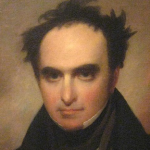
Daniel Webster
Daniel Webster lost his bid for re-election during the Year Without a Summer.
In 1817, after the Year Without a Summer was history, Josiah Meigs, commissioner-general of the Land Offices, began a more systematic approach to observing weather phenomena. He ordered the twenty Land Offices under his authority to take thrice-daily recordings of the temperature, winds, and precipitation. Author Samuel Goodrich visited New Hampshire, observing:
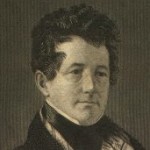
Samuel Goodrich
Samuel Goodrich described the despair that seized people during the Year Without a Summer.
“At last a kind of despair seized upon the people. In the pressure of adversity, many persons lost their judgment, and thousands feared or felt that New England was destined, henceforth, to become part of the frigid zone.” Indeed, 1817 started out cold as well, convincing Northeast farmers it was time to migrate to the Midwest.
Rev. Samuel Robbins in East Windsor, Conn., wrote, “We have had a great deal of movings this spring. Our number rather diminished here.”
At the time, many reasons were given for the weird weather phenomena: sunspots, deforestations, great fields of ice floating in the Atlantic, Benjamin Franklin’s lightning rod experiments (more than fifty years before), and, of course, the wrath of God.
As we now know, the Year Without a Summer was most likely caused by the massive volcanic explosion on Mt. Tambora in April 1815, killing 15,000 instantly, and, as time went on, another 65,000 perishing of disease and starvation.




Thinking Independently
Where Was Ben Cline?

What an Air Cleaner Can — and Cannot — Do

Belle Grove to Open Exhibit Exploring the Complex Life of Monday Robinson

Virginia Joins Bipartisan Push for Stronger Rules to Fight Illegal Robocalls

The Well Lies to You

Resumption of Capital Improvement Program Goes Forward at County Planning Commission Meeting

In Rare Move, SCC Orders Three In-Person Hearings for NextEra-Dominion Merger Case

Brenda Louise Morgan (1955 – 2026)

Norma Jean (Markle) Freschi (1933 – 2026)

POLICE: 7 Day FRPD Arrest Report 9/7/2026

Warren County DSS Highlights 5K, Halloween Jubilee and New SNAP Cards

This Week’s Showtimes at Royal Cinemas as of September 10th

9/11: A Personal Memoir — Live Scene Account of a Friend Who Was There

Virginia Health Department Updates Food Allergen List, Food Establishment Guidance

Feds Float Ending Tax-Exempt Status for Private Universities That Have Race-Based Policies

Larry “Tex” Ritter (1954 – 2026)

What to Do With All That Zucchini

Warren County High School Inducts 22 Into National Honor Society

10 Killed on Virginia Roads During Labor Day Holiday Weekend

Voters Could Move Congress to Revisit H.R. 1 Healthcare Overhaul, Kaine and McClellan Say

Daniel R. Keyser (1933 – 2026)

Town Council’s Data Center Dialogue Plays Out Against September 11 Backdrop

Virginia Voters to Decide Voting Rights Amendment in November
