
Local News
All WCPS students to attend 4 days of in-school learning beginning March 15
A new Warren County Public Schools (WCPS) COVID-19 reopening plan received unanimous approval from the Warren County School Board during its Wednesday, February 17 meeting.
Beginning on March 15, all WCPS students in grades pre-kindergarten through 12 will attend in-person instruction four days per week (Monday, Tuesday, Thursday, and Friday) with every Wednesday reserved for virtual instruction for all students.
WCPS Superintendent Christopher Ballenger reviewed the school division’s reopening plan, which calls for allowing additional days for secondary students in grades 6 through 12.
“We know how important it is for our students to be in class. We want them in class,” said Ballenger, who added that not being physically in the classroom has been shown to cause both short-term and even lifetime challenges for students. “We have to do what’s right for students,” he said.

WCPS Superintendent Christopher Ballenger tells the School Board, “We know how important it is for our students to be in class. We want them in class. We have to do what’s right for students.”

The WCPS 2021 School Year Phase III: COVID-19 Reopening Plan incorporates updated guidance issued by the U.S. Centers for Disease Control and Prevention (CDC) released last week. WCPS Assistant Superintendent for Administration Melody Sheppard, WCPS Special Services Director Michael Hirsch, WCPS Director of Secondary Instruction Alan Fox, WCPS Transportation Director Aaron Mitchell, and WCPS Director of Elementary Instruction Lisa Rudacille joined Ballenger in outlining the new CDC guidance for the School Board members, highlighting how the school district has handled instruction, transportation, and mitigation strategies since schools were shut down statewide in March 2020 due to the pandemic.
For instance, Hirsch said that WCPS follows recommendations for its mitigation strategies from both the CDC and the Virginia Department of Health. Last March, said Hirsch, WCPS established a division-level COVID-19 team to analyze the impact the ongoing pandemic was having on schools and instruction.
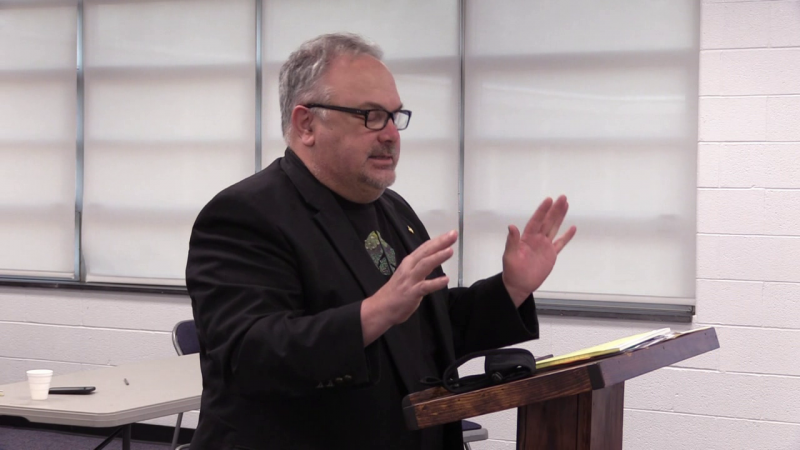
WCPS Special Services Director Michael Hirsch describes the plan to the School Board. He said “We’ve now implemented and activated school-based teams. So, there is a COVID-19 mitigation team at each school that’s going to look at related measures taken in each building and how it is impacting students.”
Since then, “we’re stepping it up,” Hirsch said. “We’ve now implemented and activated school-based teams. So, there is a COVID-19 mitigation team at each school that’s going to look at related measures taken in each building and how it is impacting students.” Then, each team will communicate and share information with the division-level team, which then can have a more global view to make further improvements, Hirsch said.

Continuous communication remains ongoing between WCPS and the Lord Fairfax Health District every day, he added, and health and absenteeism data is being sent daily to the health department. “Our clinics and our care rooms are continuing to stock and update PPE [personal protective equipment] and consistently looking at new and improved equipment that’s coming out on the market that we can purchase to keep our staff and our students safe,” Hirsch said.
Additionally, WCPS has made social-emotional learning opportunities available at every school building and a whole new initiative has been started around those opportunities by the division’s social-emotional learning coach, who is focusing on students’ mental health, according to Hirsch.
Other mitigation strategies include efforts by families and students to “just stay home when they’re sick,” Hirsch said. “That mitigation strategy alone has done more good than all the others combined.”
WCPS faculty and staff also continue to encourage handwashing and the use of hand sanitizer — strategies that Hirsch said are now being taught to elementary school students and students with disabilities.

Another ongoing WCPS mitigation strategy is that face masks also must be worn when students are in school or on the bus. WCPS has purchased some additional face shields, which are placed over a person’s masked face for added protection when physical distancing cannot be maintained, such as on a school bus, where the WCPS mitigation strategy calls for one student per seat.
Mitchell said the school district’s current ridership data shows that WCPS “should be able to maintain one student per seat with everyone going back to four days a week.” Ballenger added that because each school bus has a total of 26 seats, there are only three buses that would be over that “magic number” of having one child per seat and that the face shields will help in such instances.
School Board Vice Chairwoman Catherine Bower asked if the face shields are disposable and if not, are students or staff responsible for cleaning them. Hirsch said they can be cleaned and reused and WCPS “has purchased a significant amount of them.” Ballenger noted that each bus driver has extra masks for students who don’t have one, as well as the face shields for busloads carrying more kids than one per seat.
Board member Ralph Rinaldi asked if there was more than one student per seat, whether everybody on that seat has to wear a mask. Ballenger said yes, all students must wear a mask to ride the school bus or be removed.

These strategies are in addition to ongoing cleaning, disinfecting, and sanitization of the school buildings. “The custodial staff has been outstanding in keeping our buildings clean,” Hirsch told School Board members. “All of these strategies have become second-nature to us and our students. We’re staying vigilant to keep our students and staff safe during this difficult time.”
Updated federal guidance
The CDC’s new Recommended Implementation of Mitigation Strategies and K-12 School Learning Modes by Level of Community Transmission says that across the board, all schools are required to continue the universal and correct use of masks, as well as implement other key mitigation strategies, including handwashing and respiratory etiquette — also known as covering your mouth and nose with your arm if you sneeze — cleaning and maintaining healthy facilities, and contact tracing and diagnostic testing in combination with quarantine and isolation, Sheppard said.
In her PowerPoint presentation, WCPS Assistant Superintendent for Administration Melody Sheppard explained that the CDC’s recommendations for reopening schools are categorized into four color-coded modes: Low Transmission, Moderate Transmission, Substantial Transmission, and High Transmission.
Likewise, CDC indicators and thresholds for community transmission of COVID-19 vary for each mode, said Sheppard, pointing out that a total of new positive cases per 100,000 persons in the last seven days indicates which mode a school district falls into and what strategies should be used. For example, 0-9 positive cases fall into the Low Transmission mode; 10-49 positive cases are in the Moderate Transmission mode; 50-99 are in the Substantial Transmission mode, and over 100 positive cases would be in the High Transmission mode.

Currently, WCPS reports there are 69 positive cases district-wide, putting the division in the Substantial Transmission mode. What this means for WCPS is that the district should be providing hybrid education to all students, with reduced attendance for middle and high school students, and six feet of social distancing across all grade levels, per the new CDC guidance.
At the same time, sports and extracurricular activities should “occur only if they can be held outdoors, with masks and physical distancing of six feet or more required,” according to the CDC recommendations.
In considering all this data, Superintendent Ballenger said that WCPS would like to bring back all students to four days of in-person instruction while freezing its current elementary school plan whereby virtual students remain virtual and in-person students remain in-person under until after Spring Break. Then, a process will be established to consider formal requests to move a student from virtual instruction to in-person instruction, he said.
This strategy would help minimize an onslaught of students returning to in-person instruction that could potentially create a backslide in the transmission of the coronavirus, said Ballenger, adding that WCPS does not “want to open the floodgates and let everybody back in” at the same time.
School Board Chairman Arnold Williams, Jr., called it “a solid plan,” while Rinaldi appreciated “a very informative” presentation from WCPS Central Office staff.
Bower made a motion to accept the WCPS plan to reopen schools on March 15 at the secondary level while freezing the current schedule for now, “keeping in mind that we may need to make some changes as things progress.” Rinaldi seconded the motion, which received unanimous approval from Williams, Bower, Rinaldi, and School Board members Kristen Pence and James Wells.
The 2021 School Year Phase III: COVID-19 Reopening Plan for WCPS is available online here.
Watch the entire School Board’s February 17 meeting below.




Virginia Names Nottoway Teacher as 2027 Teacher of the Year

Wings & Wheels 2026 Ready for Takeoff at Warren County Airport on May 9th

Warren County Plants ‘Liberty Tree’ to Honor America’s 250th Anniversary

Healthcare Costs Top of Mind for Voters as Midterms Approach, Survey Finds

FBI Raids Virginia State Senator Louise Lucas’ Portsmouth Office, Cannabis Business

Edwin Johnson Henry (1936 – 2026)

Congressman Ben Cline Highlights Budget Reform, SNAP Oversight, and Space Competition

Kimberly D. Licalzi Fox (1970 – 2026)

June 17th Set for Continued Hearing on Natalie Godin’s Psychological Evaluation and Supervised Conditional Release

US Senate GOP Wants $1 Billion for Security for Trump’s Ballroom in Immigration Bill

Urban Agriculture and Firearm Assembly at Town Council Work Session

Front Royal Programs Highlight Housing, Food, and Community Support

Virginia Joins 21 States in Opposing USPS Gun Mailing Proposal

Commentary: Spanberger’s Data Center Position is the Test of Her Affordability Message

Spanberger Weighs Legislation to Allow Class Action Lawsuits in Virginia Courts

Electricity Doesn’t Give Second Chances on the Job Site

ORDER OF PUBLICATION: In the Circuit Court for Warren County, Virginia

An Open Letter of Gratitude to the Teachers in Warren County, Virginia

John’s Dream Scores 35th Win at Shenandoah Downs, Headlining Virginia Breeder’s Aged Stakes

The Dog Who Owned the Mail

Dad’s Secret Treat for Mother’s Day: The Frittata

Governor Spanberger Signs Bill to Decriminalize Suicide

Otis Sterling “Hubby” Darnell Sr. (1945 – 2026)

Virginia Lit the Fuse for Independence — 250 Years Ago This Month
