
Local News
Stephens City Volunteer Fire and Rescue began service as one bay door facility on Mulberry Street
The Frederick County Fire and Rescue Department Station 11 – Stephens City Volunteer Fire and Rescue (SCVFR) provides fire protection and emergency response services to the greater Stephens City community. The Fire Department’s mission is to prevent the loss of life and property by responding to fire, medical emergencies, motor vehicle accidents, rescue calls and hazardous material incidents. SCVFR currently maintains about three acres of land which include a 13,000-square foot building. The building has 10,000 square feet dedicated specifically for fire and rescue services, including storage, living quarters and training/meeting space. A community hall makes up the remaining 3,000 square feet of the building.
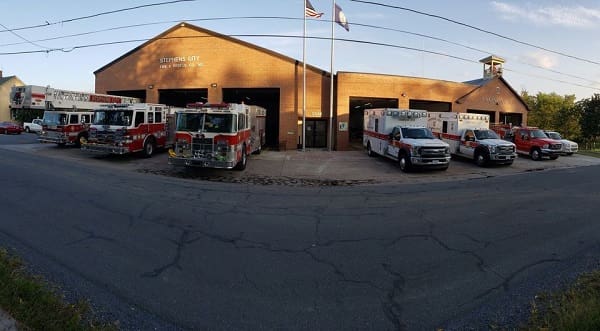
Stephens City Volunteer Fire & Rescue seven bay facility on 5346 Mulberry Street. Courtesy SCVFR.
In accordance with GIS Division of Information Technologies, County of Frederick, VA, SCVFR First Due response area is fifty-two square miles with a population of 29,500. The response area borders extend to the Winchester city line to the north, Route 522 to the east, Vaucluse Springs to the south and just past Cedar Creek Grade to the west with approximately 237 road miles within.
“The future for SCVFR is optimistic,” said Fire Chief Timothy Vaught. “We continue to have overwhelming support from our local stakeholders including town and county governments, citizens, and businesses in which we serve. Planning continues for upgrading our current property, equipment and fleet as firefighting technology progresses.”

Early days of firefighting.
In the early days, the original fire alarms were people. These individuals would hustle around the town, ringing bells to warn the community of imminent danger and alerting folks to come equipped with buckets to respond to the fire. Very often, by the time bucket brigade volunteers were organized to fight the fire, there was nothing but glowing embers to greet them when they arrived at the scene.
According to the late town historian Mildred Lee Grove, whenever a Stephens City fire was first observed, someone in a position of authority had to phone Winchester and request one of the city Fire companies act. The responding fire company needed to ascertain, in advance, if there was adequate funding available to cover their services. Prior to 1941, the town had no water system and cisterns were the primary source of water. Often Stephens Run had to be dammed up during town fires so firefighters could pump water into their hoses.
During the 1930s, there were several devastating fires in Stephens City. According to the late Robert E. Aylor, two great fires prompted the town to consider establishing a fire department. The first fire was at M.J. Grove Limestone Company in the Mudville District in 1936 and the second was a major commercial fire at Willie Boyd “Pud” Steele’s magazine and newspaper store at 5317 Main Street in 1938. Aylor was the Stephens City school principal at the time and would become the fire company’s first president.
Town leaders believed these major fires were an initiative to establish a local fire company rather than rely on fire companies from Winchester. In April 1939, Robert E. Aylor and ten others organized the Independent Hose Company. In August 1939, the new fire company requested financial assistance from the town council. Mayor Lomax Parker called a bond issue election for providing a water system to improve firefighting efficiency. On November 4, 1939, during a special meeting, the council voted (4 yes, 1 no, 1 absent) to build the first town water system with a cost not to exceed $9,000.

Until this time, Frederick County did not have any fire protection other than fire companies from the town of Winchester. The Independent Hose Company was chartered in 1941 as Frederick County’s first volunteer fire company. Julian Steele was the first chief and Robert E. Aylor was the president. The firefighters were H.R. “Boots” Mills, Maurice Lemley, Joseph Clevenger, John Gossard, Marshall Venable and Dave Brumback.
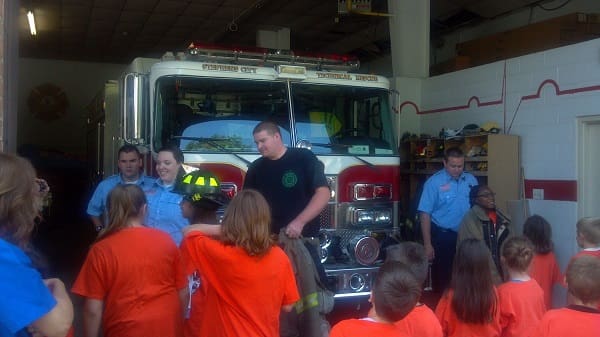
Fire prevention education and awareness being presented by SCVFR staff to students from a local church preschool in August of 2012. Courtesy SCVFR.
A Lady’s Auxiliary was also formed to assist the firefighters with fund-raisers to build a fire hall. Many of the fund-raising functions were held at Stephen City High School and were attended by large crowds. The first fire engine was a 1933 Dodge 6-cylinder which the members purchased for $1,000 from the South End Hose Company in Winchester. The truck was housed in the school basement on Main Street until members built the original one bay door section of today’s fire hall on Mulberry Street in 1941. A portion of the money was raised by selling individual concrete blocks for eleven cents each. In November 1947, the company’s name was changed to Stephens City Fire Company, Inc. The fire company then bought a new 1947 International which was garaged in the fire hall.

Fire department becomes central focus of community.
The 1950s gave birth to an upsurge of civic and social organizations, all of which vied for volunteers. Stephens City fire department was able to dominate the volunteer activities for decades because no other organization could match the adventure that was found in a firefight or the thrill of saving human life and property.
In 1957, a community hall was added to the back end of the original building. The original firehall on Mulberry Street was a simple structure. Around 1963, a second door was added to the original building to allow for two fire trucks and later saw its size triple by 1976 when two additional bays were built on the north side. During this time, the Ladies Auxiliary sponsored many fundraisers to include lawn parties, bingo, beauty pageants, apple butter sales, fire hall dances, chicken dinners and carnival parades. In the 1960s and 70s the Auxiliary donated $2,500 to $4000 annually to payoff fire hall equipment debt.
In 1983, Stephens City became a first responder company. The fire company became known as Stephens City Volunteer Fire and Rescue Company in 1991 when it was certified as a basic life support facility and transport agency. SCVFR achieved certification as an advanced life support company in 1994.
1994 brought more changes as Stephens City broke ground for an 8,000 square-foot addition to the north side of the fire hall. The additional space provided for three bays, bunk rooms for men and women, a recreation room, meeting and classrooms, a lounge with kitchenette and storage rooms. The building dedication took place on February 25, 1995.
In the fall of 2016, due to overcrowding issues, the company converted a 2,220-square-foot residential building built in 1921 on an adjacent property into additional administrative offices. It houses the Fire Chief, Fire Marshall, and operational offices (Fire, EMS and Safety), meeting rooms and archives.

In 2017, SCVFR expanded its apparatus storage with the addition of a 4,250-square-foot ancillary building to the rear of Fire Station 11. Two of the four bays are drive through. The building stores a technical rescue squad, reserve fire engine, brush truck, utility truck, three rescue boats, grounds maintenance equipment, hazmat support trailer and other support items related to emergency response.
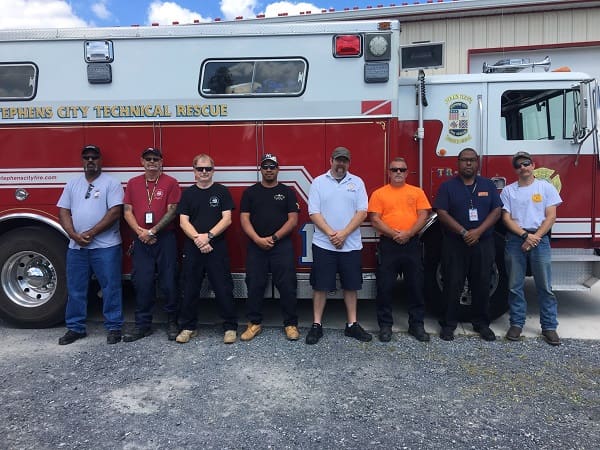
SCVFR Technical Rescue Team returning from a multi-day deployment for Hurricane Dorian response efforts in September of 2019. Courtesy SCVFR.
Transition of firefighting equipment through the decades.
78-year-old Tom Merritt began volunteering for the SCVFR when he was sixteen. He received lifetime membership in 1991 and has served the department as a firefighter, emergency medical technician, treasurer, vice president and president. Tom provided an overview on the history and evolution of the fire equipment used through the decades.
In 1939, the fire department purchased a 1933 Dodge one and a half-ton chassis with water pump mid-mounted on the equipment. It was converted from a soda pressure unit to a front mounted 250 Gallons per Minute (GPM) pump.

In 1947, a new KB7 International with a 500 GPM front mounted pump and a 500 Gallon Water Tank (GWT) was purchased.
Next came an American LaFrance unit built on a 1963 cab over 850 Ford with a 750 GWT and 750 GPM mid mounted pump.
In 1974, came a new American LaFrance Pioneer II with a 1,000 GPM pumper and a 750 GWT. Equipment included cross lay hoses to support the rapid deployment of a hose line to attack a fire. A jump seat provided five firefighters to ride inside the cab for more safety.
In 1982, came a new 99 Pierce Arrow 2,000 GPM and 750 GWT adding a larger pumping capability.
In 1990, a new Pierce Lance Custom Built 2,000 GPM, 1000 GWT, Compressed Air Foam System (CAFS) 50-gallon Class B foam, 10-person cab to allow more firefighters to ride in safety.
1996, a used tandem rear axle canopy cab-forward ‘88 Emergency One (E-One) “Hurricane” 100-foot rear mount ladder quint featuring 1,500 GPM, 250 GWT with cross lay hoses. First ladder truck allowed a platform for firefighters to work from a distance for safety.
In 2001, Tower 11 becomes a 1986 Pierce Arrow 105-foot Steel Ladder Bucket with 2,000 GPM, 300 GWT, 6-person cab. Tower 11 has an interesting history as it originally was ordered for Dulles Airport in Virginia and was painted lime green and white. Stephens City had some significant revisions made to the truck, including the addition of a 4-door cab, upgraded pump and roll up compartment doors.

Tower 11 operating at a garden apartment fire in October of 2008. Courtesy SCVFR.
In 2004, came a new Pierce Contender Mini Pumper 750 GPM and 270 GWT with CAFS 30-gallon Class A foam, 2-person cab. Truck used for brush and wood fires.
In 2006, a used 2002 Pierce Dash 1250 GPM and 750 GWT rescue engine including “Jaws of Life” hydraulic-extrication tools used for highway accidents and to supplement the technical rescue team.
In 2017, a new Engine 11 Pierce Arrow Velocity Custom Pumper, 2,000 GPM and 1,000 GWT, 6-person cab was purchased to replace aging apparatus. Many of its new features, like the guard walls on top of the truck and the automatic ladder system, were engineered to help the firefighter stay safe. Truck came equipped with full harnesses and airbags.
Training and volunteering.
When SCVFR was a small rural town fire department, training consisted of a sit down with the Fire Chief and listening to the “old tried and true” methods of firefighting. That is the way we do it here syndrome. However, as the role of the volunteer firefighting responsibilities expanded, so did the necessity for classroom training to perform a multitude of important tasks.
According to SCVFR President Lenny Peters, the Federal Government established the National Incident Management System (NIMS) in the early 1990s. That brought the Feds, State agencies and local government emergency services all under the same system and method to managing incidents. All Fire Rescue personal are required to have NIMS 100, 200, 700 and 800 program courses, while Fire Chief’s Officers must also receive NIMS 300 and 400 which offer training in command, personnel and logistics.
FEMA introduced the Incident Command System (ICS) about the same time. ICS brought fire rescue incident command under one umbrella on how incidents are managed. “Volunteers are encouraged to take incident command and leadership classes available online, locally and at Emmetsburg Maryland at the National Fire Academy,” Peters said.
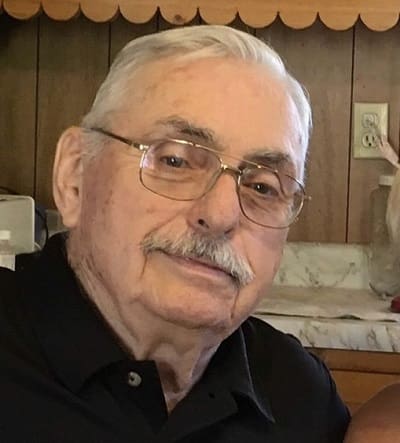
Walter Saunders joined the Annandale (VA) VFD in 1951 when he was seventeen. Saunders was employed by Fairfax County Fire Services (1957-58) and District of Columbia Fire Dept. (1959-80). Saunders was an active volunteer at SCVFR holding positions as firefighter, treasurer, photographer and historian from 1995 through 2011. Saunders’s 20 binder historical record of Stephens City firefighting (1939-2011) was essential in the writing of this article. Courtesy Walter Saunders family.
Chief Vaught describes current volunteer opportunities as emergency medical services, search and rescue, traffic incident management and maintenance of equipment, uniforms, and vehicles. “Those interested in emergency response should know that SCVFR offers fire and EMS services and technical rescue services such as water rescue and rope rescue,” Vaught said. Vaught believes there is a place for volunteers not interested in fighting fires or providing medical care. “These include grant writing, public relations, clerical office work and strategic planning. For those pursuing a paying position within fire and rescue, volunteering is a wonderful way to gather experience and education to increase employment opportunities,” Vaught added.
Chief Vaught said volunteerism continues to be on the decline nationwide. “While some funding is received from local governments for our operational expenditures, a substantial portion of our operating capital is derived from fundraising and station events. Additionally, the administration of the organization and upkeep of the station and grounds are all conducted by volunteers. As experienced members depart through attrition, the remaining members must shoulder additional responsibilities to ensure the continuation of service. It can take many years for an entry-level member to gain the knowledge and experience necessary to advance to management levels within the organization. This applies to both the business department and emergency response aspect. Without volunteers to evolve into these roles, the organization becomes diminished,” Vaught concluded.
Fundraising and public relations.
Today the SCVFR currently staffed by fifty volunteers (fire-fighters, medical services and administrative support) and twelve career personnel who provide support 24-hours a day, 7 days a week. Current financial support for the fire company is derived from several sources to include state, county and town funding, EMS Revenue Recovery, local donations, social hall rentals and two annual letter solicitation fundraisers. Fundraising efforts supplement the overall budget.
SCVFR continues to provide outreach to the community, offering fire prevention awareness education material and equipment displays to day care, elementary and middle schools, and church groups. The ever-popular Santa Tours makes special appearances to first due subdivisions during a two-week period in December. SCVFR participates in the annual Newtown Heritage Festival, Shenandoah Apple Blossom Festival, Middletown Fourth of July, and Front Royal Fireman’s Carnival parades.




The Four-Year-Old Stage: When Your Preschooler Tests The Limits

The Dignity Is In The Doing

New Medicare Bridge Program Covers Weight-Loss Drugs For Some Patients

“Can’t We Just Watch the Movie at Home?” A Question About the Future of Movie Theaters

Two Front Royal Churches Plan Joint Oct. 25 Gathering Focused on Faith and Virginia Ballot Issues

Robert Arthur Babineau (1961 – 2026)

Here’s Where Doctors Diverge on Virginia’s Pending Reproductive Rights Constitutional Amendment

Virginia Teachers Balance AI Innovation with Student Creativity Amid Rising Academic Pressure

Donna Kersey Deavers Smith (1945 – 2026)

William Franklin “Rocky” Walker (1959 – 2026)

Measles Cases Reach 4,080 for the Year — the Highest in Decades

Data Center Backlash Set to Sway Midterm Elections

Mary Ann Williams (1942 – 2026)

Winston Richard Summers (1946 – 2026)

With Mother Nature’s Cooperation Festival of Leaves Draws Another Huge Crowd to Greet the Fall Season

Turning Off an Airbag Is Allowed in Limited Circumstances

A Retirement Account for a Grandchild Starts With a Summer Job

Your Photos Survive A Lost Phone, But Not A Wrong Tap

Walking Malls Don’t Solve Problems

Festival of Leaves 2026 Wraps Up a Successful Day in Downtown Front Royal

Autumn Delights: Spotlight On Pumpkins!

Lord Fairfax Health District Receives $5,000 Grant To Support Local EMS Crews

Why an AI Bubble Could Reach Your Savings

The Platypus: A Truly Amazing Animal!
