
Automotive
A history of roads in Virginia: First construction appropriation in 1909
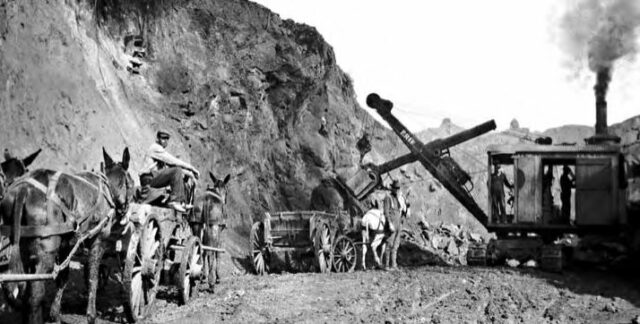
An Erie steam shovel is pictured in operation along with mule-drawn dump wagons.
By 1908, the need for better roads had reached the point that the legislature made its first appropriation for construction purposes under the new state program—$25,000 annually, beginning March 1, 1909, “out of any money in the state treasury not otherwise appropriated.” It was intended mainly for use in counties where convict labor was not available and was to be matched equally by the counties paying for road improvements.
“This law does more than provide a very considerable additional fund for road improvement, as its requirement that a county shall raise an amount equal to its share of the fund before it can be obtained arouses the people to the importance of making extra efforts to provide money for improving the roads,” Wilson said.
During this period, state law directed the counties to levy a road tax of up to 40 cents for each $100 in value on real estate and personal property, with the revenue to cover the counties’ share of improvements and to buy road equipment. In addition, the counties were authorized to issue bonds “for the purpose of macadamizing or otherwise permanently improving the public roads… or building bridges… ”
By 1910, Virginians owned 2,705 motor vehicles, and the General Assembly decided the time had come to regulate their use. That year, the state’s first registration and licensing of motor vehicles was required, with registration fees of $5 for autos of 20 horsepower or less, $10 for those with 20 to 45 horsepower, and $20 for vehicles with more than 45 horsepower. A $2 registration fee was set for motorcycles and 235 were registered in 1910. The fees were to be paid into the state treasury as a special fund to be spent for improving main roads. Total revenue from the first year’s collections amounted to $21,656.
In 1910, the General Assembly also enacted the first controls on motor vehicle speeds in Virginia. Twenty miles an hour was the established limit in open country, while eight miles an hour was established in towns, around curves, and at key intersections.
Three years later, with more than 10,000 motor vehicles in the state and the road program continuing to grow, Commissioner Wilson left Virginia to become chief engineer for the U.S. Office of Public Roads and Rural Engineering in Washington, an agency that had followed the Office of Road Inquiry. Wilson was succeeded by George P. Coleman, who had been his assistant since 1906.
Even as the changeover in administration was occurring, Wilson again cited the nagging problem of inadequate road maintenance:
“The expenditure of considerable amounts of money derived from long-term bonds by the various counties in the state for the construction of roads, and the evident lack of care of these roads after they have been constructed, demonstrates that unless some more adequate means for the maintenance of these roads is provided than has yet been provided by the several counties in which they have been constructed, there will come a time when the counties have little left but the debt which they have incurred,” Wilson said.
Wilson also stressed that unless stringent maintenance requirements were imposed, “the expenditures made and the work of this department during the past seven years will have been as naught.”
By that time, the counties had issued approximately $7 million in bonds. George Coleman agreed with his predecessor that this investment wasn’t being protected. Increasing use of roads made the problem even more urgent. By 1916, more than 37,000 motor vehicles were registered in the state. It would be a pivotal year for the road program in Virginia and nationally.
In Richmond, the General Assembly passed an automobile maintenance law providing that income from vehicle license fees be placed in a special maintenance fund to be administered by the commission, in cooperation with county authorities and with expenditures to be matched equally by the counties.
The legislature also began curing the headache of the state’s disjointed roads, some of which were smooth and hard-surfaced in one county and rutted dirt in the next. A study committee — consisting of three members of the state Senate, four from the House of Delegates, and the highway commissioner — was appointed to develop a plan for a state highway system to include the main roads between population centers.
In Washington, meanwhile, increasing attention was being focused on the problems of improving roads that connected various states. Coleman had been a chief organizer of the American Association of State Highway Officials (later became AASHTO) in 1914. The group was formed by highway administrators in the states to provide a forum for discussion of technical, legislative, and economic matters and to strengthen the state-federal relationship on roads.
One of the association’s first moves was to designate a committee to prepare proposed legislation for the Congress authorizing federal participation in construction of highways and encouraging better state-to-state coordination. Coleman was chairman of that legislation drafting committee.
The committee’s proposals were submitted to Congress in 1916 and were approved that year largely as presented. The new law provided for construction of rural public roads and defined them as “any public road over which the United States mails now are or may hereafter be transported.” Federal funds were not to exceed 50 percent of the cost of constructing improvements, and the states were to have the responsibility for maintaining the completed facilities.
President Woodrow Wilson signed the Federal Aid Road Act on July 11, 1916. It was the federal government’s first comprehensive law aimed at establishing a nationwide highway system. When it was passed, America had 2,578,078 miles of public roads, 294,569 miles or 11.4 percent of which were surfaced.
For the 1916-17 fiscal year, Virginia received approximately $100,000 in federal funds. The road between Hansonville and the Washington-Russell County line at Moccasin Gap, now U.S. Route 19, was the first road in the state to be improved with federal aid.
Next up: State system approved; WWI interrupts progress
Produced by the
Virginia Department of Transportation
Office of Public Affairs
1401 E. Broad Street
Richmond, VA 23219
VirginiaDOT.org

Town Council Reviews Goals at Retreat in Advance of Work Session

New Virginia Laws Target School Construction and Classroom Cellphone Use

Clear Horizons Brings Fresh Approach to Mental Health

Funding Cuts, State Error Strain Virginia’s HIV Care System

Virginia Hospitals Filed More Than 1 Million Medical Debt Lawsuits Since 2010, a New Report Finds

Spanberger Signs Bipartisan Bills Tied to Billions in Business Investment Across Virginia

Birthright Case Forces US Supreme Court to Confront Prospect of Americans Losing Citizenship

Caleb Benton McKinstry (2010 – 2026)

Ideas for Nurturing — or Rediscovering — Your Inner Child

Protein Takes Center Stage in Updated U.S. Dietary Guidelines

Blue Ridge Wildlife Center Acknowledges a Quarter of a Century of Work in Wildlife Preservation & Human Education

What Does A ‘Fair Share’ Really Mean?

South Warren Ruritan Club Hosts 20th Annual Spaghetti Dinner Fuels Scholarships for Local Teens

Trees Take Root as Virginia’s Frontline Defense Against Urban Heat

Virginia Set to Rejoin RGGI as Utilities Prepare to Pass the Cost Back to Ratepayers

Virginia Joins Multi-State Lawsuit Challenging Trump’s Election Order

Trump Budget Seeks 43% Boost in Defense Spending, Cuts in Many Domestic Programs

Virginia Sees 33,000 ACA Enrollment Drop Since Subsidies Expired, More Likely on the Way

Annual Dental Checkups and Cleanings: Essential Appointments

4 Stimulating Activities for a Healthy Brain After 50
The First Amendment: America’s Unique Foundation of Freedom

How to Tackle Credit Card Debt

Summer Enrichment Camp Gives Teens Hands-On Learning Opportunities

VDOT: Warren County Traffic Alert for April 6 – 10, 2026
