
Local Government
After lengthy closed session, council ponders its role in regulating short-term-tourist rentals
The Monday evening (Jan. 10) Front Royal Town Council Work Session began with a two-hour-plus Closed Meeting at which first, “probable litigation” involving a claim of damaged private property by unidentified Town operations was discussed; followed by discussion of personnel matters including “… performance, demotion, salaries, disciplining, or resignation of specific public officers, appointees, or employees … specifically of the Town Planning Commission, Town Board of Zoning Appeals, and the Local Board of Building Code Appeals”, as well as a late added “and other personnel”.

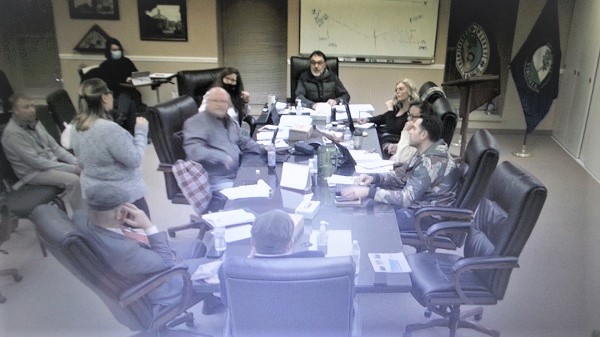
The first two hours of Monday’s work session was conducted behind closed doors regarding a property damage claim against the Town, and personnel matters. Royal Examiner Photos by Roger Bianchini
As there was no meeting scheduled, no announcement or action followed the closed session.
The open portion of the work secession featured a wide-ranging conversation about establishment of a Town Code on regulating Short-Term Tourist Rentals. Town Planning Director Lauren Kopishke opened by telling council that no one had showed up at a December Planning Commission Public Hearing on the matter, so there was no public input on parameters or preferences to fit town residential patterns interacting with the increasingly popular “quasi-commercial” use of personal residence as a money-making short-term rental endeavor.
After an overview from Kopishke of the draft proposal based on the existing County Code, opinions of elected officials on levels of regulation went in wide and varied directions. Letasha Thompson opened by expressing concern over a requirement that all short-term rental parking be in driveways, and not allowed on streets. – “Some people don’t have driveways” she worried over that segment being prohibited from qualifying for Conditional Use Permits (CUPs) to allow them to profit off renting their properties out.
Kopishke responded that such conditions were included to protect normal neighborhood parking patterns and would ultimately depend on the number of cars short-term rental customers would bring to bear on a location.
Amber Morris wondered if the Town should initiate any regulations on the use, noting that there were statewide codes. “Where in the Town Code are short-term rentals specifically prohibited? Because I have been approached recently that it is not specifically against code. And in the state of Virginia it’s pretty blanketed. And my concern with this is … that we’re kind of going above and beyond and we’re adding unnecessary measures to the entire thing as a whole,” she told the planning director, later wondering why after “10-plus years” of non-enforcement, why start regulating now?
“While it’s not defined in our zoning ordinance – all we have defined are lodging homes. And these do not permit short-term stays under 14 days. So, to allow this we have to at least define it in our ordinance,” Kopishke responded, adding, “The state does permit it, which is why it makes sense for us to adopt something, because the state just defines what it is and explains how they’re going to tax it. It doesn’t explain how to regulate it.”
Planning Director Lauren Kopishke, standing to left, explains dynamics of Town’s role in regulating a developing rental trend, short-term out of private homes, as council ponders its role in regulating a quasi-business operation inside its limits.
Morris countered that the draft seemed “a little over-regulated” in its existing form. Planning Director Kopishke noted that with such a broad state code it made sense for each jurisdiction to establish its own regulatory code to accommodate its community structure, so as not to allow a new quasi-business use to disrupt the lifestyle of existing neighborhoods.
“Every jurisdiction has something a little bit different. So, what I took just for simplicity’s sake was Warren County’s because that’s what people around here would be used to. I looked at Strasburg, Strasburg’s just a little bit more complicated – Winchester, Fauquier County, they have more regulation to it. So, this is bare bones,” Kopishke said of the draft structure presented to council for an early review.
“This leaves a lot up to our discretion, right?” Vice-Mayor Lori Cockrell observed.
“The way it’s written gives you as council a lot of control. If you want less, we can put less prohibitions in there. It’s how council would like it to be done,” the planning director explained. This led Councilman Joseph McFadden to note that many people who might be attracted to the idea of making money off short-term rentals of their home or other structures might not think through a business plan – “This just gives them something to think about. I think it’s great there are some (guidelines) in here. Like you said, we decomplicated it, uncomplicated it as much as possible, keep it bare bones, I’m all for it,” McFadden said.
However, Morris continued to voice concern over any attempt at regulation, noting that in the absence of a code, a number of town citizens have been operating this type of rental use for a number of years. – “But we haven’t gone after them,” Kopishke noted. She observed that were its council desire, the Town could initiate legal actions to stop those operations until a code is established and permitting obtained. – “It could be considered a Class 3 misdemeanor,” the planning director pointed out, adding that it did not seem a desirable approach to label people “criminals” for pursuing a use in a vacuum of town guidance or regulation.
“That’s not the concern, but the concern is we’ve been doing this for 10-plus years and it hasn’t been enforced, why are we adding new (regulations)?” Morris continued in questioning why bother to regulate now. McFadden responded that some people who would like to initiate such an operation were not because they wanted “to operate within the law”. Establishing legal parameters to protect short-term tourist operations, as well as their neighbors’ interests in a more “bare-boned” manner as described, seemed an optimum path forward, he reasoned.
“I think we should do less regulation,” Morris injected, without explaining what was “less” than the no regulations or enforcement the Town has been operating under.
Among regulations on the table were the necessity of short-term tourist rentals having landline phones to assure the ability to contact emergency services if necessary, limitations on number of rental occupants (two per bedroom), vehicles and parking, and a one-time application fee of $400.
“I look at this as protecting our citizens, the people who live here every day … that their quality of life in their neighborhood, their children, whatever, that it doesn’t affect them because somebody next to them wants to do this,” Vice-Mayor Cockrell observed as the conversation wound down. The entire discussion lasted for nearly 20 minutes (33:50 to 52:00 minute mark of the Town video). As to a path forward, Kopishke told Royal Examiner she would remove the driveway parking restriction and forward the newest draft ordinance to the planning commission for further review and a recommendation on final action to council.
See this discussion, as well as others, including parameters for Vape/Vape Oriented Businesses (following the short-term tourist rental discussion); the Order of Business” at regular council meetings – one proposed switch was having Public Comments on non-agenda items after Public Hearings; two committee appointments; options forward in the employee health care insurance pool; pending Capital Improvement Projects; and a Sole Source Purchase of Neptune Water Meters at a projected cost of $65,523.
Not on the agenda
One other unscheduled item that occurred just before the work session’s convening around 6 p.m. was serving of a no-trespass order on Mayor Holloway by a representative of his Virginia Ave. neighbor Cheryl Langlais. As noted toward the conclusion of Norma Jean Shaw’s story on Holloway’s dog-containment fence construction and permitting issues, Holloway had refused to accept a registered letter serving him with the notice in the wake of his and other social media posts concerning his discontent with his neighbor’s report on his dogs running loose and her in-home business licensing issues.

Mayor Holloway does not appear pleased shortly after receiving a no-trespass order just before Monday’s work session’s convening. Below, a copy of the trespass order initially attempted to be delivered by registered letter, which the mayor is reported by its sender to have declined to accept.

Mayor built fence prior to obtaining zoning permit – is a pattern emerging?

Constitution 101: Revenue and Presentation Clauses

What Are the Main Breeds of Dairy Cows?

Navigating Student Aid: How to Make Smart College Financing Decisions

Vonnie Grovine Blosser (1933 – 2026)

Front Royal VFW Unveils New Headquarters, Invites Veterans and Community to Reconnect

Sheriff Cline Introduces Major Frank Myrtle as New Chief Deputy of Warren County Sheriff’s Office

Warren County School Board Opens 2026 With New Leadership, Student Showcases, and Focus on Accountability
Still a City on a Hill: Celebrating 250 Years Of the American Experiment

Realigned County Board of Supervisors Revisit FOIA Legal Issues, Hear From An Aroused Public on Library Reinstatement

5 Essential Elements for Planning a Successful Wedding

Warren County School Board Elects 2026 Leadership

The Year of Confusion: What Did the Romans Do in January?

Dustin Blake “D-Ham” Hamilton (1996 – 2026)

Warren County Board of Supervisors Elects 2026 Leadership at Annual Meeting

In Statewide Survey, Employers Say Virginia Child Care Crisis Negatively Impacts Businesses

Commentary: Doing The Happy Dance as Social Security Pays Up

US House Backs Extension of Health Insurance Subsidies After Dems Force Vote

US Senate With GOP Support Advances War Powers Resolution Rebuking Trump on Venezuela

Tribute to an Extrordinary Local Lady and Her Nationwide Legacy

3 Must-Have Accessories to Make Winter Driving More Comfortable

Travel Planner: A Lovely Gem Hides in an Unexpected Place

The Sufficiency of a Sworn Affidavit: Town Planning Commission Favors Administrative Enforcement for Auxiliary Dwelling Units

Warren County Girls’ Basketball Team Set to Face Manassas Park This Friday

Battery Storage Bills Make a Return After Previous Vetoes
