
State News
Army Corps Plans to Fast-Track Infrastructure Priorities, Including in Virginia
The U.S. Army Corps of Engineers on Monday unveiled a new initiative aimed at delivering critical national priority projects faster and cheaper.
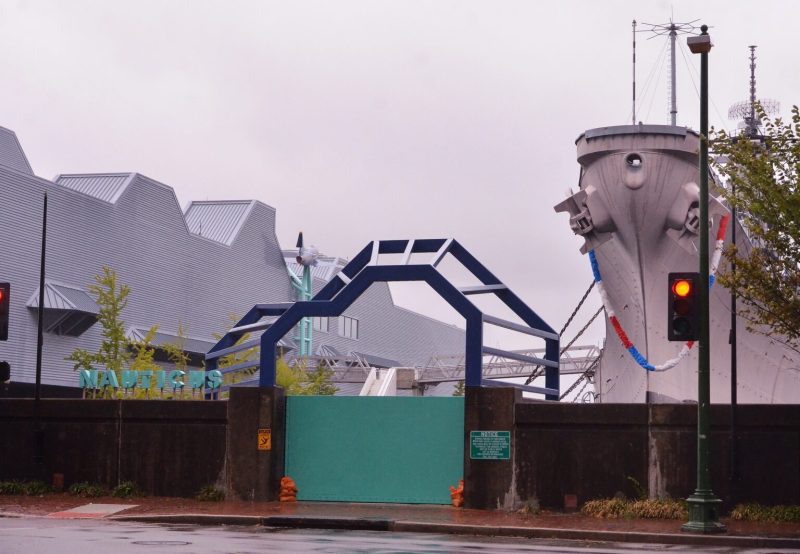
The Norfolk Floodwall, constructed by the Army Corps of Engineers in 1971. The wall is being expanded in a $2.6 billion project led by Norfolk leaders and the Army Corps of Engineers. (Photo by Jim Morrison/Virginia Mercury)
It’s a potential breakthrough for the Corps — which has long been accused of being slow to get projects off the ground and completed, causing skyrocketing costs — and could fast-track some of Virginia’s coastal resilience projects.
“The Army Civil Works’ ‘Building Infrastructure, Not Paperwork” initiative will enable the U.S. Army Corps of Engineers to deliver critical projects and programs for the nation more efficiently, sooner, and at less cost than the current ways of doing business,” said Assistant Secretary of the Army for Civil Works Adam R. Telle in a press release.
The plan’s initiatives include overhauling the regulatory process to eliminate delays in permitting projects; empowering commanders to “take informed risks” to advance key water resources programs so they can be completed faster and at less cost; and consolidating decision-making about some projects at the national level, not local districts.
The plan also aims to contract out feasibility studies rather thad doing them in-house and to cancel contracts that are “not in the interest of the American taxpayer,” the release said, shifting resources to the most critical water projects.
Army Corps’ projects have long experienced delays, cost overruns and, in many cases, planning and design that never led to construction. Critics of the Corps are skeptical about whether the changes can be made and whether the agency’s core mission to protect the environment will remain a priority.
Still, they agreed reforms are necessary to address the Corps’ logjam of projects that has persisted for decades.
Overcoming a history of held-up projects, including in the commonwealth
In Congressional testimony last year, Telle said the Corps had $78 billion in projects authorized but not yet appropriated and about $44 billion that had been appropriated but not spent, including $12 billion that had been sitting idle for more than five years.
Threatened cities along the Atlantic Coast in recent years have seen their storm risk plans delayed after issues and challenges arose to their designs, which were completed only to 10%.
The new initiative seeks to make the analysis of a project proportional to its scope and cost, calls for flexibility in making changes, and appears to back more complete designs before projects are authorized.
One of the held-up projects is the $2.66 billion Norfolk Coastal Storm Risk Management plan, the largest infrastructure in the city’s history with nine miles of floodwall. It’s now projected for completion in 2037, five years after originally scheduled. The cost likely will skyrocket when a new estimate is released.
The Norfolk plan is just one of several billion-dollar storm risk projects in major cities, including Miami, New York, and Charleston, that have endured delays or pauses.
During testimony Tuesday before the House Transportation and Infrastructure Committee, Telle described visiting a California dam project where a local official said he hoped his grandchildren would benefit.
“He had a realistic perspective on our program, which is it takes generations, quite often, to deliver,” Telle said. “It was a sad moment for me, because we’ve almost conditioned our stakeholders out in the field to think that our work is going to take generations, and it shouldn’t be that way.”
That, he said, was the impetus behind the initiative.
“We need to empower commanders to determine what their priority is, and then hold them accountable from year to year about how they’re cutting red tape and delivering on those projects, whether it’s funding, but more importantly, process and effort, rather than expecting them to inch every project down the field one inch at a time,” he said.
A spokesman for the Norfolk District office of the Corps said it was working to implement the initiatives “and ensure alignment with the President’s priorities.”
Feasibility studies for other storm risk plans in Virginia Beach, Newport News, and Hampton are in the works; it’s unclear what effect the new initiative will have on those.
In response to questions about those projects, the Norfolk district spokesman said that “USACE will be focused on strategically allocating available resources to prioritize the most pressing infrastructure needs across the country.”
To academic and environmental observers, the Corps’ initiative, while short on details, represents much-needed progress and reforms. But its language is worrying, some cautioned.
Rob Young, director of a program studying developed shorelines at Western Carolina University, was struck by the vagueness.
“There’s glittering language there about all the wonderful ways they’re going to streamline the way the Corps delivers projects. But, I mean, it’s pretty pie in the sky,” he said.
He also pointed out how often the new initiative states the goal is to meet the president’s priorities. Congress, he noted, authorizes civil works projects.
“The legislative branch is supposed to be driving this bus,” he added. “I got the sense from reading that document that somehow they were going to constrain the Corps to focus on executive branch priorities, and I find that to be a little bit concerning.”
In October during the government shutdown, Russell Vought, the Trump administration’s budget chief, paused $11 billion in U.S. Army Corps water infrastructure, flood control, and environmental restoration projects for “lower priority projects” in cities including New York, San Francisco, Boston, and Baltimore — all Democratic strongholds.
Democratic senators protested after being told the Office of Management and Budget “indicates that projects will be paused in an effort to “reorient” how the federal government prioritizes Corps projects.”
Melissa Samet, the National Wildlife Federation’s senior water resources counsel who follows Corps policies, is worried that foundational environmental policy like the Clean Water Act may be pushed aside.
“A lot of the provisions seem focused on beating stuff up without any backstop for making sure that what’s actually happening is the best project on the ground, using the best solutions. I think that is a huge problem,” she said. “And then, there’s what are the priorities?… Are you actually designing projects to protect the environment, as the Corps is supposed to do?”
William “Skip” Stiles, a longtime Congressional staffer who recently stepped back from heading Norfolk-based nonprofit Wetlands Watch, has similar concerns.
“This attempt at reform is a blinking yellow light, because you wonder, what’s the real agenda here?” he asked. “Is it to speed the Corps up or is it to decimate the environmental review pieces of Corps projects?”
He noted that past reforms — like a post-Hurricane Sandy move to require feasibility studies of plans like Norfolk’s to be completed in three years for $3 million — was a transparent process that included Congressional hearings and ran through the regulatory process.
Conversely, the new initiative was announced without transparency about how it was developed. “What’s the real agenda here?” Stiles added.
That reform, requiring only three years for feasibility plans, proved impossible to meet in cities like Miami, New York, and Virginia Beach. In 2024, it expanded to four years and $5 million, but even that goal won’t be met in some cities.
But “faster is not always better,” noted Samet. “There’s been clearly this focus on speed. But these are big complex projects, and big complex projects need to be properly planned, and if they’re not meaningfully planned and designed, you have no idea what the ultimate cost will be or what the implications of what you’re doing will be. Will it actually make people safe? They don’t know.”
Samet, Young, and Stiles said there are opportunities within the revamped guidelines.
“Can they be more effective and efficient? Absolutely,” Samet said. “Is it a good thing to contract out on some of these more complex projects? Maybe so, and that could be a very good thing,” depending on who is doing the outside work, she said.
They expressed concern that in the drive to move faster, environmental guardrails will be ignored.
Dredging projects in Virginia, which include the James River, the Atlantic Ocean Channel off Virginia Beach, and the Nansemond River, were highlighted as an example of how the new policies will increase capacity.
“To do so, USACE will work with Endangered Species Act resource agencies to significantly expand the seasonal windows for dredging within ports,” the release said.
Young said whether the initiatives will yield results depends on the details and public input.
“We spend a huge amount of time on paperwork justifying projects that we know people want to get done,” Young added. “There absolutely is room for reforming this process if it could be done in an organized way with lots of good input from communities and engineers and scientists and geologists and the environmental community.”
Transparency is key, Stiles said, adding that the new policies reflect Department of Government Efficiency (DOGE) cuts.
“This is probably also a consequence of Trump having decimated the ranks of the Corps of Engineers,” he said. “There just aren’t enough people left to do the work.”
The Norfolk District did not respond directly to a question about staffing, but a spokesman emailed that the Corps’ work has expanded beyond its initial mission. By refocusing on core mission areas, reducing or eliminating projects, and eliminating red tape, he said, the agency will return to delivering projects faster and cheaper.
“Now more than ever, the nation needs the U.S. Army Corps of Engineers to deliver – for resilient infrastructure, and for the economic vitality that depends on reliable navigation, flood risk management and efficient permitting,” said Col. Sonny Avichal, Norfolk District commander, in a press release.
by Jim Morrison, Virginia Mercury
Virginia Mercury is part of States Newsroom, a nonprofit news network supported by grants and a coalition of donors as a 501c(3) public charity. Virginia Mercury maintains editorial independence. Contact Editor Samantha Willis for questions: info@virginiamercury.com.

Virginia State Police Recover Firearms, Seize Over 150 Pounds of Narcotics in Weeklong Operation

Donna B. Reedy (1961 – 2026)

Army Corps Plans to Fast-Track Infrastructure Priorities, Including in Virginia

Downsizing: When to Decide It’s Time to Simplify

Workers, Speaker Scott Criticize Plan to Axe Data Center Tax Exemption as Budgets Advance

If Your Insurer Left the ACA Market, a Special Enrollment Period for New Insurance Ends March 1

David Perry McDaniel (1955 – 2026)

5 Individual Sports Ideas to Explore If Your Child Doesn’t Like Team Sports

Music, Quilts, Birds and Books: A Month of Discovery at the Library

Crowns for a Cause: Fire Department Pageant Funds Lifesaving Truck

Ghosts, Caverns, and Helltown Secrets: Local Author Samantha Warren Brings Haunted History Back to Life

Break Your Phone Addiction and Improve Your Life

A Voter’s Guide to Virginia’s 2026 Redistricting Push

Virginia Democrats Sharpen Focus on ICE Limits After Spanberger’s State of the Union Rebuttal

As Federal Drug Pricing Program Reforms Lag, Virginia Senator’s Bill Seeks State-Level Solutions

Maple-Flakes Chai Tea Mix: A Comforting, Aromatic Blend with a Touch of Natural Sweetness

Bill Would Allow African American History Course to Replace Certain World History Requirements for Graduation

12 Outside Agencies, Including Samuels Library, Make Fiscal Year/2027 Budget Requests to County

Maryland Lawmakers Snub Trump at Contentious State of the Union Address

Cline Introduces Bill to Eliminate Federal Taxes on Eminent Domain Sales

HUD Reintroduces Proposed Rule Targeting Rental Aid for Mixed-Status Immigrant Households

Tyndale’s Works Shaped the Spiritual and Cultural Foundations of a Future Nation

In Democratic Rebuttal, Spanberger Accuses Trump of Driving Up Costs and Chaos

Trump in State of the Union Speech Touts US ‘Turnaround for the Ages,’ Attacks Democrats
