
Local News
Blue Ridge Technical Center celebrates National CTE Month
Whether aspiring students attending Warren County Public Schools (WCPS) want to be a nutritionist, millwright, industrial machinery mechanic, auto mechanic, drafter, microbiologist, electrical engineer, HVAC installer, an aerospace or nuclear engineer, a nurse, or a welder, then the Blue Ridge Technical Center (BRTC) has the requisite courses to get them started.
Through BRTC’s career and technical education (CTE) courses, students prepare for productive futures while meeting the Commonwealth’s need for well-trained and industry-certified technical workers. And according to the Virginia Department of Education, CTE programs in the state’s public schools serve more than 670,000 students in one or more CTE courses in grades 6-12.
PLTW Biomedical Science is alike those at BRTC that are focused on biomedical science, for instance.
Kelly Racey is one of the two BRTC instructors who teach the Project Lead The Way biomedical science curriculum, a project-based learning system that explores real-world issues through topics like disease, DNA analysis, prosthetic design, public health, and more. Along the way, students gain experience with state-of-the-art tools and techniques that are used by professionals in hospitals and labs every day, Racey wrote in an email to the Royal Examiner.
She provided Warren County School Board members with an overview of the CTE biomed science courses as part of recognizing February as National CTE Month during the board’s Wednesday, February 1 meeting.
The first semester of biomed includes the “Principles of Biomedical Science,” or PBS, which is open to students in ninth through 11th grade. Racey currently teaches the second year, which is human body systems, and Christina White, a patient care tech teacher at BRTC, is teaching the medical interventions section.
During the first semester, Racey said 54 kids enrolled in the PBS class, in which they explored concepts in biology and medicine as they took on the roles of different medical professionals.
Students are exposed to over 60 medical careers as they complete project-based activities, she said, and over the course of the semester, they are challenged in various scenarios to deal with real-world problems as part of the project-based learning system.
“On day one, the students walk into class where they’re asked to investigate a crime scene to solve a mystery of a dead woman,” explained Racey. “It’s a staged woman in my class — just letting people know that!”
In the forensic science unit, students collect evidence, fingerprints, hair, insects, digital phone evidence, and blood DNA. Students also have opportunities to work with the same equipment and tools used by lab professionals, everything from hospital-grade microscopes, micro pipettes, dissection equipment, blood typing equipment, phlebotomy, arms, and DNA electrophoresis, Racey added.
“I always think in ninth grade doing DNA electrophoresis is pretty special,” said Racey, referring to gel electrophoresis, which is a technique used to separate DNA fragments (or other macromolecules, such as RNA and proteins) based on their size and charge.
Students have even made their own lie detector tests and interrogated people with heart rate monitors and respiratory belts, “which was pretty neat,” she added.
Once the forensic science unit is completed, students go right into the medicine part and explore why this woman died. “They do histology of brain tissue. They examine hearts. They dissect hearts,” said Racey. “They know a lot about the heart.”
In the next PBS unit, students diagnose and treat fictional patients by learning to take vital signs manually, everything from heart rate, blood pressure, respiratory rate, even EKGs. And they’re introduced to the Health Insurance Portability and Accountability Act of 1996 (HIPAA), the federal law that required the creation of national standards to protect sensitive patient health information from being disclosed without the patient’s consent or knowledge.

Students also explore some sensitive topics of medicine, like genetic mutations, and go on to learn about protein synthesis and karyotypes and pedigrees. And they diagnose and predict how these mutations are passed on to families, said Racey (above), who added that “the course is packed with hands-on opportunities.”
“It’s a great program for these kids and these kids are great,” she said.
Exemplary CTE students
Every February, the CTE community across the nation celebrates CTE Month to raise awareness of the role that CTE has in readying learners for college and career success.
At BRTC, for example, Warren County students may take courses in automotive, culinary, carpentry, electricity, engineering, nursing, biomedical, and welding.
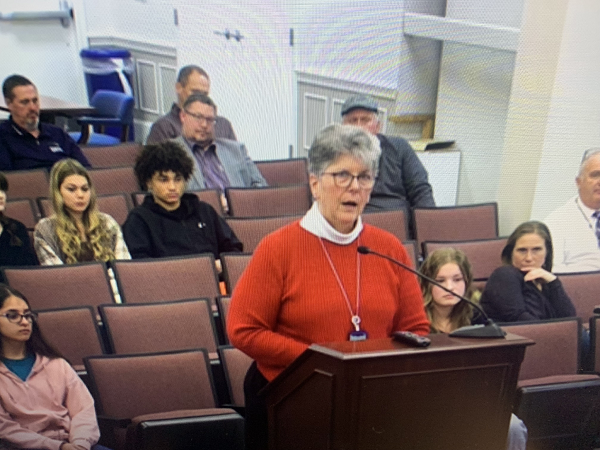
Jane Baker (above), CTE director at BRTC, told the School Board that this year’s CTE Month theme is “Celebrate Today, Own Tomorrow!”
“And that’s exactly what career and technical education is all about,” she said. “This month really focuses on what we refer to as the CTSOS, which are Career and Technical Student Organizations.”
In Warren County, such CTSOS include Educators Rising, which at one point was named Teachers for Tomorrow. There is also DECA, Future Farmers of America (FFA), and SkillsUSA, among others.
“Sometimes we get so caught up in a lot of the other activities and the other coursework and demands that go on in a school that we lose focus of the ability level of students who choose to engage in CTE classwork,” Baker added.
In fact, as part of celebrating National CTE Month, Racey said she and Baker also wanted to celebrate some of the biomed students who had great success in the first semester.
As part of the Project Lead The Way biomed curriculum, which consists of four classes, the students were required to take a national introductory course test at the end of the semester.
“They do some simulations on it where they have to simulate all these lab experiments and come up with data and it’s matching and labeling body parts,” Racey said.
Students’ end scores on the national test are graded from 100 to 600. Racey said that 52 percent of BRTC students in the PBS course scored in the distinguished category, which means that they were in the top 10 percent of the country.
Even more commendable is that eight BRTC students scored 600, meaning they scored in the top one percent in the country.
“It’s something to be proud of,” Racey said. “But honestly, I’m also proud of these kids because they work hard. Their critical thinking skills and their work ethic is just wonderful.”
Racey recognized the eight students to celebrate their 600-score accomplishment, “but also for just being good people and great students.”
From Warren County High School: Catherine Hulse, 10th grade; Renae Badin, 10th grade; Elizabeth Dunnet, ninth grade; Caleb Zurliene, 10th grade; and Luka Lee, ninth grade.
From Skyline High School: Scout Broadbent, 11th grade; Alexandra Hemingway, 11th grade; and Sadie Comstock, ninth grade.
At the end of the year, students are required to take an End of Course Test that measures content and lab skills where they can earn Virginia credentials for graduation.
“I think our kids can stand up to anybody in the country in science,” Racey said.
School Board kudos
Some of the School Board members commended CTE coursework in their regular meeting reports.
Board member Andrea Lo, for instance, said she visited BRTC last year, and in one of the classes she observed, students “were setting up a class all about analyzing urine samples and there were little cups of urine all over the room,” she said.
“I didn’t want to ask if it was real urine or like yellow chemicals, and I still don’t wanna know, but it does look like a very interesting class and I know they’re doing a lot of hands-on activities there,” said Lo. “It was great to see the students here who have been achieving so highly there.”
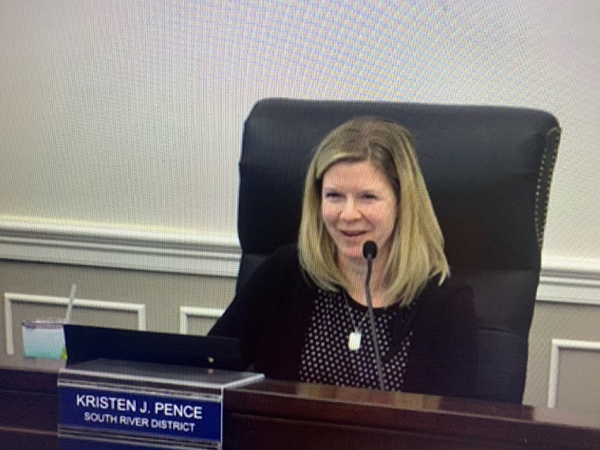
Warren County School Board Chair Kristen Pence (above), who holds a doctor of veterinary medicine and works as a vet in Warren County, said that a few weeks ago, she had the opportunity to visit with both of the veterinary science classes, which are just a few more of the programs that have been brought in under Baker’s leadership.
“And I can tell you that both of those teachers have so much excitement and enthusiasm for the courses and the things that they’re teaching,” Pence said. “Those students in those 11th and 12th grade classes are really amazing. They rival what our veterinary techs do in their schooling.”
Pence said that the BRTC students taking those CTE classes actually use the same textbooks that vet students would use when they go to tech school.
“I got to spend an hour with the students at Warren County High School and the questions that they came up with, what they wanted to know more about, and what they would do in the future, it was a really good experience to have that conversation with them.”
Pence also said that prior to her stint on the School Board, she was on the planning group for BRTC’s Project Lead The Way when it was first coming to the County.
“So actually hearing about the program from Ms. Racey and then the excitement that the students are having and the stuff that they’re learning in that program is really amazing,” said Pence. “It’s come so far in not that many years because it’s still fairly new to our County.”
Click here to watch the entire School Board meeting from February 1.

Supervisors Revisit Cross-County Chester Gap F&R Service, See Member-Staff Confrontation After Numbers Apology Offered

Get Your Equipment Ready Before the Start of Fishing Season

Landscaping Careers Offer Outdoor Work and Creative Opportunities

Blue Ridge Wildlife Center Patient of the Week: Virginia Opossum

From Crime Scenes to K9 Units: Citizens Academy Opens in May

Weekly Yard Waste Pickup Begins April 8 in Front Royal

Town Council Reviews Goals at Retreat in Advance of Work Session

New Virginia Laws Target School Construction and Classroom Cellphone Use

Clear Horizons Brings Fresh Approach to Mental Health

Funding Cuts, State Error Strain Virginia’s HIV Care System

Virginia Hospitals Filed More Than 1 Million Medical Debt Lawsuits Since 2010, a New Report Finds

POLICE: 7 Day FRPD Arrest Report 4/6/2026

Spanberger Signs Bipartisan Bills Tied to Billions in Business Investment Across Virginia

Birthright Case Forces US Supreme Court to Confront Prospect of Americans Losing Citizenship

Caleb Benton McKinstry (2010 – 2026)

Ideas for Nurturing — or Rediscovering — Your Inner Child

Protein Takes Center Stage in Updated U.S. Dietary Guidelines

Blue Ridge Wildlife Center Acknowledges a Quarter of a Century of Work in Wildlife Preservation & Human Education

What Does A ‘Fair Share’ Really Mean?

South Warren Ruritan Club Hosts 20th Annual Spaghetti Dinner Fuels Scholarships for Local Teens

Trees Take Root as Virginia’s Frontline Defense Against Urban Heat

Virginia Set to Rejoin RGGI as Utilities Prepare to Pass the Cost Back to Ratepayers

Virginia Joins Multi-State Lawsuit Challenging Trump’s Election Order

Trump Budget Seeks 43% Boost in Defense Spending, Cuts in Many Domestic Programs
