
EDA in Focus
Board of Architectural Review seeks answers, promises on Afton Inn
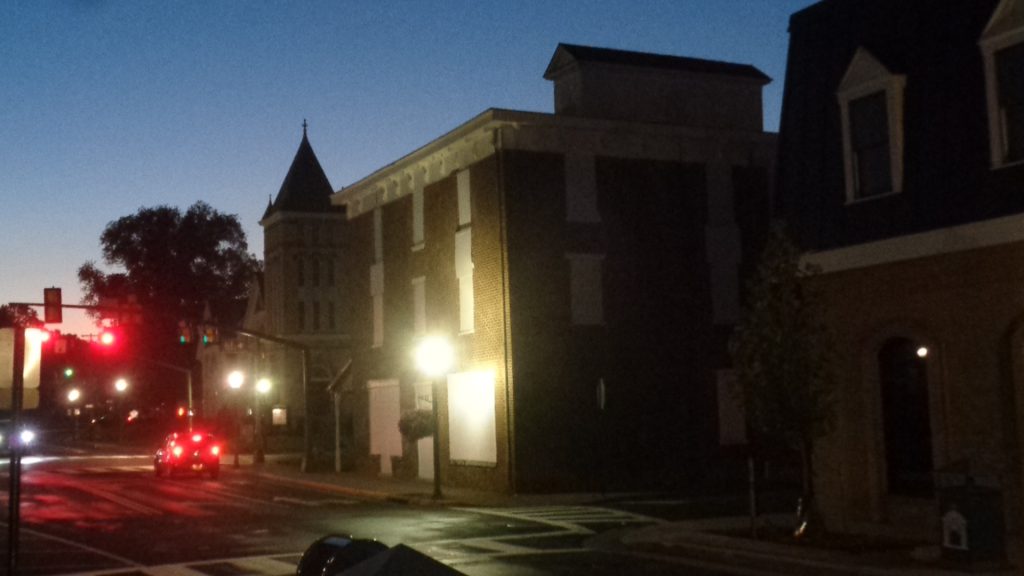
Twilight of the original Afton Inn? The view at the end of the Aug. 8, BAR meeting. Photos/Roger Bianchini
Front Royal’s Board of Architectural Review had some hard questions about the proposal forwarded to them to begin the authorization process for the demolition of the 149-year-old Afton Inn. The BAR first discussed the proposal at a Tuesday, August 8, work session. Unfortunately, no one was there to answer those questions from either the Front Royal-Warren County Economic Development Authority or the announced, Northern Virginia-based development group MODE Partnership LLC.
MODE and/or the EDA will have a second chance to make nice with the BAR on Tuesday, August 15. In the absence of hard answers to their questions on August 8 and facing a public hearing on the demolition proposal on August 22, the BAR scheduled a second work session this Tuesday, 4:30 p.m. at Town Hall. The BAR requested a tour of the Afton Inn shell, perhaps explaining the early start of this week’s work session.
The EDA has been entrusted with marketing the Afton Inn property over the past two years since the Town agreed to a swap of the Afton Inn property for the then-recently vacated old Town Hall building that the town government had outgrown. Following a closed session on July 28, the EDA board passed two resolutions authorizing, first the demolition of the long-dormant Afton Inn at the intersection at the head of Front Royal’s Historic Downtown; and then “redevelopment of the former Afton Inn” by the MODE Partnership.
Primary on the minds of the four BAR members present were what kind of guarantees would be in place to see that rebuilding along proposed and approved guidelines are met, if demolition of the historic, if long-derelict structure does take place.

BAR Board Chair Angela Toler and her colleagues wondered what assurances will be in place to assure re-construction if demolition is authorized?
“This is the most important corner in this town,” BAR board Chair Angela Toler observed.
“We don’t want a parking lot there,” board member Duane Vaughan said.
Town Planning Director Jeremy Camp told the architectural board that a recent study indicated there was not currently a shortage of downtown parking – so a parking garage was not currently at the top of Front Royal downtown construction priorities.
In the absence of principals from the developer or the EDA, Camp acted as an intermediary on some questions. Town Attorney Doug Napier was also present to address some questions with legal aspects.
As for guarantees a developer follows through on what has been promised to achieve demolition of a historic structure, board member Michael Whitlock and Napier batted the notion of “surety” or “performance” bonds to achieve that end.
Looking at the drawings submitted by the MODE group on their renovation plans, several board members worried at the idea of high-end apartments as the primary use of the rebuilt structure.
“Every luxury apartment plan we’ve seen has failed,” Toler reminded her board.
“But Front Royal is changing – I’m an example of that – I moved here and I have clients who are more open to luxury plans,” Whitlock, who is in the construction industry, responded of Front Royal’s potential for change over the next 10 years.
“But once this building comes down, it’s not coming back,” Toler reminded the board of the decision they are being asked to propel forward.
No rush to judgment
And the fact they felt rushed toward a decision with a public hearing and possible vote scheduled for August 22, and no direct feedback from the developer as of yet, seemed to irk the entire board. With Mayor Hollis Tharpe in attendance as an observer, it was noted that the town council has a public hearing on the demolition proposal scheduled at its regular meeting of Monday, August 28.
“We need more information – it’s too quick a turnaround to the public hearing,” Whitlock agreed with his colleagues – though he did add later that the entire redevelopment proposal was “exciting”.
Toler suggested that perhaps the board could put off its vote following the August 22 public hearing on the demolition. “What will we see, signs saying ‘Tear it Down’? It has been boarded up essentially all my life,” Toler observed, adding, “We REALLY welcome the public’s input on this.”

The current state of what has become a historic dilapidated structure for about two decades.
Town Attorney Napier told the BAR they could defer a vote, but are obligated legally to vote one way or the other “within a reasonable amount of time.” That reasonable amount of time could be used to work with the developer to iron out any unanswered questions or assurances the board of architectural review is seeking prior to endorsing demolition of a historical structure that has become a prominent downtown eyesore the past 15 to 20 years.
Demolition criteria
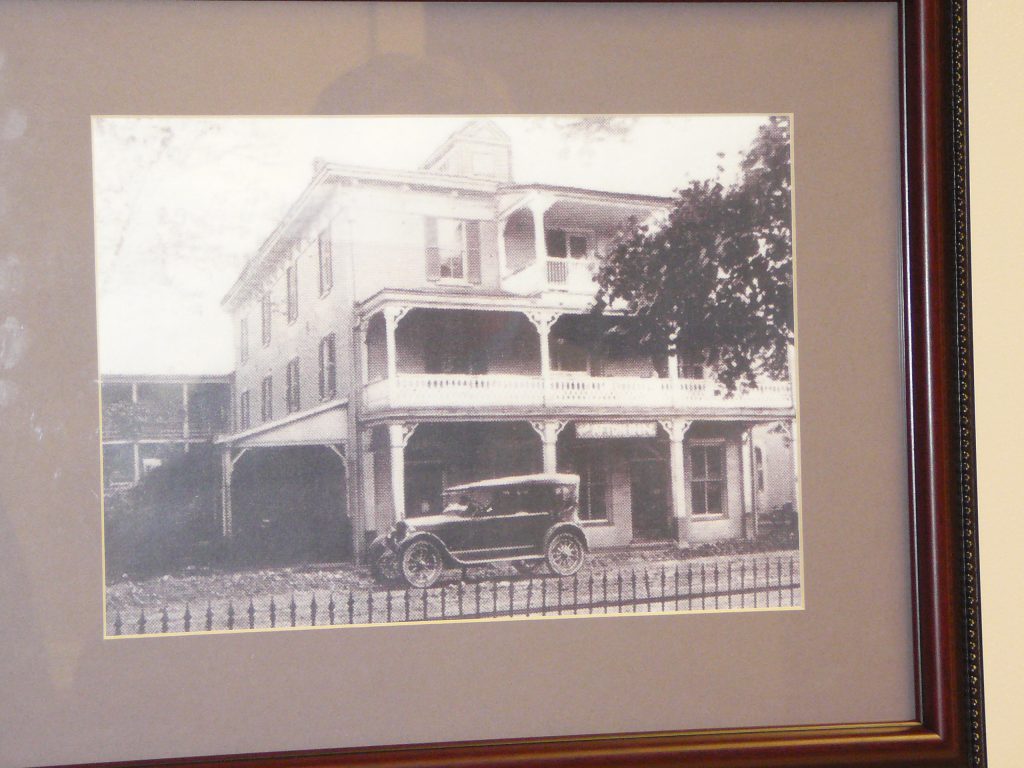
Above, the Afton Inn, circa 1920s; below, circa early 1940s. Courtesy Photos/Warren Heritage Society

Camp presented a “Demolition Review Guideline” he prepared to assist the BAR in approaching what all agreed is a decision of some historical import for the Town of Front Royal. Our research indicates the Afton Inn was constructed from 1867-68, in the direct aftermath of the Civil War. For decades and into the early and mid 20th century the building served as a centerpiece of downtown culture. However, it fell into disrepair and was last used as a private-sector school book storage depository before being boarded up in the late 1990s-early 2000s.
Camp’s “Demolition Review Guideline” covers four essential questions:
- Contribution to Historic District
- Structural Integrity
- Feasibility (of renovation versus demolition)
- Due Diligence (of the applicant in pursuing renovation options)
After some discussion Vaughan observed, “Question number one is all that really matters.” And Vaughan’s observation appeared to hit the nail on the head. For while no one would deny the building’s past contributions to the town and what is now generally known as its Historic Downtown Business District, can it be argued that contribution continues or is realizable and financially viable through renovation?
Feasibility study
One attempt to answer question number three on feasibility in the negative was submitted by the EDA through Camp for the architectural board’s review. Included in the agenda packet was a four-page “Site and Property Survey” conducted in 2016, not by the current applicant, but by Skyline Management, LLC, of Stephenson, Virginia.
That survey’s summary states, “After spending numerous hours on this site with Architects, Engineers and Contractors we have come to the conclusion that saving the facade and constructing a new addition would be the best use for this structure. The structure has caricature that we feel can be of value during its rebirth process. Saving as much of the façade, windows, doors and exterior trim helps in keeping with the historic streetscape of Front Royal.

MODE Partnership exterior drawing of a re-constructed Afton Inn.
And what did the MODE Partnership include in its proposal? – The reclamation of as much wood and brick as possible to be utilized in rebuilding along the highly visible North Royal Avenue-East Main intersection where a planned outdoor restaurant/beer garden would stand.

County Receives 5 More FY-27 Budget Overviews Prior to Closed Meeting on Administrator Search & Business Expansion

Belle Grove Opens March 21 With First Public Viewing of Memorial Quilts Honoring Enslaved Individuals

Iran At a Crossroads: Democracy, Monarchy, and the Lessons of the 1950s

Federal Judge Upholds Ruling That Certain Ex-Felons Should Not Automatically Lose Voting Rights

Virginia Lawmakers Explore Autonomous Technology for Transportation

Misconceptions About Multiple Sclerosis

Five Reasons to Consider a Career in the Community Sector

Frederick County Cattle Carrier Crash – Animals Still Reported At Large

‘Grow Up’: Former Republican Delegate Defends Civil-Rights-Themed Mailers in Redistricting Fight

Virginia One Step Closer to Probation Reform With Bills Headed for Spanberger’s Desk

Merit Versus Reality: Town Council Weighs Priorities Against Finance

Blue Ridge Wildlife Center Patient of the Week: American Beaver

POLICE: 7 Day FRPD Arrest Report 3/9/2026

Discover Rotary with the Rotary Club of Warren County

Maureen Cora (Cooper) Valdez (1942 – 2026)

President Trump Secures Trillions in New U.S. Investments as Companies Expand American Manufacturing

Judge Blocks Some of Trump DOJ’s Sweeping Changes to Immigration Appeals

Front Royal Women’s Resource Center to Host ‘Dare to Dream’ Luncheon March 28

Virginia’s Congressional Republicans Urge Trump Admin to Review Legislation to Tighten Oversight of VMI

Plug-In Solar Panels Near Approval by General Assembly

Civil Rights Imagery in Anti-Redistricting Mailers Draws Outrage in Virginia

What Is a Cull Animal?

New Federal Dietary Guidelines Encourage More Protein, Less Sugar

Brenda Jean Chrisman (1953 – 2025)
