
Crime/Court
Charges dropped against N.C. man at scene of friend’s suicide: But that is only the beginning of the story
According to Nicholas Ranstad and his attorney Jerry Talton, the recent dropping of several minor firearms charges against Ranstad is more than a legal story about Ranstad’s name being cleared in the death of a friend. For the distinguished military veteran it is really a story about a failing federal system of Veterans Administration (V.A.) funding, impacting treatments for America’s veterans, including therapy for those with Post Traumatic Stress Disorder (PTSD).
As Royal Examiner’s Norma Jean Shaw reported at the time of his early May 2019 arrest, Ranstad was taken into custody at a residence on the 200-block of Doom Peak Road in Linden by Warren County Sheriff’s Office deputies responding to a reported suicide. In fact, it was Ranstad who made the 911 call reporting the death of Sean Miller, Talton and Ranstad confirmed.
After first responders arrived to the scene where Miller was dead of a gunshot wound to the head, Ranstad, then 40 and a North Carolina-based retired U.S. Military veteran and serviceman advocate, was informed of his Miranda right not to self-incriminate.
Ranstad then explained to officers at the scene he had come to “check on the welfare” of Miller, a Marine veteran whom he had met and befriended in therapy for PTSD in 2017. When he got no response at the door, Ranstad told officers he had entered the house by picking a window lock.
Upon entering the residence and discovering his friend dead of a gunshot wound to the head, Ranstad told the first responders he “became upset” and “used one of the firearms he carried on his person to shoot four rounds inside the residence” Shaw wrote in our report on the incident and Ranstad’s arrest. Ranstad was released from RSW Jail several days later on a $10,000 secured bond.
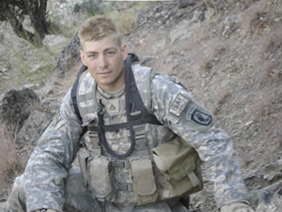
Nicholas Ranstad in the field during his military service overseas. Courtesy Photos/Nicholas Ranstad
Ranstad notes his reaction wasn’t a proper one, but an immediate unleashing of frustration and pain at being too late to help his friend through a building emotional crisis. What Ranstad believes to be the root of that crisis is the story he wants told, more than just charges against him being dropped.
But as to the groundwork for that larger story, Commonwealth’s Attorney John Bell confirmed that he had sent the “nul pros” (colloquial for nolle prosse) – dropping without prejudice – paperwork to Talton last week to complete for submission to the General District Court for approval by the district judge. Bell said he inherited the agreement to drop the charges from former Acting Commonwealth’s Attorney Bryan Layton after Bell defeated Layton in a 2019 election to succeed the departed Brian Madden to a judgeship appointment.
The 13-month interval between Ranstad’s arrest on reckless use of a firearm and firing it inside a dwelling and submission of the “nul pros” request to the court was a result of awaiting State Lab ballistics test results.
“If the ballistic reports confirmed his story, the charges would be dropped in the interest of justice,” Bell said of the arrangement.
Initially through his attorney, Ranstad told Royal Examiner he feels a re-routing of V.A. funding into the private sector has crippled the V.A.’s function and negatively impacted treatment options available to veterans creating potential, and as in the case of his Warren County-based friend Sean Miller, verifiably fatal consequences.
An online search of the issue led us to a report by Suzanne Gordon and Jasper Craven on the website “The American Prospect: Ideas, Politics and Power” describing the current funding situation at the VA.
“When questions about VA privatization and the internal staffing crisis arise, Trump allies proudly boast that, on the president’s watch, the V.A. budget has hit historic highs… What this claim fails to mention is that a major driver of Trump’s V.A. spending is on private-sector care, which now makes up nearly 20 percent of total health care spending,” Gordon and Craven reported, adding, “As a result, V.A. hospitals are still being starved. Rather than having plenty of money for recruiting and retaining staff, a senior V.A. administrator told the Prospect that 14 out of 18 of the VHA’s integrated service networks are virtually out of money… ‘Maybe someone up there is sitting on a pot of money but no one knows,’ one (V.A.) administrator told the Prospect.”
While “The American Prospect” is an admittedly liberal news source, we could find nothing online contradicting the base facts in its above description of the situation at the V.A.
We asked Ranstad about his experience of this transition in V.A. funding and services dating to his own and Miller’s 2017 PTSD treatment through the private sector.

Ranstad in full sniper ‘ghillie suit’ gear
“The treatment we received – private treatment facility – felt like we were on a conveyor belt, just going through the motions. The facility was getting an abundance of money from the V.A.; they were able to build a massive military-specific facility (resort). A couple of days in I was extended for two weeks of a five-week in-patient, which ended up being three months.
“I felt our treatment was being watered down in a ward that was to house 20 people when I left; we had 30. They just kept packing us in $1,000-a-day per service member. It was a huge distraction watching staff consistently being spread thin and getting new staffers all the time and having to explain to them where everything was and showing them the ropes.
“They were cutting back on the quality of therapy, to funding the brand-new building. It became the talk of the ward about how the military funding was being spent, and it was a sh*t show, so we simply relied on each other.
“I found the best therapy was after dinner chow, where we sat around talking to each other. I have been through every modality of therapy and found that was the best therapy for me, which made me, and continues to make me question the science behind a lot of these ‘therapies’.”
The Ranstad-Miller story brought a painful memory to the surface for this reporter, who initially told Talton of the early 1980’s death of a close personal friend, Larry Brennan, to suicide after Reagan Administration cuts to V.A. funds that paid for PTSD therapy that Brennan was receiving in the wake of his combat service in Vietnam.
Within three months after his regular therapy sessions were cut off due to the Reagan budget cuts, Brennan died as Miller did, of a self-inflicted gunshot wound. I inject this story at Talton and his client’s suggestion as an indicator that the issue of proper funding of the V.A. and treatment of U.S. veterans suffering from the emotional, as well as physical consequences of warfare, is not a new one.
If not this reporter’s concerns based on personal experience, Ranstad’s might be taken seriously, not only by the public, but also the U.S. military and federal government, as substantial and worthy of re-opening discussion of decisions on how the V.A. and veteran services are funded and conducted.
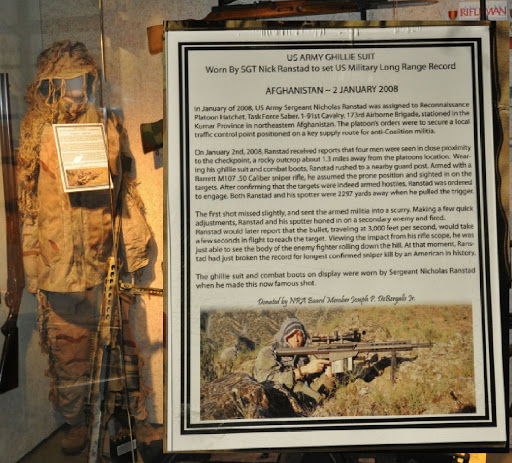
Ranstad’s Afghanistan sniper ‘ghillie suit” on display at the NRA Museum in Fairfax
Ranstad was not exactly an unknown quantity nationally at the time of his May 2019 arrest here. As Shaw reported last year, information on the website TeamRanstad.org indicated Mr. Ranstad set a U.S. military standard with the longest confirmed sniper kill by an American soldier in combat. Ranstad told Royal Examiner that since his father’s death his involvement in TeamRanstad has waned, thought the organization appears to be continuing its mission of “getting our front line troops in remote and desolate locations the supplies and morale items they need.”
A visit to that website notes that Ranstad’s record targeted kill at distance with a rifle was reported in Afghanistan in January 2008 at a distance of 1.3 miles. And despite two longer sniper kills being recorded since, by a British sniper in 2009 at 1.5 miles and a Canadian sniper in 2017 at 2 miles, Ranstad’s standard-setting in that realm of warfare has led to a great deal of notoriety. He was featured on the June 2010 cover of Soldier of Fortune magazine with the headline “Sniper in Afghanistan”.
But more than a military cover boy, Ranstad and his team’s accomplishments on the battlefield led to more substantial recognition, including acknowledgement by the Tennessee General Assembly, as well as garnering a 2011 invitation with his sniper team spotter and “best friend” Alex Simpson to the White House. And his sniper camouflage “ghillie suit” is displayed at the NRA museum in Fairfax.
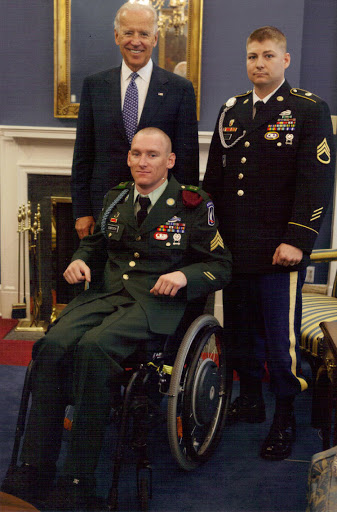
Ranstad and his spotter and ‘best friend’ Alex Simpson were honored with a summer of 2011 invitation to the White House. Here they are greeted by then Vice-President Joe Biden.
But it is not his past expertise on the battlefield that Ranstad wants the focus on in this story. Rather, it is how and why decisions are made at the federal level on funding and securing quality medical treatment, both physically and psychologically, for our veterans from the wounds of war. And an important follow-up question is whether there is adequate federal oversight of such crucial budgetary appropriations to assure our tax money is being spent as intended, rather than simply used to line private-sector pockets.
They are questions ALL Americans who respect our men in uniform who have served on battlefields around the world to stem threats to the nation should ask themselves – AND ask their elected representatives who vote, sponsor, propose, or continue to justify such appropriations.
If we can’t put political partisanship aside to reach an honest appraisal of whether or not our tax money earmarked for veteran services is, in fact, helping those veterans, for whom and when will we ever do so?
Royal Examiner and this reporter support Ranstad’s desire for an honest appraisal and reassessment of the current Administration’s move to direct much V.A. funding into the private sector, so that more veterans like Sean Miller and Larry Brennan do not slip through the cracks.

Spanberger Order, RNC Lawsuit Highlight Divide Over Virginia Voter Roll Maintenance

DNC Kicks Off Voter Registration Blitz, Unveils New Campaign Playbook Ahead of Midterms

Republican State Lawmakers Propose Three-Month Gas Tax Holiday in Virginia

April Star Birthdays: Famous Faces Celebrating This Month

Time to Strengthen Those Hips Again

Supervisors Discuss Evolving FY-26/27 Budget Priorities and Revenue Sources, Including Real Estate Tax Hike & Cigarette Tax

From Students to Leaders: Mountain Vista Governor’s School Hall of Fame Honors Two Graduates

Hundreds Gather in Front Royal for “No Kings Day” Rally

How Public EV Charging Stations Work

A Social Network Just for AI? Bots Chat About Life, Love and More

Out of Closed Session WC EDA Approves Resolutions Regarding Evolving Property Sales and Brokerage Services

Driver Dies After Crash While Fleeing Police on I-81

Laurel Ridge Honors Cynthia Schneider as Distinguished Alumna of the Year

New ‘Farm to Fam’ Initiative Launches, Bridging the Gap Between Local Farms and Families in Need

5 Tips for Great Family Easter Photos

Nicotine Pouches: A Worrying New Trend

Annual ‘Taste of Books’ Fundraiser Leads April Lineup at Samuels Library

Scientists Turn Lead Into Gold—But Only for a Moment

Virginia State Police Report Drug Seizures, Firearm Recoveries in Weekly Operation

Children Activities by Samuels Public Library for the Month of April

VDOT: Warren County Traffic Alert for March 30 – April 3, 2026

Front Royal Police Arrest Man in Series of Indecent Exposure Incidents

WCHS DECA Students Shine at State Conference, Advance to Nationals

Expert Tips to Make Spring Cleaning More Efficient
