
Local News
Class cameras, enhanced policy, mandated staff training could bolster student safety
Adding cameras in preschool and special needs classrooms and requiring mandatory child abuse and neglect reporting that is acknowledged by every employee of Warren County Public Schools (WCPS) could help improve the safety of students.
Following the grand jury indictment earlier this month of a former WCPS special education teacher charged with multiple counts of felony abuse and misdemeanor assault, the Warren County School Board, during its June 21 work session, discussed ways to improve student safety.
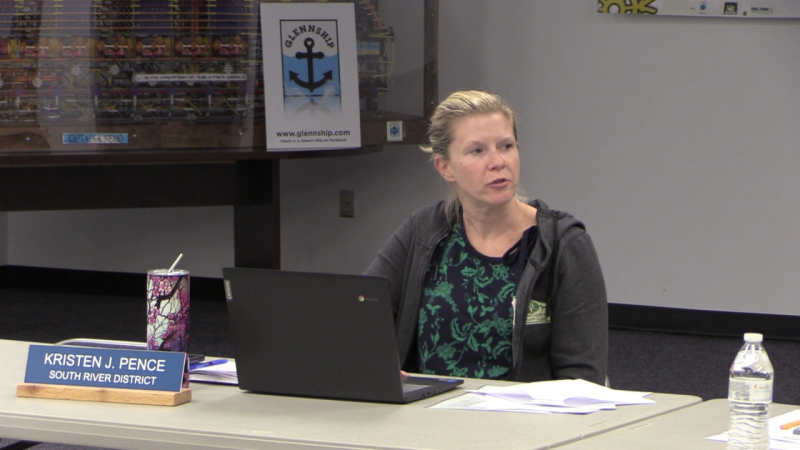
School Board Chair Kristen Pence (above) presides over the board’s June 21 work session.
Board Chair Kristen Pence and board members Antoinette Funk, Andrea Lo, and Melanie Salins were present for the meeting. Board Vice Chair Ralph Rinaldi was absent.
According to Pence, the School Board recently received a petition that was circulated by a local community member who received 138 signatures showing support for adding cameras in classrooms.
WCPS Superintendent Christopher Ballenger discussed a proposal that aims to increase safety and accountability and raise awareness about activities within the school environment by adding cameras to preschool and special needs classrooms.
WCPS Technology Director Timothy Grant said that the cameras and an optional audio add-on could be integrated into the school division’s existing system with adjustable access levels that would allow for selective viewing, ensuring that only authorized personnel, such as principals and central office staff, have access to the footage.
Implementing such a measure, Ballenger said, would help create a secure environment while addressing concerns about unauthorized access to video footage.
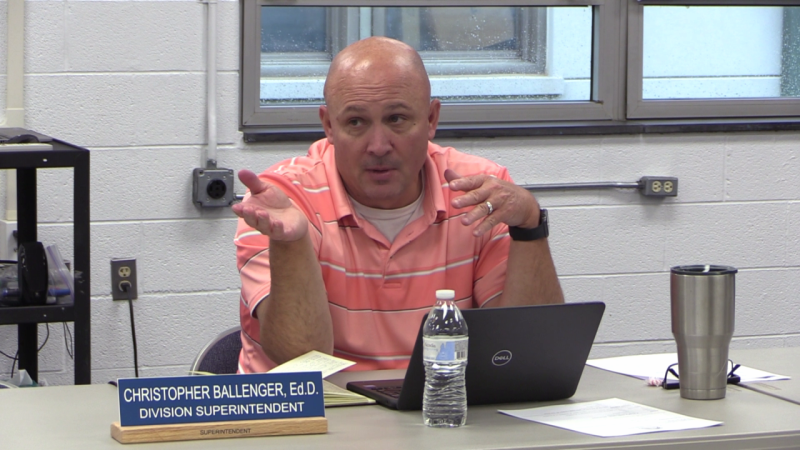
Regarding legal and privacy considerations, Ballenger (above) said that while no law in Virginia prohibits the use of cameras in classrooms, legal aspects need to be thoroughly examined. For example, student records and their long-term storage requirements are crucial factors to consider, he said, particularly for special education students.
“What I’m saying,” Ballenger told the board, “is that whatever we do, or whatever you decide to do, if you want to go with cameras, we’re going to have to have a pretty detailed outline policy that will follow some pretty strict guidelines and restrictions to access or process storage.”
The creation of video records also raises questions about the handling and potential disclosure of such records. Collaboration with neighboring states, such as West Virginia, which has existing policies in place, could provide valuable insights and help shape a comprehensive policy framework, according to Ballenger, who said he is not opposed to having cameras in the classrooms.
“But I think whatever we do, there needs to be a good quality policy that really outlines the details,” he said.
Toward that goal, for instance, the policy should define guidelines for their usage, determine the access levels for different personnel, establish storage and retention protocols, and address concerns regarding the potential misuse or distribution of recorded footage. Creating a workable policy requires careful consideration of the practicality, legality, and ethical implications surrounding video surveillance in an educational setting, said Ballenger.
At the same time, public opinion is necessary, and the School Board will have to decide whether it’s essential to actively seek input from staff members, particularly preschool and special education teachers, to gauge their opinions and gather recommendations, according to the superintendent and members of the board.
In other related work session topics, the School Board discussed looking at some of the online tracking for what could be the school division’s mandatory professional development or training courses every year regarding child abuse and neglect and updating the handbook to include a checklist for WCPS employees to sign showing that they understand they are mandatory child abuse and neglect reporters and know how to do it, among others.
“Before anybody steps foot in the classroom, they would need to complete the child abuse and neglect training,” suggested Salins. “If it’s within a 12-month period or outside of a 12-month period, then they would have to take it. Let’s really be thoughtful and make sure we’re not overlooking something else that really our teachers need to have as like a baseline to protect the safety of our students.”
Ballenger said that the pilot program could start with cameras in preschool and special services this coming school year and then could possibly be used later in higher grade levels. He noted that the funding to install cameras in 10 preschool classrooms this summer is estimated to cost $12,908 — or $1,290 per room, including equipment, licensing, audio add-on, and installation. Ballenger also will meet again with school division attorneys to discuss the many legal implications of such a pilot program.
Pence encouraged people to attend the School Board’s July 12 meeting to provide comments on these items during the community participation segment.
To view the exclusive Royal Examiner video in its entirety, go to: https://www.youtube.com/watch?v=m2EUk6MV3dg.

Virginia Joins Multi-State Lawsuit Challenging Trump’s Election Order

Trump Budget Seeks 43% Boost in Defense Spending, Cuts in Many Domestic Programs

Virginia Sees 33,000 ACA Enrollment Drop Since Subsidies Expired, More Likely on the Way

Annual Dental Checkups and Cleanings: Essential Appointments

4 Stimulating Activities for a Healthy Brain After 50

The First Amendment: America’s Unique Foundation of Freedom

How to Tackle Credit Card Debt

Summer Enrichment Camp Gives Teens Hands-On Learning Opportunities

VDOT: Warren County Traffic Alert for April 6 – 10, 2026

David Silek to Remain in Chairman’s Seat of WC Republican Committee Pending 6th District Appeal Decision

Sales Set to Bloom Like Daffodils This Spring

America 250: The Bookseller Who Helped Save the Revolution

Business Growth Series: Why Good Businesses Still Struggle to Grow

Brownies with Mini Chocolate Easter Eggs

Shenandoah Downs Opens 11th Season April 11 with Tribute to Roger Hammer

We Don’t Know Everything About DNA

How PAAS Came to Dominate the Easter Egg Dye Tradition

Spanberger Signs Bipartisan School-Safety, Student Support Bills Into Law

Melanie J. Pomeroy (1958 – 2026)

David Benjamin Heller (1990 – 2026)
1776 Wasn’t Just About Independence

Three-Tiered System for Urban Agriculture Based on Lot Size Takes Shape at Town Planning Commission Work Session

Child Abuse Awareness Month Brings Focus to Reporting, Prevention in Warren County

National Dental Hygienists Week: Is Your Oral Care Routine Optimal?
