
EDA in Focus
Developer, EDA answer questions on Afton Inn demo-rebuild proposal
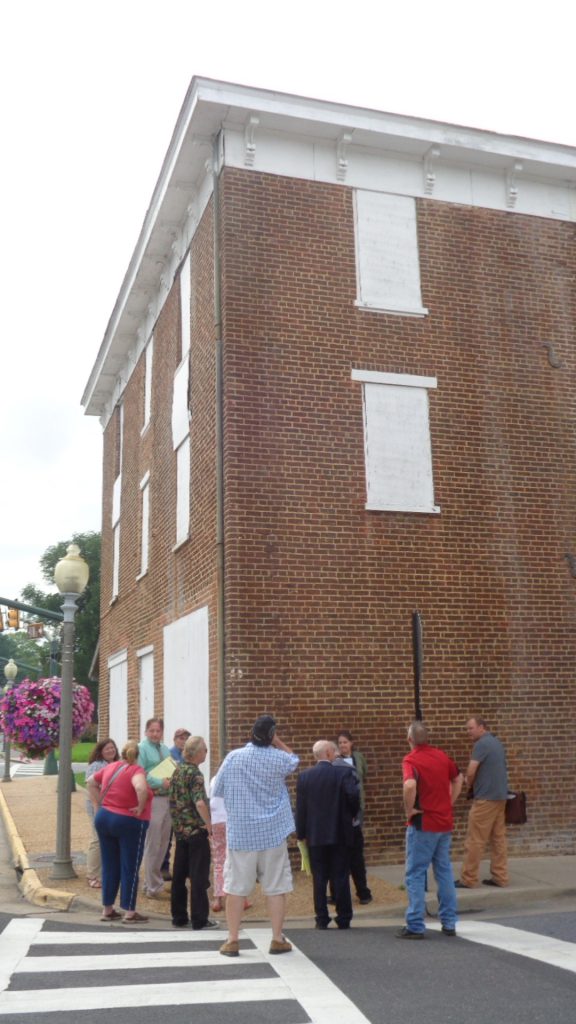
Wait, you expect me to go in THERE?!!? Photos/Roger Bianchini
Following the Tuesday, August 15, Board of Architectural Review (BAR) tour of the Afton Inn, MODE Development Partnership Architect Jim Burton and EDA Executive Director Jennifer McDonald fielded questions about the demolition proposal forwarded to the Town by the EDA on July 28.
The BAR will be asked to make a recommendation on approval or rejection of that proposal following a public hearing scheduled for Tuesday, August 22. At this time the BAR meeting and Afton Inn demolition public hearing is slated for the same second floor Town Hall meeting room in which the architectural board’s work sessions have been held the past two weeks.
How far this week’s work session Q&A with the EDA and MODE went in providing the BAR with the information it wants to make an informed decision on August 22 remains to be seen.
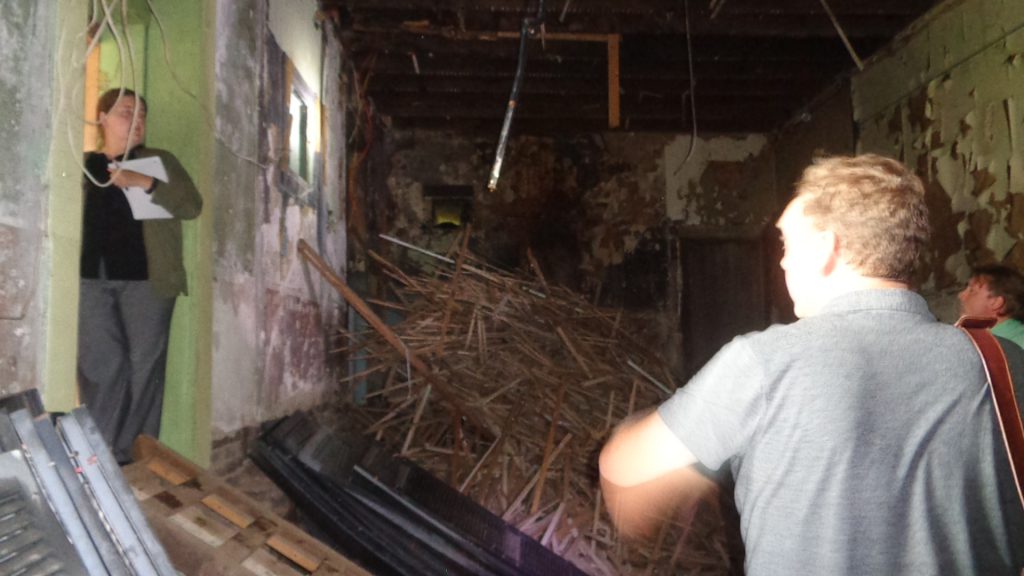
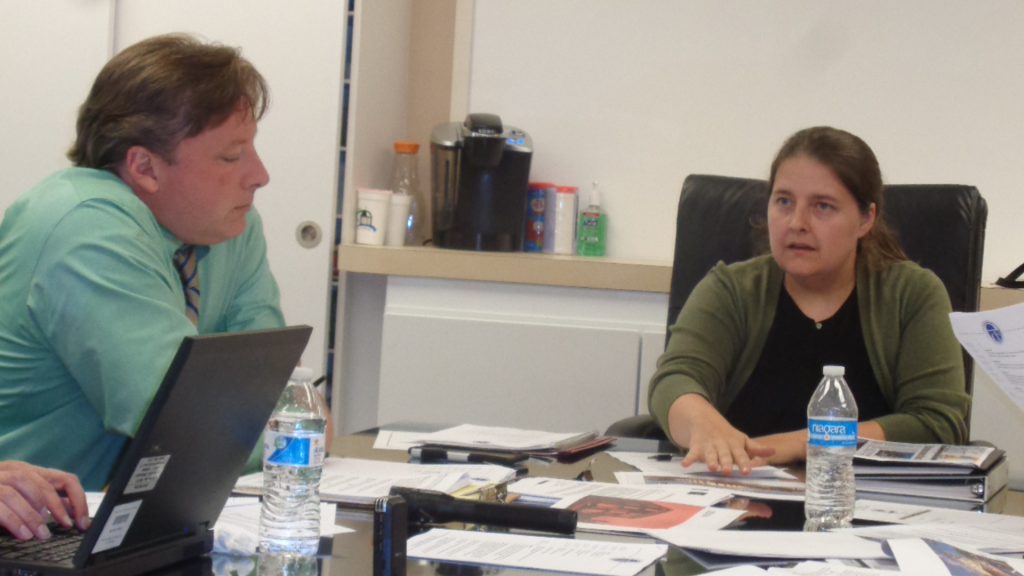
Above, BAR Chair Toler decides a building may not be the only thing worth saving on the Afton site; below, back in safer climes the dynamics of what may come are discussed, as Town Planning Director Jeremy Camp listens.
BAR Chair Angela Toler asked McDonald to walk her board through the EDA marketing process leading to the current application seeking demolition of what may be the oldest surviving building in Front Royal. The EDA chair recounted a two-year effort to market the 149-year-old structure (circa 1868) for renovation. She said four candidates came forward, all to drop out near the “finish line” due to costs and the unavailability of redevelopment grant money each felt necessary to cover what were discovered to be the additional costs of renovation.
MODE Partnership Architect Jim Burton of Carter-Burton Architecture PLC out of Berryville told the BAR that renovation could cost an extra $300,000 to $600,000, with the high-end number “easily” possible. The difference in costs with that high-end estimate is $2.1 million for a demo-rebuild versus $2.7 million, essentially to attempt to save the outside brick shell of the building.
Noting the BAR’s preference for saving a historic structure, perhaps the oldest surviving in Front Royal’s downtown at the head of its historic district, Toler told Burton of what is proposed, “When the historic façade is gone, that is when we care.”
BAR member Michael Whitlow told Burton that the board hadn’t had the details on cost differentials in the original proposal forwarded to them. However, an elaborated “structural report” written by Burton included in the August 15 agenda packet did cover that detail absent in the previous week’s work session packet.
That assessment states, “Overall the added cost to work with the existing building and to bring it up to code could add an additional $400,000 plus or minus depending on the final approved Schematic Design. (Snead Co. of Boyce has stated it could take $2,000,000 to bring the shell up to code strength and standard. It is possible the building could collapse in areas during construction if the proper shoring expenses are not factored in)
“After investigating the structure we have found it does not make financial sense to renovate while adding and changing use in certain areas. By clearing the site and reusing some brick and wood it will allow for the Design Intent to be achieved at a fair market price while insuring the quality that is needed for this prime location.”

Architectural Board member Michael Whitlow, red shirt, and his colleagues seek and find more specific answers to redevelopment questions – but are the answers specific enough to authorize demolition of Front Royal’s oldest downtown historical structure? – Stay tuned over the course of two public hearings (Aug. 22 & 28) in the next two weeks.

MODE Partnership exterior drawing of a re-constructed Afton Inn.
Asked about the drawings presented and what the main replacement structure would be made of, Burton replied “modern stucco”. The submitted plan indicates that reclaimed brick and wood would be utilized for the outdoor patio/beer garden envisioned for the Royal Avenue side as part of the first floor restaurant including a proposed pizza oven.
“You can see where we would prefer more preservation,” Toler told Burton. The architect replied that the crumbling interior brick, among other variables included in his updated report made that a risky and expensive proposition.
Told that IF it was agreed demolition was necessary the BAR would prefer more brick used in a rebuild, Burton replied the developer was open to that suggestion, particularly at the front facade. Whitlock pointed out to his fellow board members that he brought back a section of brick from the building’s interior to illustrate that he had been able to crumble portions of that brick in his hands.
Burton told the BAR he appreciated their desire for preservation; that in fact he had helped write preservation codes for some localities.
Replying to the architectural board’s desire for an assurance a rebuild would occur if demolition was approved; McDonald said the EDA would have “no problem” asking for a performance bond from the developer. She noted, however, that she could not guarantee that such a request could be legally mandated; but that she would have no issue with forwarding a performance bond request to the development group.
Questioned about how aggressively the EDA had marketed the Afton Inn for redevelopment, McDonald replied that it had been advertised on numerous state websites and presented at a number of regional trade shows.
Asked about placement of “a sign out front”, McDonald replied the EDA had put one up but had to take it down due to restrictions on EDA’s being perceived to compete with private sector developers.
Noting what she had seen from the side doorway, Toler wondered at the interior state of the building with what she called “trash” piled up – trash that appeared to be interior debris from the structure itself, but certainly trash at this point. “I feel like the building got a little short changed,” Toler said of the interior state with no apparent effort to stem the state of the deterioration over the past two years.
Toler wondered about a budget for preservation efforts after the Town acquired the Afton Inn from Frank Barros in a trade for old town hall two years ago. McDonald replied “there was no budget” presented to the EDA with the building.
“I feel like we’re being asked to approve this with demolition being the only option,” BAR member Joan Harding said. She bemoaned the loss of another historic structure, stating she believed it was “detrimental” to the town, adding, “I want the façade kept.”
An invited observer was Aubrey Vonlindern, an architectural historian for the Virginia Department of Historic Resources. Noting her job was preservation, rather than demolition and redevelopment, she observed that she had seen buildings in worse shape that had been saved in other communities (don’t think she was present for the interior tour).
Noting the Afton Inn is “the oldest structure” in downtown Front Royal, Vonlindern suggested taking an application for tax credits for saving the façade to Richmond – “It’s the oldest building in downtown, it should be given a chance,” she said.
As the work session ran to a conclusion, Harding re-stated a complaint from the previous week, that the drawings of the redevelopment plan were not compatible with surrounding buildings or the Afton shell – “I have grave reservations on this,” she said.
Board Chair Toler concluded that she feared that if the Town approved demolition of its oldest historic structure, the application for a State “Community Development Block Grant” now on a desk in Richmond “goes right in the trash.”
Asked following the meeting what she thought of the hard questions being asked about possible preservation options for the Afton Inn at this point, EDA Executive Director McDonald said, “They are absolutely doing their job to try and salvage a historical building, that’s their role; and we are doing ours. The Town has to decide, do they want a building to sit there vacant or do they want something that will be creating tax revenue and be a viable part of Main Street.”
As BAR Chair Toler said near the conclusion of the August 8 work session, “We REALLY welcome the public’s input on this.”
Remember that time and place, Tuesday, August 22, 7 p.m., second floor meeting room of Town Hall …

Regional ‘Walk for Peace’ Rallies Locals to the Cause of Personal and World Peace

ODU Shooting Case Renews Debate Over Virginia’s Inactive Background Check Law

3 Good Reasons to Eat Meals as a Family

Institutional Investors Play Small but Visible Role in Housing Market

From Newsroom to Classroom—And Grateful for Samuels Library

Library Leaders Share Hope, Challenges at Community Coffee Chat

How Farming Is Changing and Evolving

Robert H. Goddard: The Visionary Who Helped Launch the Space Age

40 Winners Named in Front Royal’s 6th Annual Pot o’ Gold Hunt

French Earl Tolliver, Jr. (1960 – 2026)

5 Tips to Prevent Sports Injuries

Standardbred Owners Ainspan, McDonald Each Score Thoroughbred Wins at Colonial Downs’ Virginia Derby Meet

Most Dangerous Cycling Scenarios Involving Cars

VDOT: Warren County Traffic Alert for March 23 – 27, 2026

Virginia State Police Seize $22.4 Million in Drugs, Recover Firearms in Weeklong Operation

Virginia Home Sales Rise in February as Inventory Grows, Spring Outlook Uncertain

Warren Supervisors Address Audit Contract, Permits, and Property Sale at March 17 Meeting

Here’s How Virginia Lawmakers Suggest the Next State Budget Handle Federal Health Care Funding Fallout

Spring Essentials Checklist: Prepare Your Home for Summer

Virginia Joins National Push for Refunds After US Supreme Court Voids Trump Tariffs

Four Reasons to Consider Hiring a Professional Cleaning Company

Ask the Expert : We Are Applying for a Mortgage Soon. What Kind of Documents Will We Need?

Charles Michael “Rusty” “Chuck” Fischbein (1944 – 2026)

Jerrold E. “Jerry” Groves (1931 – 2026)
