
Local News
Eight Endangered Black-Footed Ferrets Born in Front Royal: Watch Them Live Online
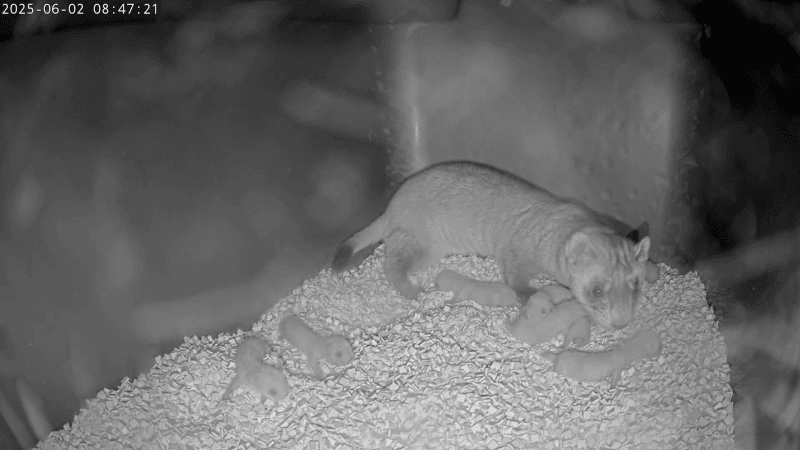
A rare and exciting birth has taken place in the hills of Front Royal, Virginia, where animal care staff at the Smithsonian’s National Zoo and Conservation Biology Institute (NZCBI) are celebrating the arrival of eight endangered black-footed ferret kits. Born May 28 to three-year-old female Aristides, the litter represents another hopeful step for one of North America’s most endangered mammals.
Animal care staff at NZCBI’s Front Royal, Virginia, campus welcomed a litter of eight black-footed ferret kits born to mother Aristides (above) and father ColeS. Photo credit: Smithsonian’s National Zoo and Conservation Biology Institute
The newborn kits—tiny, blind, and weighing less than 10 grams—can now be viewed by the public through the Black-Footed Ferret Cam, a temporary live webcam on NZCBI’s website. This gives wildlife lovers a rare chance to witness the earliest days of a species once thought to be extinct.
“This is a very exciting moment for conservation,” said one NZCBI staff member. “These little ones are part of a national effort to save a species that came very close to disappearing entirely.”
This is Aristides’ third litter. Her mate, ColeS, a two-year-old male from the U.S. Fish and Wildlife Service’s Ferret Conservation Center in Colorado, is celebrating his first successful fatherhood. Their pairing was no accident—it was recommended by the Association of Zoos and Aquariums’ SAFE (Saving Animals From Extinction) program, which carefully tracks genetics, health, and behavior across the black-footed ferret population in human care.
This matchmaking system uses a “studbook,” a record that helps coordinators decide which ferrets should breed to maintain healthy genetic diversity in the population. Aristides is one of 20 breeding female black-footed ferrets living at the Conservation Biology Institute in Front Royal.
While they may look a bit like domestic ferrets, black-footed ferrets are a distinct native species and the only ferret species originally from North America. They were declared extinct in the wild in the late 1970s, only to be rediscovered in 1981 in a small colony near Meeteetse, Wyoming. Just 18 ferrets were brought into human care in 1985, and from those survivors, decades of careful breeding began.
Since 1989, NZCBI has played a critical role in that effort. Over the years, 1,252 kits have been born in Front Royal, with more than 750 returned to the wild. Today, 45 black-footed ferrets reside at the site.
The kits now under watch will be carefully monitored as they grow. At four days old, they begin receiving regular check-ups. At around 10 days, animal care teams will conduct neonatal exams and determine the sexes of each kit. Around three weeks old, their signature dark eye masks and foot markings will appear. They’ll open their eyes at about 37 days and start exploring their tunnels—built to mimic prairie dog burrows—by day 45 or 50.
The kits will nurse for the first month, then begin tasting meat from their mother’s diet. By three to four months of age, they’ll be ready to separate from their mom.
This August, NZCBI and the SAFE program will assess the genetic makeup of the growing kits to determine the next steps. Some may remain at NZCBI or move to other breeding facilities, while others may join the U.S. Fish and Wildlife Service’s pre-conditioning program, which prepares them for release into protected wild habitats. There, they’ll learn to navigate burrows and catch prey—skills essential for survival.
Although the kits are small, their impact is anything but. Every healthy birth and successful release strengthens the fragile thread holding this species together. With continued research, coordination, and public support, black-footed ferrets are slowly clawing their way back from the brink.
For now, the public can enjoy a rare window into their lives. The live Black-Footed Ferret Cam streams footage of the newborns as they grow and begin to interact with their surroundings. It’s a reminder of how vulnerable wildlife can be and how powerful it is when people come together to protect it.
To watch the kits live or learn more about the black-footed ferret recovery program, visit the
’s NZCBI website at nationalzoo.si.edu.

Constitution 101: Revenue and Presentation Clauses

What Are the Main Breeds of Dairy Cows?

Navigating Student Aid: How to Make Smart College Financing Decisions

Vonnie Grovine Blosser (1933 – 2026)

Front Royal VFW Unveils New Headquarters, Invites Veterans and Community to Reconnect

Sheriff Cline Introduces Major Frank Myrtle as New Chief Deputy of Warren County Sheriff’s Office

Warren County School Board Opens 2026 With New Leadership, Student Showcases, and Focus on Accountability
Still a City on a Hill: Celebrating 250 Years Of the American Experiment

Realigned County Board of Supervisors Revisit FOIA Legal Issues, Hear From An Aroused Public on Library Reinstatement

5 Essential Elements for Planning a Successful Wedding

Warren County School Board Elects 2026 Leadership

The Year of Confusion: What Did the Romans Do in January?

Dustin Blake “D-Ham” Hamilton (1996 – 2026)

Warren County Board of Supervisors Elects 2026 Leadership at Annual Meeting

In Statewide Survey, Employers Say Virginia Child Care Crisis Negatively Impacts Businesses

Commentary: Doing The Happy Dance as Social Security Pays Up

US House Backs Extension of Health Insurance Subsidies After Dems Force Vote

US Senate With GOP Support Advances War Powers Resolution Rebuking Trump on Venezuela

Tribute to an Extrordinary Local Lady and Her Nationwide Legacy

3 Must-Have Accessories to Make Winter Driving More Comfortable

Travel Planner: A Lovely Gem Hides in an Unexpected Place

The Sufficiency of a Sworn Affidavit: Town Planning Commission Favors Administrative Enforcement for Auxiliary Dwelling Units

Warren County Girls’ Basketball Team Set to Face Manassas Park This Friday

Battery Storage Bills Make a Return After Previous Vetoes
