
State News
Federal proposal requiring Mountain Valley Pipeline completion halted
WASHINGTON — A permitting reform proposal by West Virginia Democratic Sen. Joe Manchin that would have required completion of the controversial Mountain Valley Pipeline was halted Tuesday.
Senate Majority Leader Chuck Schumer removed the measure from a catchall spending package late in the afternoon after Manchin released a statement calling on him to do so.
The U.S. Senate then voted 72-23 to advance the spending bill, which would provide billions to aid Ukraine’s war effort, help communities throughout the country recover from natural disasters and keep the federal government funded through mid-December.
The Manchin plan had drawn a widespread rebuke from most Republicans, a few Senate Democrats, including Virginia Democratic Sen. Tim Kaine, and a large group of progressive U.S. House members, all of which could have put passage of the government funding package at risk before the current law expires on Friday at midnight.
Federal climate deal could force completion of Mountain Valley Pipeline
Schumer said in his floor speech that he’d work with Manchin and others “to have conversations about the best way to ensure responsible permitting reform is passed before the end of the year.” West Virginia Republican Sen. Shelley Moore Capito said language could be attached to the National Defense Authorization Act, the annual policy bill for the Pentagon.
Oregon Democratic Sen. Jeff Merkley said in a statement removing Manchin’s permitting reform bill from the government spending package was the “right move” and urged leaders to keep it off “any future ‘must-pass’ legislation.”
“Many would agree that our permitting system could be improved,” Merkley said. “If the Senate is going to take up these questions in the future, it must be with a deliberative committee process and a robust, stand-alone floor debate that gives the American people, and especially those most impacted by this legislation, a full opportunity to weigh in.”
Kaine issued a statement shortly after the vote saying that “like so many Virginians, I’m relieved we defeated the attempt to greenlight the Mountain Valley Pipeline without normal administrative and judicial review. Now we can move on and fulfill our responsibility to fund the government.”
Virginia Sen. Mark Warner said in a statement that the U.S. “still need(s) to take sensible steps to reduce European dependence on Russian energy while maintaining an affordable and resilient supply here at home” and said he intends to continue work on reforms “that protect our national and economic security, but also respect concerns voiced by those communities most impacted by these projects.”
Kaine pipeline objections
Many lawmakers had urged the removal of Manchin’s permitting reform bill from the must-pass government funding package for weeks. Earlier this month, more than 70 progressive Democrats signed onto a letter that asked party leaders to keep Manchin’s bill out of the funding package that must become law before Oct. 1.
Kaine has repeatedly rebuked the bill, saying its requirement of approval for the Mountain Valley Pipeline “could open the door to serious abuse and even corruption.”
The 303-mile Mountain Valley Pipeline, which is intended to carry natural gas from the Marcellus shale fields of West Virginia to southern Virginia, has been a major point of contention in Virginia for years. Facing numerous court challenges from opponents, Mountain Valley has repeatedly lost federal approvals and remains unfinished, with most of the incomplete portions of the line lying in Virginia’s Giles, Craig and Montgomery counties.
“The pipeline runs through Virginia for 100 miles and takes property from landowners, but I was not consulted as a deal was struck to approve it and thus not given an opportunity to share my constituents’ deep concerns,” Kaine said in a statement earlier in the day announcing he’d vote against the package.
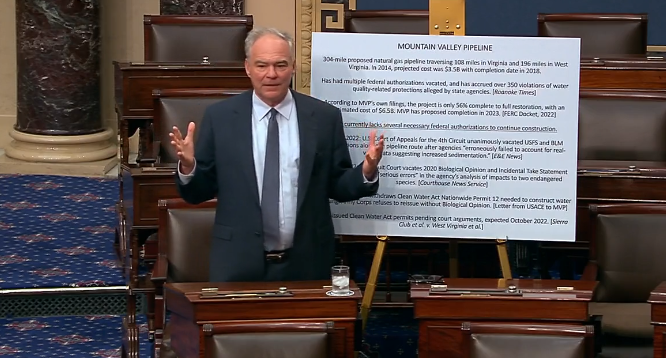
Virginia Sen. Tim Kaine speaks on the U.S. Senate floor about legislation from West Virginia Sen. Joe Manchin that would force completion of the Mountain Valley Pipeline.
Kaine then urged Senate leaders to pass a funding package “free of the unprecedented and dangerous MVP deal.”
Senate Minority Leader Mitch McConnell, a Kentucky Republican, also rejected the permitting reform part of the package, saying from the Senate floor Tuesday afternoon before Schumer removed the bill that it was a “poison pill.”
“What our Democratic colleagues have produced is a phony fig leaf that would actually set back the cause of real permitting reform,” McConnell said.
Meanwhile, Louisiana Attorney General Jeff Landry and 17 other Republican attorneys general including Virginia Attorney General Jason Miyares sent a letter to U.S. Senate leaders Tuesday opposing Manchin’s energy permitting bill on the grounds that it “would effectively create a backdoor Clean Power Plan,” overrule “states’ traditional authority to set their own resource and utility policies, and upset the careful balance of state and federal authority that has been a cornerstone of the Federal Power Act for nearly a century.”
Government funding
The overall spending package, if approved by the U.S. Senate and U.S. House this week, would fund the government through Dec. 16. The measure must become law before Friday at midnight, when current federal spending authority expires, to avoid a funding lapse or a partial government shutdown.
That is a scenario Democratic leaders wanted to avoid, especially with just weeks to go before the November midterm elections.
The spending package, released just before midnight Monday night, would provide billions in funding to ease home heating and cooling costs for low-income households, pay for community block disaster grants, and continue recovery efforts related to the Hermit’s Peak/Calf Canyon Fire that damaged much of New Mexico this spring.
It includes $12 billion in Ukraine aid, the third installment this year, bringing the total U.S. investment in the country’s war effort to about $66 billion.
Congress approved a $13.6 billion relief package in March, just weeks after Russia invaded Ukraine, and another $40 billion package in May with broad bipartisan support.
The Biden administration requested this tranche of Ukraine assistance, funding a total of $11.7 billion.
U.S. lawmakers also opted to include $35 million “to respond to potential nuclear and radiological incidents in Ukraine, assist Ukrainian partners with the security of nuclear and radiological materials, and prevent the illicit smuggling of nuclear and radiological material.”
The package does not include $22.4 billion in COVID-19 funding or $4.5 billion for the monkeypox outbreak, both of which were requested by the White House and broadly rejected by Republicans.
Senate Appropriations Chairman Patrick Leahy, a Vermont Democrat, said Tuesday he believes leaving out that public health funding is “shortsighted.”
Leahy said he would “revisit” the issue in December, when Congress is supposed to agree on a full-year funding package.
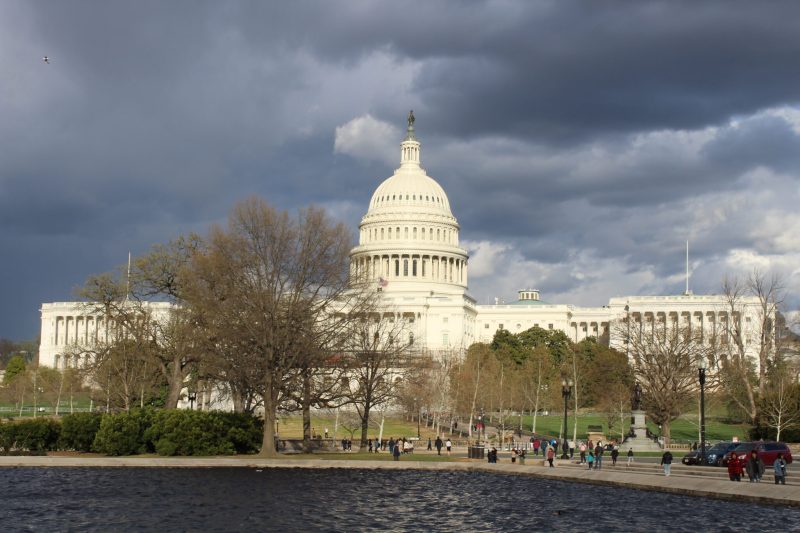
The U.S. Capitol in Washington, D.C., on Saturday, March 26, 2022 (Photo by Marisa Demarco / Source New Mexico)
Avoiding a shutdown
The short-term spending bill, sometimes referred to as a continuing resolution, or CR is needed to prevent a government shutdown when the current spending law expires at the end of the fiscal year on Sept. 30.
The stopgap is intended to give lawmakers and the Biden administration more time to agree on how much the federal government should spend during the fiscal year 2023, which begins on October 1, and where any increases in funding should be directed.
Bipartisan agreement on total discretionary spending levels, $1.512 trillion for the current fiscal year, would allow the 12 panels in charge of an annual government spending bill to begin drafting legislation to fund dozens of departments and agencies.
President Joe Biden’s budget request for the upcoming fiscal year asked Congress to approve $795 billion for defense programs and $915 billion for nondefense programs, which includes spending on the Homeland Security, Justice, and Veterans Affairs departments.
Current law provides for $782 billion for defense spending and $730 billion for nondefense funding.
If Congress and the White House cannot agree on the bills before their new December deadline, they can pass another short-term spending bill extending into 2023.
However, that type of funding strategy poses problems for many federal departments, including the Pentagon. Since the short-term stopgap spending bills continue current spending levels and policies into the new fiscal year, federal departments typically can’t start new programs or boost spending in areas they targeted for additional funding in the budget request.
by Jennifer Shutt, Virginia Mercury
Virginia Mercury is part of States Newsroom, a network of news bureaus supported by grants and a coalition of donors as a 501c(3) public charity. Virginia Mercury maintains editorial independence. Contact Editor Sarah Vogelsong for questions: info@virginiamercury.com. Follow Virginia Mercury on Facebook and Twitter.

Coldest Night of the Year Fundraiser Walk Raises $35,000 By Time of Departure

Blue Ridge Technical Center Students of Criminal Justice Present Their Projects to be Graded by the Sheriff and Her Deputy

South River Leaders to Host Community Forum Focused on District Issues

Delegate Delores Oates Highlights Budget Debate, Tax Policy Dispute, and Upcoming Referendum

Warren Heritage Society Reopens March 4 with Expanded Access and New Ways to Explore Local History

Webb Space Telescope Spots a Supermassive Black Hole on the Run

Do You Suffer From Premenstrual Syndrome?

Nationalism, Patriotism, and the Politics of Identity

VDOT: Warren County Traffic Alert for March 2 – 6, 2026

Virginia State Police Recover Firearms, Seize Over 150 Pounds of Narcotics in Weeklong Operation

Donna B. Reedy (1961 – 2026)

Army Corps Plans to Fast-Track Infrastructure Priorities, Including in Virginia

Downsizing: When to Decide It’s Time to Simplify

Workers, Speaker Scott Criticize Plan to Axe Data Center Tax Exemption as Budgets Advance

If Your Insurer Left the ACA Market, a Special Enrollment Period for New Insurance Ends March 1

David Perry McDaniel (1955 – 2026)

5 Individual Sports Ideas to Explore If Your Child Doesn’t Like Team Sports

Music, Quilts, Birds and Books: A Month of Discovery at the Library

Crowns for a Cause: Fire Department Pageant Funds Lifesaving Truck

Ghosts, Caverns, and Helltown Secrets: Local Author Samantha Warren Brings Haunted History Back to Life

Break Your Phone Addiction and Improve Your Life

A Voter’s Guide to Virginia’s 2026 Redistricting Push

Virginia Democrats Sharpen Focus on ICE Limits After Spanberger’s State of the Union Rebuttal

As Federal Drug Pricing Program Reforms Lag, Virginia Senator’s Bill Seeks State-Level Solutions
