
Local Government
From Fallujah to Front Royal – arguing about curb & gutter waivers
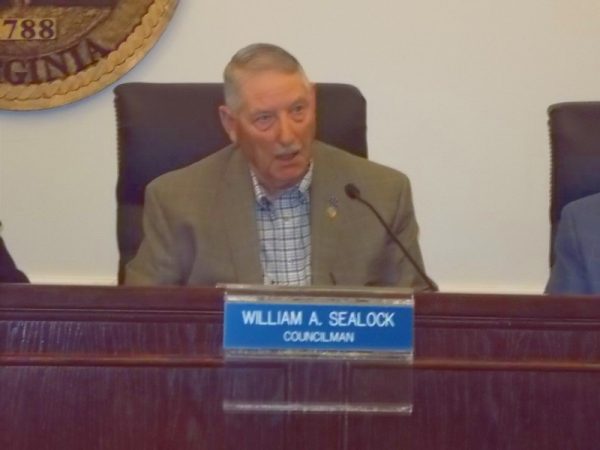
At a Monday evening, January 28 public hearing Front Royal Vice-Mayor William Sealock gave an unexpectedly broad perspective on why a total curb and gutter waiver request from the local Veterans of Foreign Wars (VFW) Post 1860 shouldn’t be granted. Sealock and Councilman Eugene Tewalt were waging a losing battle against the waiver request since recent work session discussion.
After the conditional use permit request to allow the new VFW Post construction passed unanimously, the waiver request on all curb and gutter work at the site was approved by a 4-2 margin, Sealock and Tewalt dissenting. Sealock’s amended motion to waive curb and gutter work around the VFW parking lot, but require it along the main road in front of the headquarters site failed by the same 4-2 margin.
Councilman Jacob Meza has been on the point of the counter-perspective to Sealock and Tewalt’s stance. That perspective is that while the Town can force the VFW to install curb and gutter to minimize potential flooding where it plans to build a replacement headquarters for the one burned in 2015 in a suspected arson by an employee, in this case it should not.
Meza has pointed out that if Samuel R. Millar VFW Post 1860 had rebuilt within a two-year timeframe its previous curb and gutter waivers would have been grandfathered in. So, he and his council allies have argued that the town government would be taking advantage of the VFW’s misfortune of a fire, accidental or intentionally set, if they take a hard line on forcing installation of new curb and gutter by current Town Code.
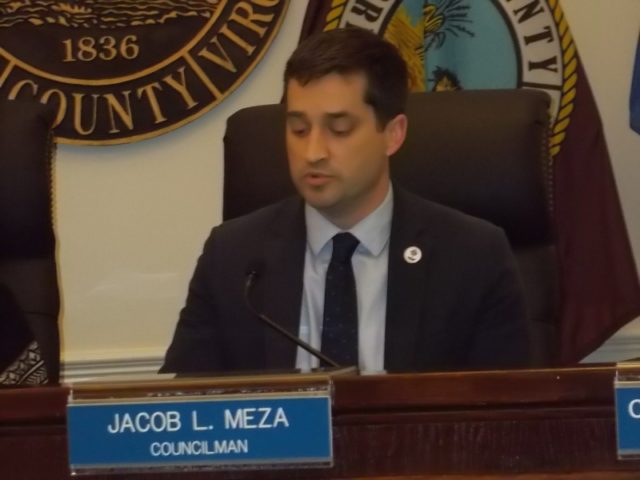
Jacob Meza took the counterpoint to Sealock and Tewalt’s arguments, asserting that while new curb & gutter infrastructure would be beneficial, to require it after an unexpected incident like a fire destroying a code-exempt building would be tantamount to government overreach and taking advantage of unexpected tragedy.
Sealock and Tewalt have countered that they are not trying to take advantage of anyone, but rather are using codes established by a previous council to facilitate long-needed infrastructure improvements in an area the VFW shares with some residential properties; and which Sealock pointed out is an historic U.S. Civil War site tourist attraction area at the river’s edge that now is as likely as not to be washed out when visited.
In prefacing his counterpoint to Meza’s “taking advantage of misfortune” premise, Sealock pointed out that he is a lifetime member of VFW Post 1860 and received supplies from the Post while overseas in an Iraq War zone.
“I was a recipient in Iraq of Post 1860 – they sent to us every month supplies that the Marines needed at Fallujah. I spent my time in Fallujah …and I was very appreciative, especially since I am a life member of Post 1860,” Sealock began in defense of requiring some counter-flooding infrastructure at the site with new construction as Town Codes now require.
Sealock noted he was part of the VFW Post Guiding Committee that surveyed and helped plan the original Post 1860 headquarters building. He traced years of property enhancement that lacked one enhancement – curb and gutter to help minimize floodplain issues at the property which lies downhill from surrounding neighborhoods along North Royal Avenue Extended, past 19th Street to Depot Avenue on the north side of the railroad track overpass.
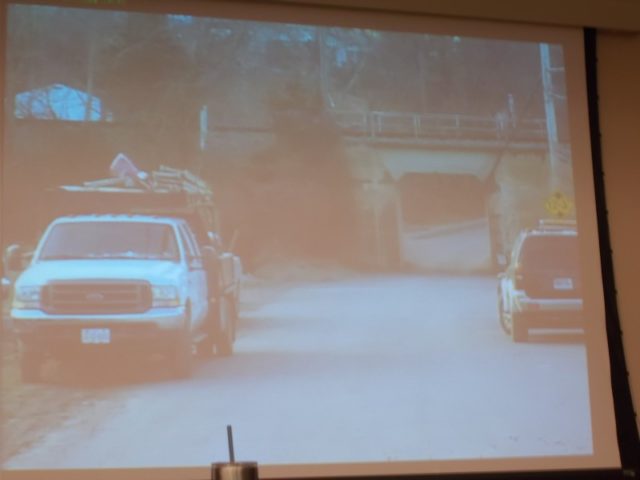
North Royal Avenue Extended as it runs downhill toward the VFW property under the railroad overpass – photo from Sealock power point presentation.
Sealock noted that the Town had incurred the expense of installing curb and gutter along the east side of portions of the area and that imposing existing codes to continue those enhancements would serve the town and its attraction as a tourist destination, as well as the VFW and its neighbors in the long run.
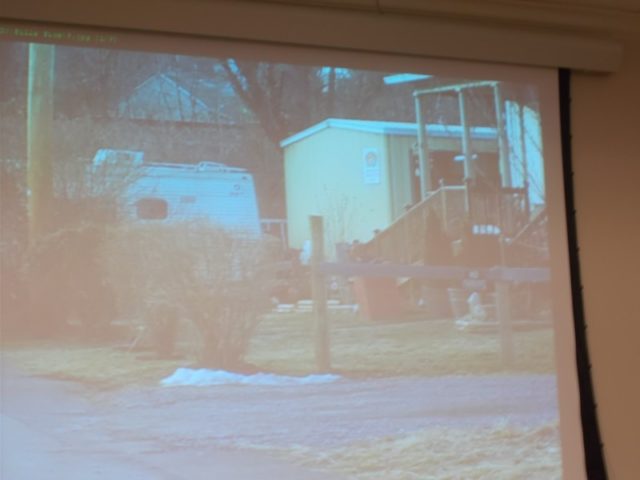
A neighboring residential property yard near the VFW construction site.
Sealock said that other planned enhancements in the VFW plan, including improvements to the existing gravel road and seeding of grassy portions of the property would face repeated threats from washing out from future heavy rains like the region experienced over the past year.
The vice mayor also noted that council had recently rejected a curb and gutter exemption request from a citizen building residentially where water run off and flooding issues, as well as nearby grandfathered exemptions, were involved. Sealock wondered at council’s consistency on enforcement of its codes.
However Sealock and Tewalt’s arguments fell on deaf council ears.
Speaking for the majority Meza replied that while legal by current code and perhaps even desirable for all concerned from an environmental, infrastructure and tourism perspective, enforcement in this case would amount to an example of government overreach. Following Sealock’s power point presentation on the site, Meza reiterated his stance that to force the additional expense on the VFW project would be taking advantage of the misfortune of the fire that destroyed the old building which had a curb and gutter waiver built in due to its construction pre-dating current codes on town curb and gutter infrastructure.
Download agenda here, includes detail drawings and plot.
See the debate and a power point presented by Sealock illustrating the physical issues at the site on this Royal Examiner video:


Cars Changing Lives Plans May 8 Golf Tournament to Support Transportation for Families in Need

William Gladwell Mason “Bill” Wilson (1936 – 2026)

Early Voting Begins Friday for Virginia Redistricting Referendum

Immigration Arrests Spark Bills to Guarantee K-12 Education Rights for All Virginia Students

Last-Minute Tweak to Bill Could Double Virginia’s Medical Malpractice Payment Caps for Plaintiffs

Discover the Power of Protein During National Nutrition Month

Why You Don’t See Your Own Nose

Cross County Emergency Service Funding, Roosters in R-1, and Sheriff’s Office Asset Upgrades Lead Budget Discussion

Freedom 250 Mobile Museum Truck to Visit Middletown During America’s 250th Anniversary Celebrations

Laurel Ridge SBDC Launches Workshop Series to Help Small Businesses Pursue State Contracts

Bedford County Supervisor Files Suit Challenging Reproductive Rights Constitutional Amendment

Bill to Require Factual Teaching About U.S. Capitol Attack Clears Virginia General Assembly

Bills Aimed at Lowering Utility Bills Also Renew Pricey Power Line Burial Program

At Nearly 100, Lillian Sloan Still Shows Up to Serve at Warren Memorial Hospital

Samuels Public Library Adult Programming Events for March

Jeannette Rankin: A Pioneer Who Opened the Doors of Congress to Women

Short-Term Rental, Rezoning, Retaining Wall, ADUs, and Special Events at Town Council Work Session

Celebrate the People Who Keep Your Business Running

Front Royal to Host Tourism Summit April 7

Thomas Ray “Tom” Lomax (1953 – 2026)

Barry Richard Hadley (1959 – 2026)

Public Notice

Rockland Non-Agenarian (90 to 99 years old) Celebrates 94th Birthday with Humane Society Supply Call, Especially for Cats!

Iran War Drives Gas Price Uncertainty Ahead of Busy Summer Season
