
Local News
Green Hill Cemetery retains memories of Stephens City’s past
Before the Civil War, funerals were managed by the deceased’s family. Once a province of the home, relatives cared for the deceased, hosting wakes, and burying loved ones in local church cemeteries or on the family farm. The body was washed and wrapped in shrouds. A local wheelwright supplied an ordinary pine box. Family and friends gathered with the minister and shared the appropriate church services before transporting the coffin to the graveyard.
In the time of the colonial revival, beginning in the 1870s¸ interest in beautifying public and private burial spaces began to emerge. Rural cemeteries became picturesque gathering places for family outings where people were motivated to visit their deceased love ones. A new focus on the natural environment created a popular culture where families were stirred by stately monuments and gardens set inside these cemeteries.
After the Civil War, the citizens of Newtown-Stephensburg (now Stephens City), began petitioning the Town Trustees for a new cemetery somewhere west of the town. The town meeting minutes of March 12, 1874, cite, a special meeting being called in the counting room of Steele and Bro. The Trustees were to consider a petition from the citizens and freeholders [landowners] of the town who are praying the Council would grant three acres of land for the purpose of laying out a cemetery to Green Hill N. T. Stephensburg Cemetery Company. On motion of Trustee John W. Beaty, it was unanimously resolved that this body grant and convey by deed to Green Hill Cemetery Company, three acres of land off the southeast corner of the Town Commons, for the purpose of laying out a cemetery. The Town Trustees present were John W. Beaty, James R. Campbell, M. W. Steele, Dr. Thomas M. Miller (president), and M. H. Albin (secretary).
On motion of James R. Campbell, the Secretary was requested to prepare a deed of conveyance to said Green Hill Cemetery Company for the purpose of laying out and establishing a cemetery thereon.[1]
Green Hill was designed as a private rural park-like setting cemetery with roads and picturesque vistas. Early visions of the cemetery emphasized naturalness of landscape, with man-made adornments such as granite and marble headstones, which would allow for a deceased person’s memory to live on for many more decades. Instead of a simple pine box, the deceased was often buried in an ornate mahogany casket, with silver-plated hardware and a silk-draped interior.
By the 1880s, most Stephens City churches began the process of transitioning their burials to Green Hill Cemetery rather than the church graveyard. In fact, some of the older graves were exhumed and relocated to the new cemetery at Green Hill. Burying families together became popular, family plots were established at Green Hill and family members previously laid to rest in church graveyards were then moved to the new family plot.
From the Stephens City Star, October 1881.
“Mrs. John H. Chrisman has removed the remains of her family from the family burying ground to Green Hill cemetery.”
“We are glad to notice that many workmen are engaged in repairing and beautifying the cemetery. Green Hill will in time be an honor to the instigators.”
“Albin & Brothers from the Winchester Marble Works have placed a few creditable tombstones in the Green Hill cemetery. We learn that they have orders for many more.”
From the Warren Sentinel, Volume 12, Number 37, 17 December 1880.
“M. D. Albin and Bro.’s City Marble Works, Market Street, near the Depot, Winchester Va. Manufacturers of Italian and American Monuments and cost at lowest prices. Designs will be furnished on application. All orders promptly attended to. Satisfaction always guaranteed. Call and examine our stock, the largest and best in the Valley.”
The illustrious families of the late 19th and early 20th century mercantile store and tavern owners, farmers, blacksmiths, wheelwrights, tanneries, saddle and harness makers, silversmiths, timbermen, and machine shops are all buried in Green Hill. These families decided to buy their own plot out of considerations for future generations. The family wanted members to have one convenient location to visit their ancestors. Cemeteries were becoming places for leisure, communing with nature, and creating a version of shared collective memories.
It is important to note that the rural cemeteries were built at a time when there were few public parks. Folks now had a large piece of ground, filled with artistic headstones and beautiful flower gardens. Huge Stephens City crowds began celebrating Decoration Day (flag day), established in 1868 to honor the war dead, by marching down Fairfax Street to the south cemetery entrance to clean and decorate the Green Hill Cemetery. On that day, both families of the living and dead convened and had a memorial service in the cemetery. A picnic-style dinner on the grounds and gospel music followed afterward. Gradually, Decoration Day became a way of establishing spiritual connections between present and earlier generations.

Decoration Day, IOOF Women of the Rebekah parade down Fairfax Street to Green Hill Cemetery, June 10, 1923. Some women are listed as Mrs. Gaither, Mrs. Rust, Caroline Lemley, Bessie Lemley, Dolly Adams, Dolly Yeakle, Chloe Carbaugh, Hazel Grim, Lillian Yeakle, Mrs. Ed Campbell, Browne Sausill, Lorena Steele, and Clementine Lemley. Courtesy Stone House Foundation, Stephens City, VA.
Robert Lee Ridgeway (1864-1946) was a farmer, cemetery caretaker and gravedigger during his life. Originally from Front Royal, VA, he moved to Stephens City and bought a two-room house on Germany Street (now Germain Street). Ridgeway expanded the house to include five rooms and maintained a barn in the backyard off Water Street on the east side of the cemetery where he kept his gravedigging tools.

L to R, Robert Lee Ridgeway, and Leonard J. Vann at Green Hill newly dug cemetery gravesite in the early 1940s. Robert Ridgeway (1864-1946) was a farmer, cemetery caretaker and gravedigger during his life. He maintained a barn behind Water Street on the east side of the cemetery. Contributed by Patty Vann Snyder.
According to Stephens City resident and granddaughter Patty Vann Snyder, Ridgeway lived with his wife, Carrie Baker Ridgeway, his sister, Pearl, and raised four children of their daughter Maggie, who died at the age of 30. “My grandfather owned cattle and the children helped him to move them to pastures that he tended around Stephens City. He kept horses for plowing and raised chickens. He was well liked in the community,” Snyder said. Snyder’s mother, Mildred Vann told her about a Mr. Stover, who owned a funeral home in Strasburg, and would visit and eat lunch with her grandfather after every burial service.

L to R, Mildred Reed Vann (8 years old), and Mable Reed Beaty (twelve years old) picnic at Green Hill Cemetery during the 1920s. Contributed by Patty Vann Snyder.
Joyce Blevins explains why she visits Green Hill several times each week. “I have family buried there. My maternal grandparents, Jesse and Lomie Racey are there as well as my parents, Robert and Hilda Braithwaite, Mom’s brother and my uncle Ralph Racey and his wife Helen. My youngest child, Ronnie Blevins, Jr. is resting there. These family members are all side by side. My mom’s oldest brother, Hugh Racey, his wife Alma, and son Alvin are buried in a Racey plot in a different section. I visit my son Ronnie because it makes me feel better and I make sure his flowers are not disturbed. When he looks down from Heaven, he knows I love and miss him. My daughters, Robin, and Jessica, make sure there are flowers for them, especially holidays and birthdays. I was taught this at a young age and have passed this on to my girls,” Blevins said.
“It is peaceful to walk around and view people’s burial plots and remember mostly good things about them. Growing up in Stephens City, there are a lot of people to remember. For myself and my daughters, the walk makes us feel close to my son and their brother,” Blevins concluded.
Many people left money in their Will to be used to maintain their grave site. Dr. Elmer Milton Steele’s 1939 Will states, “I desire a reasonable amount set aside from my estate for a tombstone for my grave. I bequeath to the Trustees of Green Hill Cemetery of Stephens City, VA fifty dollars, and direct the same be fully invested and the interest to be used for the upkeep and care of my lot in said cemetery.”[2]
In 1965, The Stephens City Cemetery Company, Articles of Incorporation were amended to read as follows:
The name of the corporation is Greenhill Cemetery Inc., and its duration shall be perpetual. It is hereby certified that this corporation is a non-stock, non-member corporation, organized under the provisions of Chapter 2, Title 13.1 of the Code of Virginia, 1950, as amended.
The initial Board of Directors were Robert K. Stickley, James W. Golladay, H. E. Massey, Alfred L. Snapp, G. W. Lemley, Julian Carbaugh, Vernon Ridings, Frank Ewing, and David Petrie.

R. M. Lemley Green Hill Cemetery key, dated 1934. Apparently at this time the gates to the iron fence surrounding the entire cemetery could be locked for the night. Robert M. Lemley lived from 1864 to 1954 and is buried in Green Hill. Courtesy Stone House Foundation, Stephens City, VA.
Such trustees and their successors shall have power to make such rules and regulations for the burial of the dead, the laying off, assignment and sale of burial lots, and the management, care, preservation, and improvement of the grounds, as they may deem proper. They may take and hold personal property and money for the purposes of the trust, and what is so acquired and all money received from the sale of lots shall be accounted for by them and faithfully applied to such purposes.[3]
John Petrie is the current President of Green Hill Cemetery. Petrie is supported by a secretary, a treasurer and six other trustees. Petrie is a retired United States Post Office rural letter carrier. He became a Green Hill trustee in 1981 and President in 2003. His father David Petrie, served as a trustee for many years until his death in 1978. “I have volunteered for so many years because I enjoy the work. My father and mother were always volunteering, and I just followed their example,” Petrie said.
“We have around eighteen or twenty family members buried here. Both great grandparents, grandparents, parents, aunts, uncles, and cousins; the Bean’s, Wise’s, Ebersole’s, Petrie’s and Carbaugh’s are all buried in Green Hill. My father and I have served because it is very much a family affair.”
Petrie handles many of the administrative tasks at the cemetery. These include meeting with bereaved families to discuss cemetery policy, site locations and cost, and coordinating with gravediggers and monument installers to identify grave sites and review cemetery guidelines and regulations.
The trustees do not have any records regarding the architect who designed Green Hill or the manufacturer of the cast iron fence which surrounds the entire three-acre property. Sandra Bosley, Executive Director of Preservation Historic Winchester, virtually visited the Green Hill fence for some historical investigation. Using a catalog from Stewart Iron Works Company in Covington, Kentucky, Bosley discovered Post 20-A style looked like a good match for Green Hill. Style 20-A is made of heavy cast iron plates and the cast iron corner, end, and gate posts, (used with iron picket fence) are securely bolted together.
This design is more typical stylistically of pre 1900 cemetery fences. “It does not appear like they [Stewart] have any catalogs available online prior to 1900, but this at least confirms they had access to that style of post,” Bosley said. The company was founded in 1862 and incorporated in 1910. At one time, Stewart supplied much of the U.S.’s cemetery fences and gates. The installation of the fence probably took place around 1885-1890.
In 1906, a full lot (10 grave sites) cost $25. Today, a full lot cost $12,000. There are approximately 235 grave sites remaining for purchase. Most of the available sites are located on the western side of the cemetery near Grove Street. The older eastern side (hill section) of the cemetery near Water Street has been basically sold out. Petrie says there are about ten burials per year.
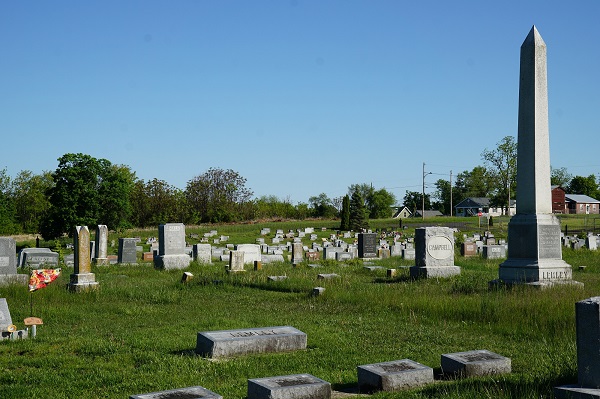
East to west view of the Green Hill Cemetery looking towards Grove Street. Courtesy Marty Barley.
According to Petrie, the east side iron fence was removed due to the unruly vegetation that took over the Water Street hill section of the cemetery. The hill was bulldozed in the 1980s, and the remnants of the old Pittman family potters clay pit and stone staircase leading up the hill were buried under. There are six gates to enter the cemetery, two on Fairfax Steet, one on Grove Street and three on Martin Street. Petrie added the third entrance on Martin to provide gravediggers more access to burial sites. A gate was installed in 2018.
The cemetery is going through some property improvements. Since October 2022, contractors have been working to clear unruly vegetation, downed or dead trees, and provide more frequent grass cuttings to make the cemetery more attractive.
According to Petrie, Decoration Day, once a huge town event, has gradually become a remnant of Stephens City’s past. Where seventy-five people once participated in the 1980s, the crowd was reduced to thirty in the 90s. By the 2000s, less than twelve attended the event and it was finally canceled around 2015.

International Order of Odd Fellows (IOOF), Decoration Day celebration next to the ole hand-operated water pump on June 10, 1923, at Green Hill Cemetery. Decoration Day was an annual observance at many privately owned southern graveyards during which folks gathered to clean up and decorate graves with flowers, reconnect with family, and honor the memories of their ancestors. Courtesy Stone House Foundation, Stephens City, VA.
Green Hill is a privately owned cemetery. The trustees do not receive any funding from the state and all work done by the caretakers is strictly on a volunteer basis. Petrie is eager to reestablish the pioneer and community spirit of the people who live, love, work, and prosper here.
John Petrie acknowledges the many family donors who have assisted in the maintenance and overall preservation of the cemetery. He continually solicits donations from individuals, local businesses, churches, and civic organizations. Donations for Green Hill Cemetery should be sent to PO Box 208, Stephens City, VA 22655.
[1] Frederick County Deed Book 103, page 238, Green Hill Cemetery, April 18 1874.
[2] Document courtesy Stone House Foundation, Stephens City, VA.
[3] Code of Virginia Code – Chapter 3, Cemeteries, Title 57-24. Powers and duties of trustees.

From Newsroom to Classroom—And Grateful for Samuels Library

Library Leaders Share Hope, Challenges at Community Coffee Chat

How Farming Is Changing and Evolving

Robert H. Goddard: The Visionary Who Helped Launch the Space Age

40 Winners Named in Front Royal’s 6th Annual Pot o’ Gold Hunt

French Earl Tolliver, Jr. (1960 – 2026)

5 Tips to Prevent Sports Injuries

Standardbred Owners Ainspan, McDonald Each Score Thoroughbred Wins at Colonial Downs’ Virginia Derby Meet

Most Dangerous Cycling Scenarios Involving Cars

VDOT: Warren County Traffic Alert for March 23 – 27, 2026

Virginia State Police Seize $22.4 Million in Drugs, Recover Firearms in Weeklong Operation

Virginia Home Sales Rise in February as Inventory Grows, Spring Outlook Uncertain

Bing Crosby Stadium Hosts Warren County–Skyline Baseball Battle Tonight

Warren Supervisors Address Audit Contract, Permits, and Property Sale at March 17 Meeting

Here’s How Virginia Lawmakers Suggest the Next State Budget Handle Federal Health Care Funding Fallout

Spring Essentials Checklist: Prepare Your Home for Summer

Virginia Joins National Push for Refunds After US Supreme Court Voids Trump Tariffs

Four Reasons to Consider Hiring a Professional Cleaning Company

Ask the Expert : We Are Applying for a Mortgage Soon. What Kind of Documents Will We Need?

Charles Michael “Rusty” “Chuck” Fischbein (1944 – 2026)

Jerrold E. “Jerry” Groves (1931 – 2026)

Town Planning Commission Moves Forward with Industrial Zoning, Holds Preliminary Discussion of Urban Agriculture

Schools Push for Budget Flexibility, Consistent Funding as Needs Grow

Skyline High Teams, Athletes Successful Seasons and Performances Acknowledged – Oh, and Those Roosters
