
Crime/Court
Judge dismisses Meza appointment/’election’ challenge a second time
On Wednesday morning, September 22, counsels for Plaintiff Paul L. Aldrich and Defendants the Town of Front Royal and recently resigned councilman Jacob L. Meza, revisited oral arguments on the defendants’ Demurrer motion to dismiss the plaintiff case as not having the legal standing to proceed.
And the following afternoon Warren County Circuit Court Judge William W. Sharp issued a written ruling, upholding the defense demurrer motion to dismiss for the second time. That despite an earlier Thursday morning request from plaintiff attorney David Downes for an additional week to file supporting arguments on the aspect of immediate or preliminary injunctions for relief sought by the plaintiff, raised the previous day. Downes explained in his written request that he had not anticipated the issue of immediate relief injunctions remaining part of the arguments Wednesday, due to evolving circumstances – most prominently Meza’s resignation, effective immediately at council’s July 26 meeting – and previous rulings on the issue upholding that portion of the defense demurrer motion.

On Thursday, Sept. 23, the Plaintiff team of Paul Aldrich, right, and his attorney David Downes, pictured here after a May hearing, got a ‘strike 2’ call in the legal challenge of Jacob Meza’s January appointment to town council. But with Meza since resigned will they take another swing? Royal Examiner File Photos by Roger Bianchini
“As I write this, I am aware that Mr. Downes has filed a Motion seeking additional time to brief the de facto officer doctrine, raised by the Court. I see no reason to grant the motion. This appears to be a well-established common law doctrine, and I am confident it applies to this case. Further, the Court had previously raised this doctrine in ruling on the Demurrer to the original Complaint, yet the Plaintiff ignored that part of my opinion in his Amended Complaint,” Judge Sharp noted in denying the plaintiff counsel request for time to submit amended arguments.
Judge Sharpe quoted several past U.S. Supreme Court justices on the advised willingness judges should have to re-examine their own decisions in prefacing his own re-examination of his initial April 7 ruling in favor of the defense demurrer motion to dismiss.
“It is ‘the duty of every judge and every court to examine its own decisions … without fear, and to revise them without reluctance’,” Justice William O. Douglas quoting a judge of the New York Court of Appeals.
“Wisdom too often never comes, and so one ought not to reject it merely because it comes late,” Justice Felix Frankfurter.
“I see no reason why I should be consciously wrong today because I was unconsciously wrong yesterday,” Justice Robert H. Jackson.
Of his decision to allow an amended plaintiff complaint to be filed and revisit his original ruling for the defense, Sharp wrote in late April, “Not a small part of my decision to enter the stay order, and give one last chance for oral argument, is my realization that I gave a very poor articulation of my reasons for my original decision, and I do not want to make that mistake again. It is therefore my intention to give a written explanation of my decision, whichever way it goes, in which my words are more carefully expressed.”
But in his continued analysis of arguments on the standing and substance of Plaintiff Aldrich’s filing, made as a town taxpaying citizen potentially impacted financially and otherwise by votes of an illegally appointed council member, Judge Sharp upheld his initial ruling in favor of the defense motion to dismiss. The judge addressed the changed circumstance of Meza’s resignation removing major points of relief sought by the plaintiff. “Gone is any issue of removing an ‘illegally’ installed councilman,” Sharp observed.
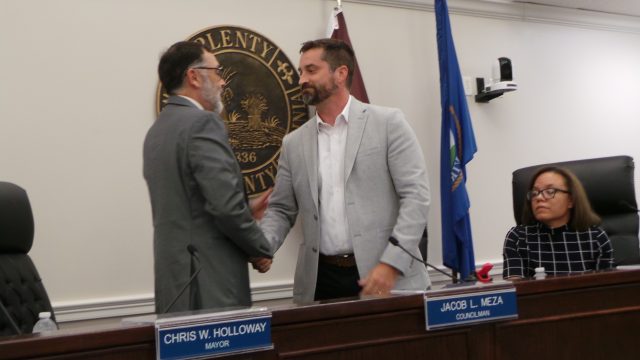
After reading a prepared statement into the record at the outset of the July 26 Town Council meeting announcing his immediate resignation, Jacob Meza, right, shakes hands with Mayor Holloway, whose council seat he was appointed to fill on Jan. 4, as he exits ‘stage right’.
Of the plaintiff claim of potential damage from Meza’s appointment, Sharp wrote: “Mr. Aldrich’s second amended complaint establishes that he is a citizen and taxpayer of the Town of Front Royal. The complaint alleges several decisions of the town council in which Mr. Meza participated, resulting in expenditures. However, the complaint does not allege that any of these decisions impacted any of Mr. Aldrich’s rights. Furthermore, the complaint does not allege that Mr. Meza’ s presence on the council had a causal relationship to any of these expenditures. While he participated in the votes, including moving or seconding motions, there is no claim that the actions would not have passed but for Meza’s participation.”
Noting his previous ruling that council actions could not be voided due to Meza’s participation in votes prior to a ruling on the legality of his seating, Judge Sharp made it fairly clear a second request for an amended complaint might be a futile gesture. “As Meza is no longer subject to removal from office and his prior actions are not voidable, I do not see any potential ongoing justiciable controversy, much less impacted right of the petitioner, that would warrant permitting another Amended Complaint,” Sharp concluded.
But has the question of whether the wording of the Town Charter dating to 1937, supports the reappointment by “election” of council members within a year of their leaving office been resolved? The judge dealt with his interpretation of that core question in his written decision:
“While Mr. Aldrich’s lack of standing disposes of the case, even if he had proper standing to challenge the appointment of Mr. Meza to the council, this claim would also fail under the law. The chief phrase of the Town Charter in dispute concerns whether membership on the town council is an ‘office under the jurisdiction of the council.’ There can be no dispute that the members of the council are officers of the town, as provided under §4 of the Charter. The question, rather, is whether such officers are considered to be under the jurisdiction of the council in the context of §47.
Chapter 47 of the Town Charter was the basis of the plaintiff’s challenge of the Meza appointment. It states: “No member of the council of the Town of Front Royal shall be appointed or elected to any office under the jurisdiction of the council while he is a member of the council, or for one year thereafter,” the relevant Section 47 passage reads. However, the court continued to side with defense counsel arguments that other Chapters of the Town Charter applied to council appointments to fill vacancies, specifically 6D and 9.
In her Demurrer filing for dismissal, defense counsel Heather Bardot pointed to Section 6D and related wording on filling council vacancies, such as the one created by Councilman Chris Holloway’s November 2020 election to mayor. “The council may fill any vacancy that occurs within the membership of council for the unexpired term, provided that such vacancy is taken within 45 days of the office becoming vacant,” Section 6D states. No reference to a one-year hiatus per appointments is made here, Bardot noted. Only the court’s authority to make the appointment were council to deadlock and be unable to fill the seat within the prescribed 45 days, is acknowledged.
Meza’s appointment was made January 4, 2021, four days after Holloway relinquished his council seat to become mayor and four days after Meza, who did not run for reelection after a controversial final year in office, vacated his seat. In 2020 Meza appeared to have alienated a portion of his base related to his Valley Health employment during the previous year. Meza did not express support for the “Birth Local” movement seeking to have Valley Health include a Maternity Unit in the new Warren Memorial Hospital. And after recusing himself from previous discussion of the new hospital funding due to his employment, the councilman chose to cast a deciding vote authorizing that EDA funding on the Town side.
In oral arguments on the original complaint, plaintiff counsel Downes suggested that Chapter 47 was intended to include council seats in the one-year prohibition, not only because council members are “under the jurisdiction” of their colleagues, but also to avoid the appearance or fact of partisan political cronyism in town politics. With the four member majority that appointed him by a 4-1 vote coming from the county Republican Committee, of which he is also a member, plaintiff counsel suggested one might at least infer the appearance of political cronyism in returning Meza to office so quickly after a voluntary choice to leave that office.
However, the judge continued to side with the defense stance that the Chapter 47 one-year prohibition applied only to appointed Town staff positions.

Town Hall and former Councilman Jacob Meza have prevailed in the second go-round of a legal challenge of Meza’s appointment to fill a council vacancy four days after he voluntarily left council.
“A comparison with the other named offices-especially those clearly under the Council’s jurisdiction-is instructive. The town treasurer, town manager, and town clerk are explicitly appointed by the council as a general rule, rather than as an exception to fill vacancies. The Council is authorized to exercise considerable oversight on them, with the ability to remove them from office and/or reassign their duties to other officers. By contrast, the council may only remove one of its own members in the case of repeated absences and exerts no other comparable oversight on its members. Furthermore, while the Charter provides that only the Council has authority to appoint the treasurer, clerk, and town manager, the Council shares its authority with the Circuit Court to appoint members to the Council when a vacancy arises. The Council can fairly be said to exercise general power over the clerk, treasurer, and town manager, but not over its own membership. Therefore, it would be inappropriate to find that membership in the Council is an office of the sort meant to be governed by §47,” Judge Sharp wrote of his stance on the matter at the heart of the citizen challenge of Meza’s appointment.

3 Ways to Extend the Life of Your Electric Vehicle Battery

Serious Charges Highlight Warren County Grand Jury Indictments

Ducks, Flowers, and Fun: Redbud Festival Returns to Browntown

Potato-Crust Quiche Makes a Lovely Brunch

Faye Barr Vance (1930 – 2026)

James Christopher “Chris” Sain (1948 – 2026)
Alice “Maybelle” Henson (1938 – 2026)

How Sleep and Stress Affect Cancer Risk

Spanberger Signs Sweeping Public Safety and Gun Violence Bills

Horses, Fans Return as Shenandoah Downs Season Begins

Skill Games Halted Again as Spanberger Issues Veto

VDOT: Warren County Traffic Alert for April 13 – 17, 2026

The Cat Who Outlasted Six Prime Ministers

Front Royal, Virginia. Vacation Destination?

Virginia State Police Report Major Drug Seizures in Weekly Crime Suppression Effort

Virginia Secures Birth Control Access as Other Southern States Eye Abortion Pill Manufacturers

SCC Approves Loudoun Transmission Line, Nixes Undergrounding; Final Route to be Determined

Slate of New Virginia Laws Address Health Care and Housing Affordability
James J. Coverston Sr. (1942 – 2026)

Business Growth Series: Your Biggest Problem Isn’t Competition — It’s Being Overlooked

Why Many Experts Say a Concussion Should Be Called a Brain Injury

Missouri Man Arrested in Undercover Operation Targeting Online Crimes Against Children

Trump Tax Plan Credited With Higher Refunds, Lower Taxes

Spanberger Vetoes Fairfax Casino Bill, Citing Local Opposition
